


While people often use the terms interchangeably, jewelry restoration and repair are two distinct approaches to bringing fine pieces back to life. Understanding the difference helps you choose the right path for your cherished items, ensuring they receive the exact level of care required without compromising their history or value.
A functional repair focuses on fixing a direct structural issue so you can safely wear your jewelry again. It addresses isolated points of failure—like fixing a snap on a gold chain or resizing a ring that no longer fits comfortably.
Restoration, on the other hand, is a comprehensive process that looks at the entire piece as a whole. It involves historic conservation, period accuracy, and meticulous structural rebuilding. When restoring an antique or estate piece, a master jeweler studies the era in which it was created (such as Victorian, Edwardian, or Art Deco) to ensure every technique, metal alloy, and replacement component honors the original maker's design intent. For additional context on historical jewelry movements and design details, museum resources such as the Victoria and Albert Museum jewellery collection can be helpful references.
| Feature | Standard Jewelry Repair | Historical Jewelry Restoration |
|---|---|---|
| Primary Goal | Restore functionality and structural integrity | Conserve historical integrity and original aesthetics |
| Scope of Work | Targets isolated damage (e.g., single broken link) | Comprehensive rebuild of worn metal and period details |
| Materials Used | Modern standard industry components | Period-accurate metal alloys and hand-cut gems |
| Techniques | Modern torch or laser welding | Specialized hand-engraving, milgrain, and historical setting |
| Ideal For | Everyday wear items, modern fine jewelry | Family heirlooms, estate pieces, vintage antiques |
When Simple Repair Is Enough
Not every piece of jewelry brought to our goldsmith studio needs a complete overhaul. In many cases, everyday wear and tear creates simple, localized damage that can be quickly fixed with standard repairs.
If your daily gold pendant chain snaps after getting caught on a sweater, a simple chain soldering job is all that is required to make it whole again. Similarly, if your wedding band feels a bit tight after a few years, a quick ring sizing can adjust the band to fit perfectly. Loose stones caused by everyday bumps can often be secured in minutes by carefully tightening the prongs. For straightforward fixes on your daily fine pieces, exploring options for Fine Jewelry Repair Near Me can quickly return your items to active service.
The Art of Comprehensive Jewelry Restoration and Repair for Heirlooms
When an estate piece or family heirloom passes down through generations, years of wear take a cumulative toll. Thinning ring shanks, smoothed-down hand engravings, missing vintage gemstones, and worn milgrain borders cannot be solved with a quick fix.
This is where the true art of Antique Jewellery Repair comes into play. Restoring estate jewelry requires deep knowledge of historical jewelry construction. A master jeweler must carefully build up depleted precious metal using matching gold or platinum alloys, recut depleted prongs to mirror period styles, and ethically source era-appropriate diamonds or gemstones (such as old mine cut or rose cut diamonds) to replace lost originals. The aim is never to make an antique ring look like it was manufactured yesterday, but rather to stabilize its historic beauty so it can safely survive another century of wear.
Common Types of Fine Jewelry Repair and Restoration Work

Over time, everyday life causes metal fatigue and structural wear on fine jewelry. Understanding the common types of repair work available helps you recognize when your favorite pieces need professional attention before a precious gem is lost.
Ring Sizing, Shank Replacement, and Prong Retipping
Rings endure more physical contact than almost any other type of jewelry. Over years of daily wear, the base of the band (the shank) gradually thins out, and the protective prongs holding your diamonds wear down.
- Prong Retipping and Tightening: Prongs are the small metal claws that grasp your gemstone. As they rub against clothing and surfaces, they become thin or flat. During retipping, a goldsmith carefully adds new precious metal to the top of the worn prong, building it back up into a secure dome over the gemstone.
- Shank Replacement: If the bottom of a ring band becomes paper-thin or cracked due to metal fatigue, a jeweler will perform a partial or full shank replacement. The worn portion is removed, and a new, solid band of matching metal is welded in place.
- Rhodium Plating: White gold jewelry is naturally alloyed with white metals and finished with a bright layer of rhodium coating. Over time, this plating wears off, revealing the warm yellow undertones beneath. Re-plating brings back that brilliant, crisp mirror finish.
Chain Soldering, Clasp Sourcing, and Stone Tightening
Necklaces and bracelets rely on small, moving mechanical parts and delicate metal links that bear constant friction.
- Chain Repair and Soldering: When a link snaps, micro-soldering or laser precision welding joins the broken ends back together seamlessly without sacrificing flexibility.
- Clasp Sourcing: Spring rings and lobster clasps contain tiny steel internal springs that degrade over time. While standard replacement clasps are easily installed, heirloom pieces often feature non-standard custom clasps. Sourcing or rebuilding an exact matching historical clasp can take specialized sourcing, but it preserves the visual balance of the original design.
- Specialized Repair Services: Whether dealing with delicate beaded necklaces requiring restringing or costume pieces needing careful handling, specialized care guarantees lasting durability. Explore our guides on Bead Jewelry Repair and Costume Jewelry Restoration to see how various material types are safely maintained.
Specialized Watch Restoration and Refurbishing
Fine timepieces are precision mechanical instruments that require equal parts micro-engineering and artistic craftsmanship to keep time reliably.
Whether servicing daily quartz mechanisms or intricately restoring vintage mechanical movements, professional watch servicing addresses internal gears, mainsprings, water-resistant gaskets, and exterior casing refinishing. Timepiece restoration goes beyond swapping a battery; it cleans out dried lubricants, replaces worn balance wheels, and polishes scratched crystals. To dive deeper into bringing vintage wristwatches back to life, check out our insights on Old Watch Restoration and overall Fine Watch Repair.
Master Techniques Used in Modern Goldsmithing

The world of goldsmithing bridges centuries-old artistic techniques with modern technological advances. Today's master jewelers combine hand-held tools with advanced equipment to perform delicate tasks that were nearly impossible a few decades ago.
Modern Technology vs. Traditional Goldsmithing
Traditionally, jewelers relied exclusively on torch soldering. While effective, the open flame generates high heat across the entire piece of jewelry. This meant delicate heat-sensitive gemstones—like emeralds, opals, or pearls—had to be tedious hand-unmounted before any structural repairs could be performed nearby.
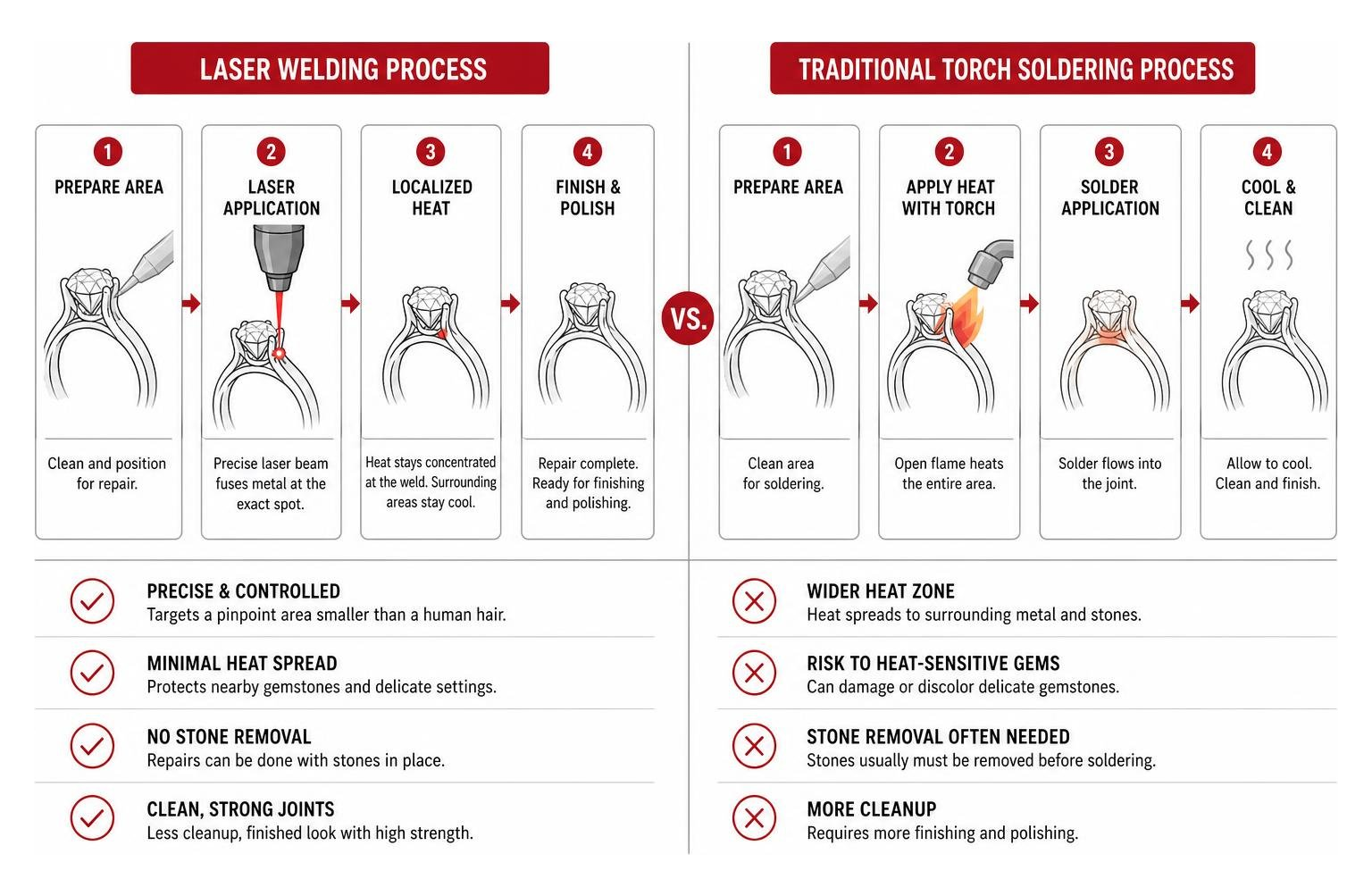
Enter the modern precision laser welder. Laser welding directs a concentrated beam of light energy onto a pinpoint spot smaller than a human hair. Because the heat remains completely localized, jewelers can perform structural prong retipping or shank rebuilds directly adjacent to fragile gemstones without removing them or risking heat damage.
At the same to time, traditional techniques remain crucial:
- Gem Recutting: Chipped or dull vintage gems are sent to lapidary specialists who re-facet the stone, restoring its original brilliance and symmetry.
- Hand Engraving & Milgrain: Restoring intricate vintage borders and historic patterns requires steady hands using traditional steel gravers.
- Glass and Enamel Repair: True vitreous enamel demands careful heat control to fill in cracks without damaging surrounding metals. Discover the intricacies of this specialized craft in our Enamel Jewelry Restoration Guide 2026, and learn more about our on-site capabilities at our Goldsmith Studio and Our Goldsmith Gallery Craftsmanship Custom and Care.
Redesigning and Resetting Forgotten Heirlooms
Sometimes, an inherited piece of fine jewelry sits in a drawer for decades simply because the style feels outdated or doesn't suit your personal taste. Jewelry restoration and repair does not always mean putting a piece back together exactly as it was created in 1920—it can also mean honoring the sentiment while transforming the materials into something modern and wearable.
Through diamond resetting and custom redesign, the center stones and precious metals from old family jewelry can be reclaimed to build an entirely new custom piece.
- Bespoke Redesign: Extract original heirloom diamonds or colored gems and reset them into a contemporary ring mounting or minimalist pendant.
- Precious Metal Trade-In: Unusable gold settings or broken chains can be melted down or traded in toward the creation of a fresh custom design. With gold prices remaining elevated, trading in unused scrap gold provides incredible purchasing power toward a bespoke project.
- Custom Jewelry Journey: Designing a piece from scratch lets you carry family history forward in a form you'll love wearing every day. Learn how to transform your unused treasures with our guide on What To Do With Jewelry Sitting In Your Drawer Turn Forgotten Pieces Into Something Meaningful, navigate your choices using our Custom Jewellery Guide 2026, or find local custom design services via Custom Design Jewelry Near Me.
What to Expect: Estimates, Pricing, and Choosing a Master Jeweler
Taking an irreplaceable family piece to a jeweler requires a high level of trust. Understanding how evaluations, estimates, and repair costs work will help you feel completely confident throughout the repair process.
How Much Does Jewelry Restoration and Repair Cost?
Because every piece of jewelry experiences different wear and tear, repair costs vary based on metal weight, design complexity, gem types, and underlying damage.
A simple chain solder or basic ring size down might cost a modest sum, whereas complete heirloom restoration involving hand engraving, custom component sourcing, and structural prong rebuilds requires significantly more bench time and material.
To guarantee transparent pricing, clear upfront quotes are provided before any work begins, eliminating unexpected fees.
- Evaluation Lead Time: While simple jobs can be quoted immediately, complex vintage restorations may need to be kept for up to 1 week for a thorough technical evaluation by our jewelers. This allows us to inspect stone stability, check alloy purity, and ensure structural metal soundness.
- Component Sourcing: Replacing unique or historical components (such as non-standard vintage clasps) can cost up to three times more than standard industry replacements because they often require custom fabrication or specialized antique sourcing.
- Appraisals: If you are restoring a high-value piece for insurance purposes, review our Jewellery Appraisals Guide 2026 and find dedicated professionals at Jewelry Appraisal Stores.
Selecting a Qualified Goldsmith and Aftercare
When choosing who will handle your jewelry, look for an established business with a proven track record, dedicated on-site workshop capabilities, and clear customer guarantees. Bringing fine jewelry into a showroom with decades of family history in goldsmithing ensures your pieces are handled with deep artistic respect.
Always ask if the shop offers a workmanship guarantee to back up structural repairs. For example, engagement ring customers at Inglis Jewellers receive comprehensive coverage for a full year to guarantee total peace of mind. Check our Our Warranty page to understand how we stand behind our bench craft.
Frequently Asked Questions About Heirloom Care
How long does a typical repair or restoration take?
Turnaround times depend directly on job complexity:
- Standard Repairs: Basic tasks like ring sizing, stone tightening, chain soldering, or rhodium plating generally take a few business days to a week.
- Detailed Evaluations: Complex vintage items may spend up to 1 week in evaluation just to receive a thorough estimate.
- Extensive Restoration & Custom Redesign: Complete historic restorations or custom reset projects requiring specialized stone sourcing, hand engraving, or lapidary work typically take between 2 to 4 weeks.
Can antique jewelry be restored without losing its original character?
Yes! Preserving historical integrity is the primary objective of true antique restoration. Experienced jewelers use period-appropriate tools, matching metal alloys, and sensitive hand techniques to maintain original design features and historic patina. Always inform your jeweler if you prefer to retain warm age-related patina on sterling silver or gold rather than having the piece machine-polished back to a high-gloss finish.
How should I care for my restored jewelry at home?
Once your restored jewelry returns home, simple care habits keep it looking brilliant:
- Gentle Cleaning: Clean pieces gently using mild soap, warm water, and a soft-bristled toothbrush. Avoid harsh chemicals, ultrasonic cleaners, or chlorine, which can weaken gold solder joints or harm porous gemstones like pearls, opals, and emeralds.
- Routine Checkups: Schedule a professional inspection every 6 to 12 months. Having a jeweler check stone stability under magnification prevents small issues from turning into lost gems.
- Proper Storage: Store fine pieces separately in soft cloth pouches or lined jewelry boxes so metal bands and diamond facets don't scratch soft stones or delicate metalwork.
Conclusion
Your fine jewelry holds far more than monetary value—it captures precious life milestones, family legacies, and irreplaceable personal memories. Whether fixing a simple broken clasp on a daily pendant or meticulously bringing an estate ring back to life, professional jewelry restoration and repair ensures your treasures remain safe, beautiful, and ready to wear for generations to come.
With over 30 years of family experience in repair and watch servicing, alongside 40 years of expertise in custom redesign and diamond resetting, our team at Inglis Jewellers takes pride in offering trusted bench craftsmanship across Atlantic Canada. Visit our store locations in Truro NS, New Glasgow NS, Riverview NB, and Sydney NS to consult directly with our goldsmiths.
Ready to give your broken heirlooms the expert care they deserve? Explore our Jewellery Repairs Complete Guide to learn more about professional repair techniques, or pop into your nearest Inglis Jewellers showroom today for a personalized evaluation!