


Why Fine Watch Repair Is Worth Taking Seriously
Fine watch repair is the specialized process of servicing, restoring, and maintaining luxury and mechanical timepieces — and doing it right requires far more than a simple battery swap.
Here's a quick overview of what fine watch repair typically involves:
| Service Type | What It Includes | Typical Timeframe |
|---|---|---|
| Battery replacement | Battery swap, basic inspection | Under 10 minutes |
| Partial service | Cleaning, water resistance check, battery/movement calibration | 1-3 weeks |
| Complete overhaul | Full disassembly, ultrasonic cleaning, lubrication, pressure testing | 3-8 weeks |
| Vintage restoration | Parts sourcing or fabrication, movement rebuild, case refinishing | Varies |
| Specialized services | Crystal replacement, pressure/water resistance testing, engraving | Varies |
Most manufacturers recommend servicing a luxury or mechanical watch every 3 to 5 years. The lubricants inside a movement dry out over time, causing increased wear and loss of accuracy. Skipping service doesn't just affect performance — it can turn a minor fix into a costly repair.
A fine watch is often more than an accessory. It may be an heirloom, an investment, or a daily companion worn for decades. That's exactly why finding a watchmaker you can trust matters so much.
The sections below walk you through everything: what services are available, how overhauls differ from basic maintenance, what to expect in terms of cost and turnaround, and how to choose the right professional for the job.
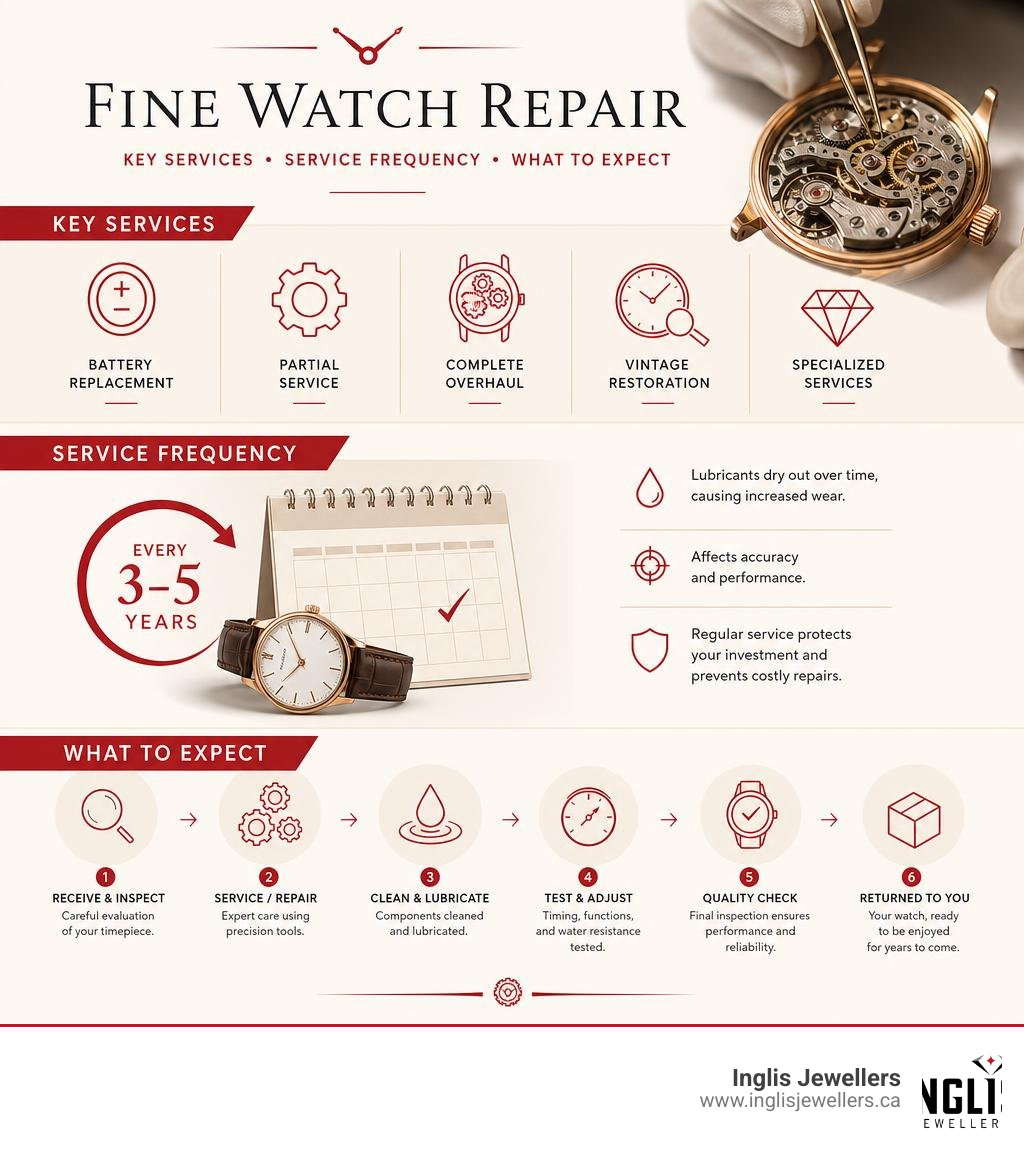
Understanding Fine Watch Repair: Services and Common Solutions
When you own a luxury timepiece, you are not just wearing a tool that tells time; you are wearing a micro-mechanical marvel. Inside that elegant metal case, hundreds of tiny gears, springs, and jewels work in perfect harmony. However, even the most robust mechanical movements are subject to friction, dust, and moisture. Neglecting your watch's maintenance needs can lead to irreversible damage. As the saying goes in our workshops, neglecting your watch is easily worse than wearing wet socks!

A professional fine watch repair center offers a comprehensive suite of solutions to keep your timepiece ticking flawlessly. These services range from minor external adjustments to highly complex internal reconstructions. Whether your watch has suffered a hard impact, been exposed to water, or simply stopped running, expert watchmakers can diagnose and resolve the issue.
If you are dealing with an older family heirloom that has seen better days, you can learn more about restoring its original beauty and function in our guide on More info on restoring vintage timepieces.
Essential Maintenance and Fine Watch Repair Services
Everyday wear and tear can take a toll on the external and internal components of your watch. Here are some of the most common essential repairs that high-end timepieces require:
- Stem and Crown Repair: The crown is the small knob on the side of the watch used to set the time or wind the movement. Because it is used frequently and protrudes from the case, it is highly susceptible to snapping, bending, or losing its internal gaskets. Replacing a broken stem or crown is vital to prevent moisture from entering the watch.
- Crystal Replacement: The crystal (the glass protecting the dial) can become scratched, chipped, or completely shattered. While minor scratches on acrylic crystals can sometimes be polished out, cracked sapphire or mineral crystals must be replaced immediately to prevent microscopic glass shards from entering the movement.
- Bracelet Sizing and Repair: A watch is only as secure as its band. Over time, metal bracelet pins wear down, leather straps fray, and clasps lose their tension. Sizing a bracelet to fit your wrist perfectly not only improves comfort but also prevents the watch from slipping off and dropping onto a hard surface.
- Battery Replacement: For quartz watches, a fresh battery is required every 1 to 3 years. High-end quartz timepieces need to be opened carefully to avoid damaging the delicate electronic circuit, and their water-resistant seals must be checked during the process.
For those residing in Atlantic Canada looking to address these common issues, finding a trusted local partner is key. You can explore our Expert watch repair services to get your timepiece back in pristine condition.
Specialized Interventions in Fine Watch Repair
Beyond the basics, luxury watches often require highly specialized interventions to preserve their structural integrity and unique features.
One of the most critical specialized services is water resistance testing. When a watch is opened for any reason, or as it ages, the rubber gaskets that seal the case back, crystal, and crown begin to degrade. To ensure your watch remains sealed against moisture, dust, and humidity, watchmakers perform advanced pressure testing. Some specialized workshops utilize high-tech equipment capable of pressure testing watches to incredible depths of up to 3,600 feet (1,200 meters) for extreme dive models.
Additionally, many watch owners like to personalize their timepieces or jewelry. Specialized engraving services, such as inside-the-ring engraving or case-back engraving, allow you to commemorate special dates, milestones, or family initials. If you want to understand how these delicate services fit into broader care routines, don't miss our comprehensive Guide to jewelry maintenance.
Complete Overhaul vs. Partial Watch Servicing
When bringing your watch to a service center, you will typically be presented with two main options: a partial service or a complete overhaul. Understanding the difference between these two procedures is essential for making the right decision for your budget and your watch's health.
To make it simple, think of a partial service as a quick tune-up and oil change for your car, while a complete overhaul is equivalent to taking the engine entirely apart, cleaning every single bolt, replacing worn parts, and putting it back together in factory-new condition.
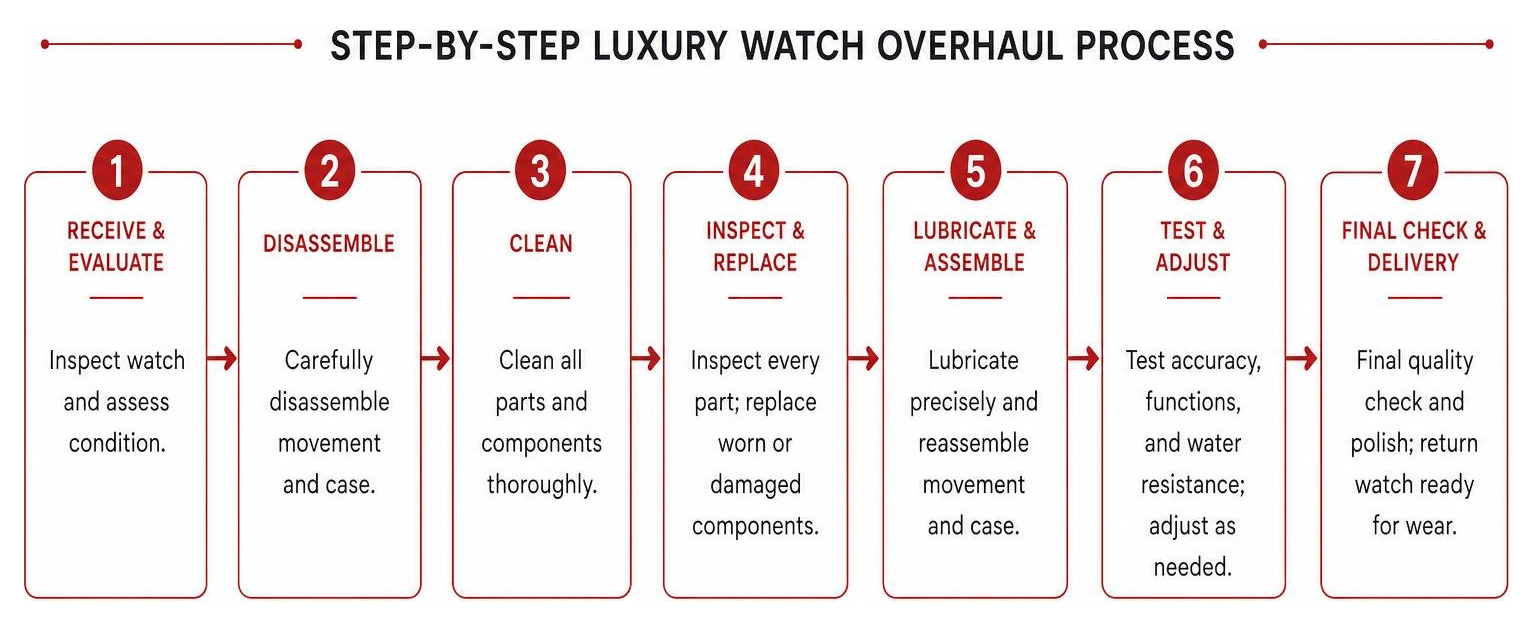
Here is a side-by-side comparison of what these two service tiers actually entail:
| Service Stage | Partial Service | Complete Overhaul |
|---|---|---|
| Diagnostics | Basic function check and timekeeping analysis. | Deep diagnostic testing of power reserve, amplitude, and beat error. |
| Movement Handling | Movement remains encased (unless replacing a quartz battery/circuit). | Movement is completely extracted and fully disassembled into individual gears. |
| Cleaning | External ultrasonic cleaning of the metal bracelet and case. | Ultrasonic cleaning of the case, bracelet, and all individual movement parts. |
| Lubrication | None (or very basic external pivot oiling if applicable). | Meticulous application of multiple specialized synthetic oils to exact friction points. |
| Part Replacement | Replacement of basic seals, spring bars, or battery. | Replacement of worn gears, mainspring, gaskets, and damaged components. |
| Calibration & QC | Basic regulation of timekeeping accuracy. | Multi-position calibration, 48-to-72-hour power reserve testing, and rigorous QC. |
A complete overhaul is a highly skilled, time-consuming process. A master watchmaker must carefully handle microscopic components, using specialized tweezers and loupes. Each movement requires specific synthetic lubricants; using the wrong oil can cause the delicate mechanisms to gum up and stop working within months.
The Lifespan of a Luxury Timepiece: When to Service Your Watch
A common question among watch collectors is: "If my watch is running fine, do I really need to service it?"
While it is true that some high-grade mechanical watches can run for decades without stopping, doing so is highly risky. Inside a mechanical watch, metal pivots rotate inside synthetic sapphire jewels thousands of times an hour. To prevent friction, these contact points are lubricated with micro-drops of specialized oil.
Over a span of 3 to 5 years, these lubricants naturally dry out, turn sticky, or attract microscopic dust particles. When this happens, the oil acts like liquid sandpaper, grinding down the delicate steel pivots and brass gears.
By the time your watch actually starts losing noticeable time or stopping altogether, severe mechanical wear has likely occurred, turning a routine preventative service into a much more expensive repair involving the replacement of multiple costly parts.
To keep your investment safe, look out for these warning signs that your watch needs immediate professional attention:
- The watch is losing or gaining significant time (more than 15-20 seconds per day for standard mechanical watches).
- The crown feels stiff, gritty, or loose when winding or setting the time.
- Moisture or condensation is visible under the crystal (even a tiny fog patch can rust a movement within days).
- You hear unusual rattling or clicking sounds when moving your wrist.
Taking care of your watch's mechanical heart is just as important as maintaining your fine jewelry. To learn more about preserving other precious items in your collection, you can Learn about antique jewelry care.
Sourcing Parts and Handling Vintage vs. Modern Watches
There is a vast difference between servicing a modern luxury watch and restoring a vintage or antique timepiece.
For modern watches, professional repair centers rely heavily on sourcing genuine OEM (Original Equipment Manufacturer) parts. Using original factory components ensures that the watch maintains its factory specifications, water resistance, and long-term resale value. High-end brands restrict the distribution of their spare parts, meaning only highly qualified, independent watchmakers with verified credentials can secure access to genuine components.
When it comes to vintage or antique watches, the repair process becomes a blend of technical mastery and historical preservation. Many parts for watches made 50, 80, or 100 years ago are completely obsolete. In these cases, a master watchmaker cannot simply order a replacement part from a catalog. Instead, they must use traditional watchmaking lathes and hand tools to hand-fabricate custom components from raw steel or brass.
Furthermore, vintage restoration requires a delicate touch. While a modern watch overhaul often includes polishing the case to a mirror-like, factory-fresh finish, doing the same to a rare vintage watch can ruin its historical value. Collectors highly prize the original lines, sharp edges, and natural patina of an untouched vintage case. A skilled watchmaker knows how to clean and stabilize a vintage timepiece without stripping away its unique character.
Whether you are looking to repair a modern daily wearer or breathe new life into a decades-old custom family heirloom, our team is dedicated to preserving your jewelry's story. You can Discover our custom craftsmanship to see how we treat every piece with the utmost respect and precision.
What to Expect: Turnaround Times, Costs, and Warranties
Leaving your prized timepiece at a repair shop can feel a bit like sending a child off to summer camp — you want to know exactly where they are going, what they are doing, and when they will be back! Understanding what to expect during the repair process can give you complete peace of mind.

- Turnaround Times: Standard watch repairs, such as battery replacements or bracelet adjustments, can often be completed in under 10 to 15 minutes while you wait. However, a complete mechanical overhaul typically takes anywhere from 3 to 8 weeks. This timeline is necessary because watchmakers must thoroughly test the watch in multiple physical positions over several days to ensure its accuracy and power reserve meet strict standards before returning it to you.
- Repair Costs: The cost of fine watch repair varies widely depending on the brand, movement complexity (e.g., a simple three-hand watch versus a complex chronograph), and the availability of parts. While a basic battery change might cost $10 to $20, a complete overhaul on a high-end Swiss mechanical watch can range from a few hundred dollars to over a thousand.
- Warranties: Reputable watch repair centers back up their craftsmanship with a formal service warranty. A quality overhaul typically comes with a 1-year to 2-year warranty covering the timekeeping functionality of the movement, giving you confidence that the work was done to the highest standard.
- Insured Shipping: If you live far from a specialized repair center, shipping your watch is a safe and common practice. Professional centers handle highly valuable timepieces daily and often provide fully insured shipping labels. High-end specialized shipping services offer insured shipping labels covering up to $100,000 USD, ensuring that even the rarest luxury watches are fully protected while in transit.
Frequently Asked Questions About Watch Maintenance
To help you better navigate horology, we have compiled answers to some of the most common questions watch owners ask.
What certifications should a professional watchmaker hold?
Watchmaking is an incredibly precise trade, and certifications serve as proof of a watchmaker's technical skills. When looking for a professional to handle your luxury timepiece, look for credentials such as:
- CW21 (Certified 21st Century Watchmaker): Administered by the American Watchmakers-Clockmakers Institute (AWCI), this rigorous certification ensures the watchmaker has proven their ability to service modern mechanical and quartz movements to Swiss standards.
- WOSTEP (Watchmakers of Switzerland Training and Educational Program): An internationally recognized credential that is widely considered the gold standard for Swiss watchmaking education.
- Factory Training: Direct certifications from luxury brands (such as Rolex, Omega, or Breitling) indicating the watchmaker is authorized and trained to work on their specific proprietary movements.
Is it better to use an independent repair shop or an authorized service center?
Both options have distinct advantages, and the right choice depends on your specific needs:
- Authorized Service Centers: Sending your watch directly to the manufacturer guarantees the use of brand-certified technicians and genuine parts. However, manufacturers often have very long turnaround times (sometimes 6 months or more) and rigid pricing structures.
- Independent Watchmakers: Highly qualified independent shops offer greater pricing flexibility, personalized customer service, and faster turnaround times. Many top-tier independent watchmakers hold the exact same certifications as factory technicians and maintain official parts accounts with major Swiss brands.
If you are looking for trusted watch repair services in Atlantic Canada, choosing a local, established jeweler with certified watchmakers on hand ensures your timepiece receives the highest level of care without the hassle of long-distance shipping.
How do I get a free estimate and safely ship my watch for repair?
Most professional watch repair centers make the estimation process straightforward and secure:
- Request a Quote: Contact the service center online or by phone to describe the issues your watch is experiencing.
- Receive Shipping Instructions: The repair center will provide guidelines on how to securely package your watch (always use a sturdy box, never a soft envelope, and do not ship the watch in its original luxury display box as it adds unnecessary weight and bulk).
- Diagnostic Report: Once the watchmaker receives and inspects your timepiece, they will provide a detailed, written diagnostic report and cost estimate.
- Approval: No work begins until you officially approve the proposed estimate. If you choose not to proceed, the watch is safely packaged and shipped back to you.
Conclusion
A fine watch is a beautiful marriage of art, history, and engineering. Whether it is a modern luxury piece that accompanies you to the office every day or a vintage family heirloom that holds decades of memories, regular maintenance is the key to ensuring it continues to run beautifully for generations to come.
At Inglis Jewellers, we are proud to serve communities across Atlantic Canada with locations in Truro NS, New Glasgow NS, Riverview NB, and Sydney NS. Our commitment to trusted craftsmanship, personalized service, and full-service support ensures that your jewelry and timepieces are always in the safest hands.
If you have a watch that is losing time, in need of a fresh battery, or ready for a complete mechanical overhaul, we are here to help. Restore your heirloom timepiece today or visit us in-store to Find a fine jewelry repair specialist near you. Let's keep your favorite stories ticking!