


Why Old Watch Restoration Is Worth Every Penny
Old watch restoration is the process of returning a vintage timepiece to full mechanical function — while protecting its original character and historical value.
If you want a quick answer, here's what restoration typically involves:
- Initial assessment — inspecting the movement, case, dial, and hands
- Full disassembly — stripping the movement down to its smallest components
- Ultrasonic cleaning — removing decades of dried oils and debris
- Parts replacement — sourcing period-correct components where needed
- Lubrication and reassembly — applying precision lubricants at specific points
- Timing calibration — testing accuracy across multiple positions
- Cosmetic decisions — deciding what to preserve versus refinish
Think about a watch that has sat in a drawer for twenty years. The glass is scratched. The movement is silent. But it belonged to someone you loved.
That's the story behind most old watches that come in for restoration. They aren't just mechanisms — they're objects with memory.
Vintage mechanical watches are, at the same time, precision instruments and works of personal history. Unlike a modern quartz watch, a mechanical movement from the 1960s or 1970s contains dozens of hand-fitted parts that were built to last — if they're cared for properly.
The challenge is that most people don't know where to start. What's the difference between a basic service and a full restoration? Will cleaning the case destroy its value? Can a watchmaker even find parts for a 50-year-old movement?
This guide answers all of that in plain language.
What is Old Watch Restoration vs. Standard Servicing?
To understand how to care for an heirloom timepiece, we first need to draw a clear line between standard maintenance and a complete restorative overhaul. Many watch owners use these terms interchangeably, but in the horological world, they represent two very different levels of care.
A standard service is like taking your car in for an oil change, brake check, and tire rotation. A full restoration, on the other hand, is like finding a dusty classic car in a barn, pulling out the engine, rebuilding the transmission, sourcing period-correct body panels, and making it road-worthy again without erasing its history.
The table below breaks down these differences:
| Feature | Standard Servicing | Full Old Watch Restoration |
|---|---|---|
| Primary Goal | Preventative maintenance and minor adjustments | Reviving a non-functional or severely degraded timepiece |
| Mechanical Focus | Cleaning, lubricating, and regulating a running movement | Total movement teardown, repairing rust, and replacing worn train wheels |
| Aesthetic Work | Light cleaning of the case; replacing basic gaskets | Stabilizing flaking dials, preserving or matching patina, crystal replacement |
| Parts Sourcing | Standard modern manufacturer parts | Sourcing rare, obsolete, or custom-fabricated period-correct parts |
| Typical Timeframe | 1 to 2 weeks | 4 to 8 weeks (or longer depending on part availability) |
| Value Impact | Maintains stable market value and running reliability | Can increase a non-functional watch's value by 50% or more |
Mechanical Integrity vs. Aesthetic Condition
When we look at standard servicing, our main objective is preserving mechanical integrity. If a watch is already running well, we want to keep it that way. We disassemble the movement, clean away old lubricants, apply fresh synthetic oils, and regulate the hairspring so it keeps accurate time. Most watches only need a full service about every 5 years to keep running smoothly.
An old watch restoration addresses both mechanical failure and advanced aesthetic decay. If a watch has suffered water damage, has a cracked acrylic crystal, or has sat dormant so long that its internal oils have turned into a sticky, abrasive paste, a simple service won't cut it.
Restoration requires a sympathetic eye. We must repair the physical damage to make the watch wearable again while carefully deciding which elements of its natural aging should be left untouched to preserve its soul.
When Does a Timepiece Become a Candidate for Old Watch Restoration?
How do you know if your watch is "vintage" or just old? In the watchmaking world, a timepiece generally crosses into the vintage category once it hits the 25-to-30-year mark.
- The Vintage Threshold: As of June 2026, watches manufactured in the late 1990s or earlier are firmly considered vintage.
- The "Neo-Vintage" Wave: Timepieces from the early-to-mid 1990s are currently riding a massive wave of collector interest. These transition-era watches combine classic proportions with early modern movement designs.
- Heirloom Status: Sometimes, age is secondary to sentiment. A 15-year-old watch that has gone through a house fire or suffered severe water damage might require restorative techniques rather than a standard service to bring it back to life.
- The Non-Functional State: If a watch has been tucked away in a drawer for decades, has broken wheels, a snapped mainspring, or a rusted winding stem, it is a prime candidate for a full restoration.
Common Issues and the Step-by-Step Restoration Process
When a vintage watch sits neglected, time does not stand still inside the case. Chemical reactions, environmental changes, and mechanical fatigue all take their toll.

Before we look at the step-by-step restoration process, let's look at the most common issues we find in vintage mechanical watches:
- Dried Lubricants: Over decades, original animal- or vegetable-based oils dry out, turning into a sticky residue. Running a watch with dried lubricants is like running a car engine without oil—the metal pivots will grind against the brass plates, creating microscopic metal shavings that act like sandpaper.
- Mainspring Fatigue: The mainspring is the powerhouse of a mechanical watch. Over decades of tension, older steel mainsprings lose their elasticity (known as "setting") or simply snap, cutting off all power to the gear train.
- Moisture Ingress and Rust: Once the rubber or lead gaskets degrade, humidity enters the case. This leads to rust on the steel components, particularly the winding stem, winding wheels, and the delicate pivots of the gear train.
- Crystal Damage: Vintage watches often feature acrylic crystals. While they can be polished easily, they are highly prone to deep scratches, cracks, and "crazing" (microscopic internal fractures caused by UV exposure).
The Step-by-Step Restoration Journey
To bring a vintage timepiece back to life safely, a skilled watchmaker must follow a highly disciplined, multi-stage process. Here is how we do it:
1. Initial Diagnosis and Assessment
Before a single screw is turned, we examine the watch under a loupe. We check the balance wheel for free movement, inspect the dial for flaking paint, and look for signs of rust. We also take detailed photographs from every angle to document the watch's starting state.
2. Total Teardown
The watchmaker carefully removes the movement from the case. The hands are pulled using specialized hand-lifters (with a protective dial shield in place to prevent scratching the dial face). The dial is removed by loosening the tiny dial feet screws. Then, the movement is completely stripped down to its individual bridges, wheels, screws, and jewels.
3. Ultrasonic Cleaning
The disassembled movement parts are placed in specialized wire baskets and run through an industrial ultrasonic cleaning machine. This process uses a series of chemical baths—first a heavy-duty cleaning solvent to break down dirt and old grease, followed by multiple rinsing solutions to leave the metal clean and residue-free.
4. Component Inspection and Repair
Once clean, every single part is inspected under high magnification. We look for worn gear teeth, bent pivots, cracked jewel bearings, and rust. Any damaged parts are repaired, polished, or flagged for replacement.
5. Reassembly and Precision Lubrication
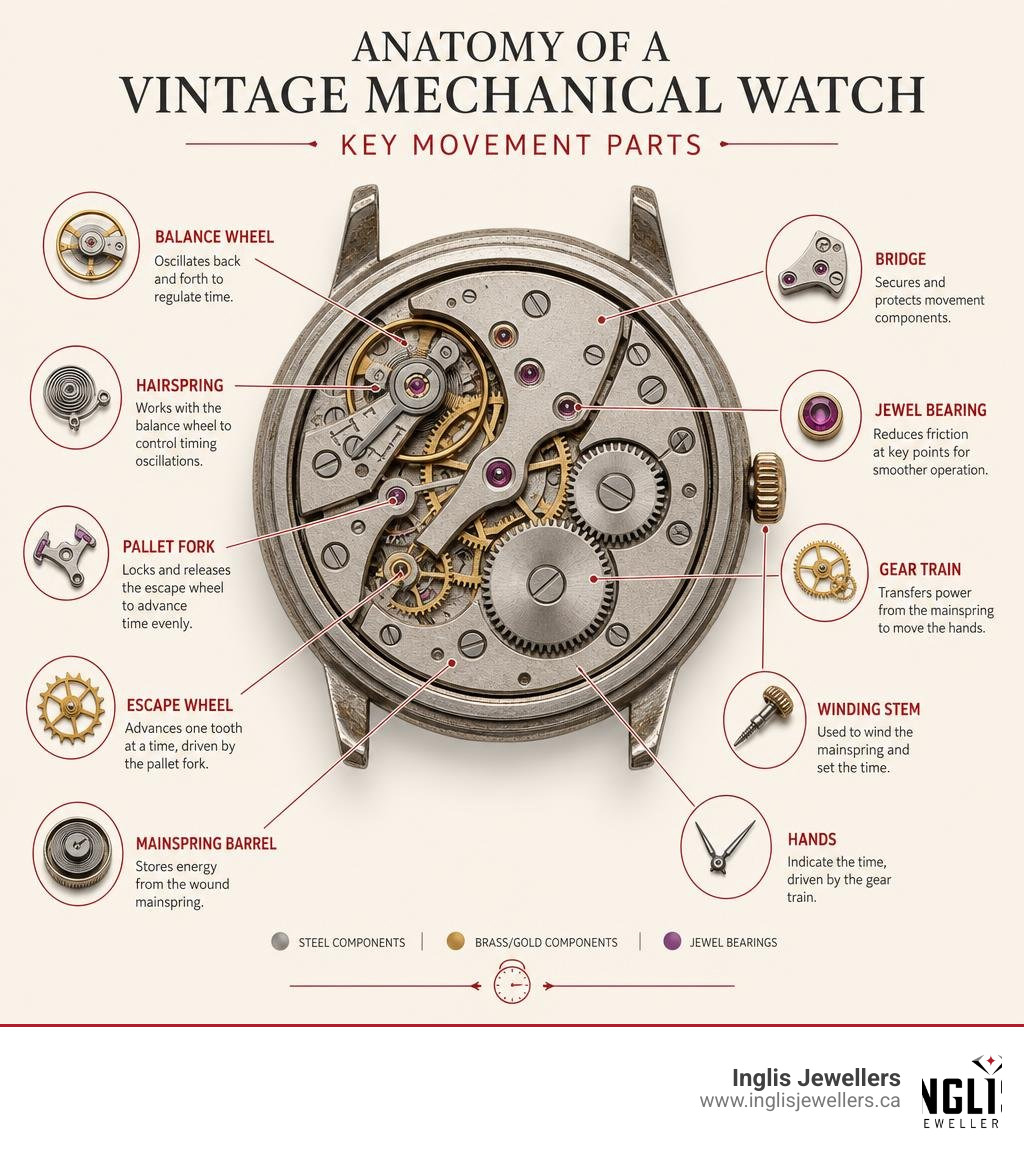
The movement is meticulously rebuilt in a logical order. As each bridge and wheel is set back into place, the watchmaker applies tiny, microscopic droplets of different synthetic oils. We use heavy grease for high-friction areas like the keyless works (winding mechanism) and ultra-light, low-viscosity oils for high-speed, low-torque areas like the escape wheel and balance pivots.
6. Timing Calibration and Testing
Once reassembled and running, the movement is placed on a digital timing machine (timegrapher). We analyze the watch's "beat rate" (how fast or slow it runs), "amplitude" (the angle of rotation of the balance wheel), and "beat error" (the symmetry of the swing). The watch is regulated and tested over several days in multiple physical positions (dial up, dial down, crown up, crown down) to ensure real-world accuracy.
Sourcing Authentic Parts for Your Old Watch Restoration
One of the greatest hurdles in old watch restoration is finding replacement parts. While modern watch brands maintain vast inventories of components, vintage parts can be incredibly scarce.
Most major watch manufacturers only guarantee parts availability for about 35 years after a model is discontinued. If you are restoring a watch from the 1950s, 1960s, or earlier, standard parts catalogs will show nothing but dead ends.
To overcome this, watchmakers must rely on specialized collector networks, vintage parts dealers, and "donor movements" (buying non-functional watches of the same caliber to harvest their usable parts).
In some cases, if a part is completely unobtainable, a master watchmaker must fabricate the component from scratch using a watchmaker's lathe.
This level of resourcefulness is beautifully illustrated in the Restoration of the Pulp Fiction watch. In this case study, a watchmaker restoring a 1920s Lancet trench watch had to navigate a broken trainwheel bridge. Because an identical replacement bridge was completely unavailable, they had to source and adapt a two-piece variant from a different production run, carefully aligning the pivots to restore the gear train's movement.
The Delicate Art of Movement Overhaul
The heart of any restoration is the movement overhaul. This requires working with components so small that a stray breath can blow them off the workbench.
Every wheel in the gear train must spin with absolute freedom. If there is even a microscopic speck of dust in a jewel bearing, the watch will lose amplitude and eventually stop running.
During an overhaul, the watchmaker pays special attention to the balance wheel and hairspring assembly—the regulating organ of the watch. If the hairspring is magnetized, dirty, or slightly bent, the watch may run hours fast or slow every day.
The level of precision required is detailed in the technical walkthrough of a Vintage Hamilton Watch Restoration: 1939 Winthrop - Overhaul. This project highlights the unique challenges of working on vintage American 14/0 sized movements, where parts like the cannon pinion and hour wheel had to be matched to the exact curvature of the dial.
It also highlights critical vintage assembly rules, such as identifying left-handed threads on winding wheel screws to avoid snapping them during disassembly.
The Patina Debate: Preserving Value vs. Refinishing
If you ask five different watch collectors whether you should polish a vintage watch case or repaint a faded dial, you will likely get five very passionate, conflicting answers. This is the famous "Patina Debate," and it is the most critical decision-making phase of any old watch restoration.
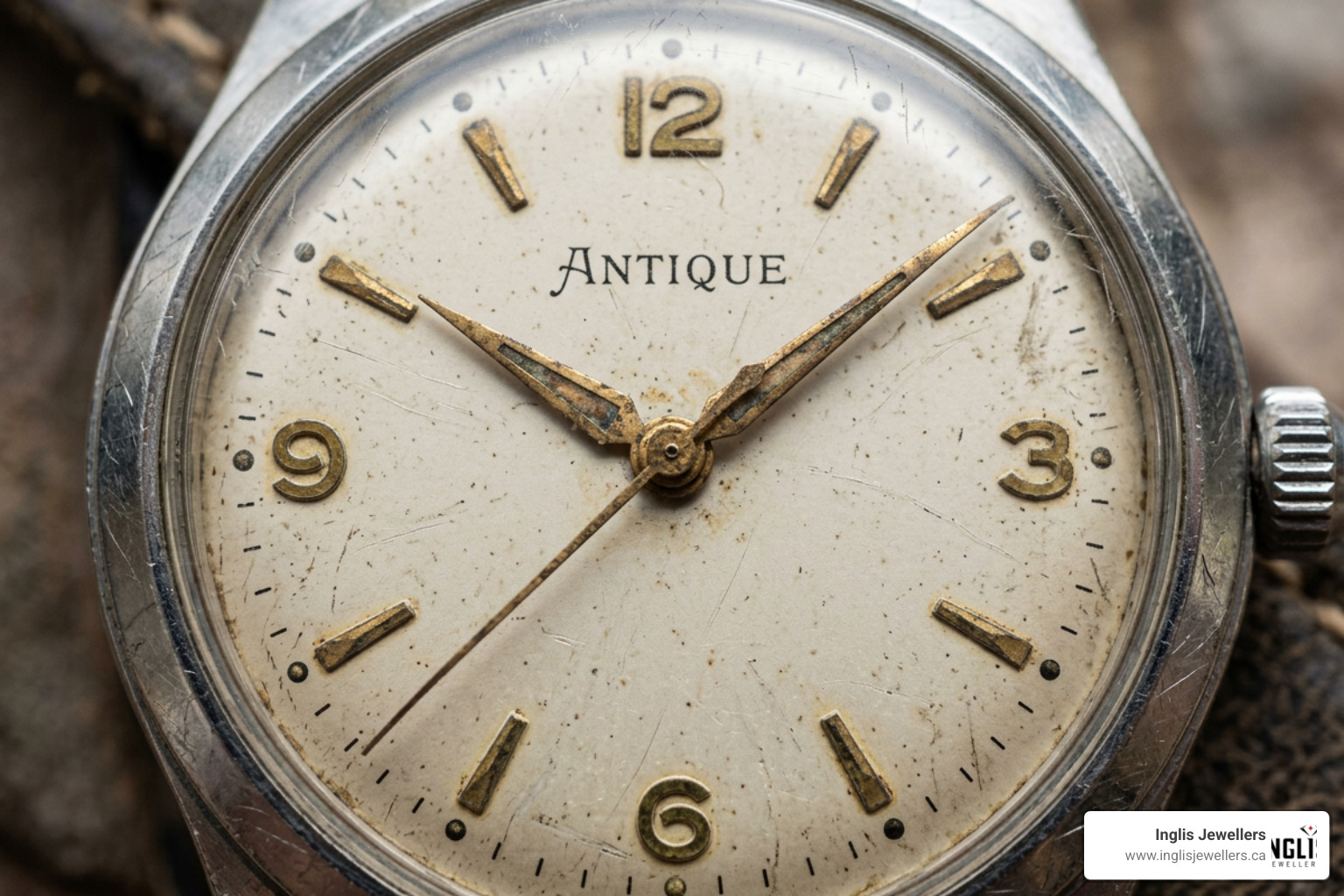
In the early days of watch collecting, the goal was to make an old watch look brand new. Dials were routinely repainted, and cases were heavily buffed on polishing wheels to remove every scratch.
Today, the collector market values originality above all else. A watch that shows its age honestly is almost always more valuable and desirable than one that has been aggressively modernized.
Here is how different restoration choices can affect both the character and the financial value of a vintage timepiece:
- The Case of Over-Polishing: Every time a metal case is polished, a microscopic layer of gold or stainless steel is shaved away. Over-polishing rounds off the sharp, crisp edges of the lugs and case lines, ruining the original case geometry. Over-polishing a vintage watch case can easily slash its market value by 30% or more.
- The "Tropical" Dial Phenomenon: In vintage Rolexes and other high-end sports watches from the mid-century, chemical reactions from UV light and humidity caused some black dials to slowly turn a rich, chocolate brown. Known as "Tropical" dials, these beautiful manufacturing defects are highly sought after. Replacing or repainting a Tropical dial can reduce the watch's collector value by 50% or more.
- Tritium and Lume Stabilization: Older watches used radioactive radium or tritium on the hands and hour markers to glow in the dark. Over 30 years, tritium ages into a warm, creamy, pumpkin-like hue. If the original tritium is flaking off, the best practice is to stabilize it from behind using specialized clear binders, rather than scraping it off and replacing it with modern, bright-green Luminova.
Our philosophy is always: preserve whenever possible, restore only when necessary. A scratch on a gold bezel tells a story of a life lived; polishing it away removes a chapter of that story.
Frequently Asked Questions about Vintage Watch Care
To help you protect your investment, we have compiled the most common questions watch owners ask about caring for their restored timepieces.
How long does a full vintage watch restoration typically take?
A professional vintage watch restoration typically takes 4 to 8 weeks.
This timeline isn't due to watchmakers working slowly; it is dictated by the meticulous nature of the craft. Sourcing rare, period-correct parts from global networks can take weeks.
Furthermore, once the watch is reassembled, it must go through an extended testing phase. We monitor the watch's power reserve, calendar functions, and multi-position timekeeping over several days to guarantee it runs reliably on your wrist.
Can a vintage watch be made fully waterproof again?
The short answer is: almost never by modern standards.
While we replace all rubber, lead, or plastic gaskets during a restoration and perform vacuum pressure testing, vintage cases have suffered decades of micro-wear. The metal around the crown tube, case back, and crystal seat may have microscopic pitting that prevents a perfect seal.
A restored vintage watch should be treated as splash-resistant at best. We strongly advise keeping your vintage treasures far away from the shower, the pool, and the ocean.
If you want to go swimming, leave the 1960s heirloom on the nightstand and wear a modern dive watch instead!
How often should a restored vintage watch be serviced?
Once a vintage watch has been fully restored, we recommend having it serviced every 5 to 7 years.
Modern watch restorations use high-grade synthetic lubricants that do not dry out or turn to gum as quickly as the old animal-based oils used decades ago. However, these synthetic oils will still migrate and break down over several years of constant mechanical friction.
You don't always have to wait for the calendar, either. Keep an eye out for performance changes:
- If your watch suddenly starts losing or gaining several minutes a day
- If the winding action feels gritty or unusually stiff
- If you notice condensation under the crystal after washing your hands
If you notice any of these signs, it is time to bring the watch in for a check-up before internal wear can occur.
Conclusion: Trusting the Right Hands
Your vintage watch is more than just a tool for keeping time—it is a mechanical work of art, a link to the past, and a family heirloom that deserves to be passed down to the next generation.
While the temptation to try a DIY repair or use a general, uncertified repair shop can be strong, vintage watches require specialized horological training, dedicated tools, and a deep respect for historical preservation. A single slip of a screwdriver can scratch an irreplaceable dial or ruin a delicate balance spring, instantly erasing both sentimental and financial value.
At Inglis Jewellers, we have built our reputation on trusted craftsmanship and full-service support across Atlantic Canada. Whether you visit us in Nova Scotia (Truro, New Glasgow, Sydney) or New Brunswick (Riverview), our team understands the delicate balance of preserving a watch's historic soul while restoring its mechanical heart.
If you have an old watch sitting silently in a drawer, let us help you bring its story back to life. Visit us in-store or explore our Professional Watch Repairs page to learn more about our services and start your watch's restoration journey today.