


Man Made Diamonds in Canada: What You Need to Know Before You Buy
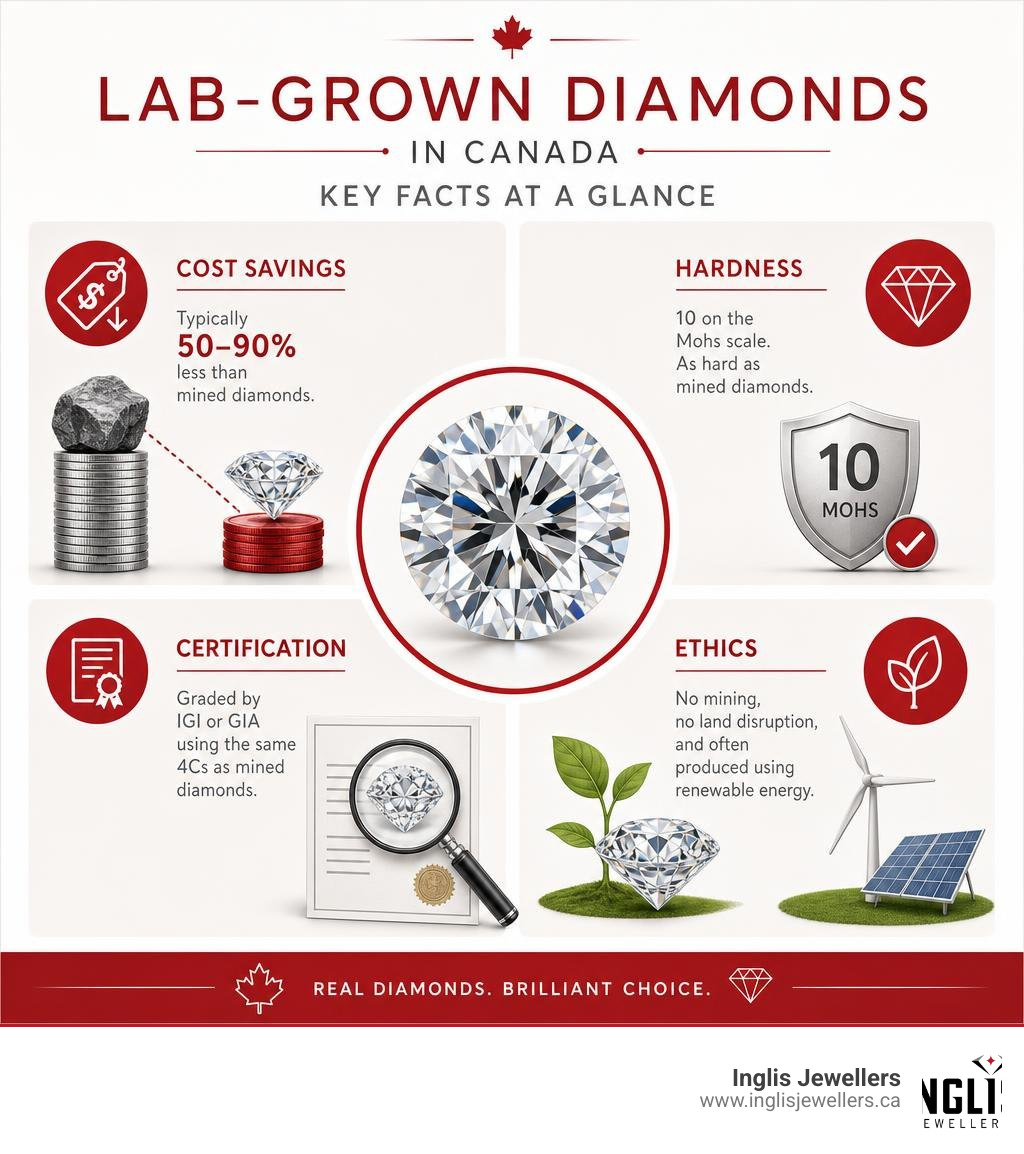
Man made diamonds in Canada are real diamonds — chemically, physically, and optically identical to mined diamonds — grown in a laboratory instead of extracted from the earth, and they typically cost 50–90% less than their natural counterparts.
Quick answers for Canadian shoppers:
- Are they real diamonds? Yes. Same carbon structure, same hardness (10 on the Mohs scale), same brilliance.
- Are they certified? Yes. Graded by IGI or GIA using the same 4Cs as mined diamonds.
- How much cheaper are they? A comparable 1-carat natural diamond runs around $4,200 CAD per carat in 2026; a lab-grown equivalent can be as low as $725 CAD per carat.
- Are they ethical? Yes. No mining, no land disruption, and often produced using renewable energy.
- What's the catch? Resale value is low — but that's true of most diamonds, mined or grown.
The interest in lab-grown diamonds across Canada has grown rapidly. A Toronto couple made headlines after purchasing a stunning 2.33-carat lab-grown diamond engagement ring for under $6,000 CAD — a stone that would have cost many times more if mined from the earth.
But with more retailers entering the market, prices and quality vary wildly. One investigative report found virtually identical 1-carat, D-colour, VS1 clarity stones selling for $228 CAD on one platform and $1,639 CAD on another.
That's the kind of gap that makes doing your homework essential.
This guide breaks down everything you need to know — from how man-made diamonds are created, to how they're graded, priced, and what to look for when buying in Canada.
The Rise of Man Made Diamonds Canada: Ethical and Affordable Luxury
The diamond industry is undergoing its most significant transformation since the invention of the modern brilliant cut. For generations, the only way to obtain a diamond was through deep-earth mining, a process requiring massive infrastructure, heavy machinery, and significant environmental disruption. Today, advanced physics and chemistry allow us to bypass the Earth's mantle entirely.
By utilizing state-of-the-art diamond growing chambers, scientists can replicate the exact conditions that occur 150 kilometers below the Earth's surface. This process begins with a tiny, ultra-thin slice of carbon known as a diamond seed. Through precise control of temperature, pressure, and gas mixtures, carbon atoms are encouraged to bond to this seed, building a crystal lattice structure layer by layer.
This technological leap has allowed for the production of gem-quality stones that are virtually indistinguishable from their earth-mined counterparts. In fact, many man-made diamonds achieve the coveted Type IIa category. Type IIa diamonds are the most chemically pure type of diamonds, representing less than 2% of all natural diamonds. They contain no measurable nitrogen impurities, which gives them exceptional optical transparency and brilliance.
Through highly efficient global distribution networks and transparent, ethical supply chains, these stones make their way from high-tech laboratories to our local showcases in Nova Scotia and New Brunswick. To understand how these spectacular gems are created, we must look at the two primary manufacturing methods.
The HPHT (High Pressure High Temperature) Method
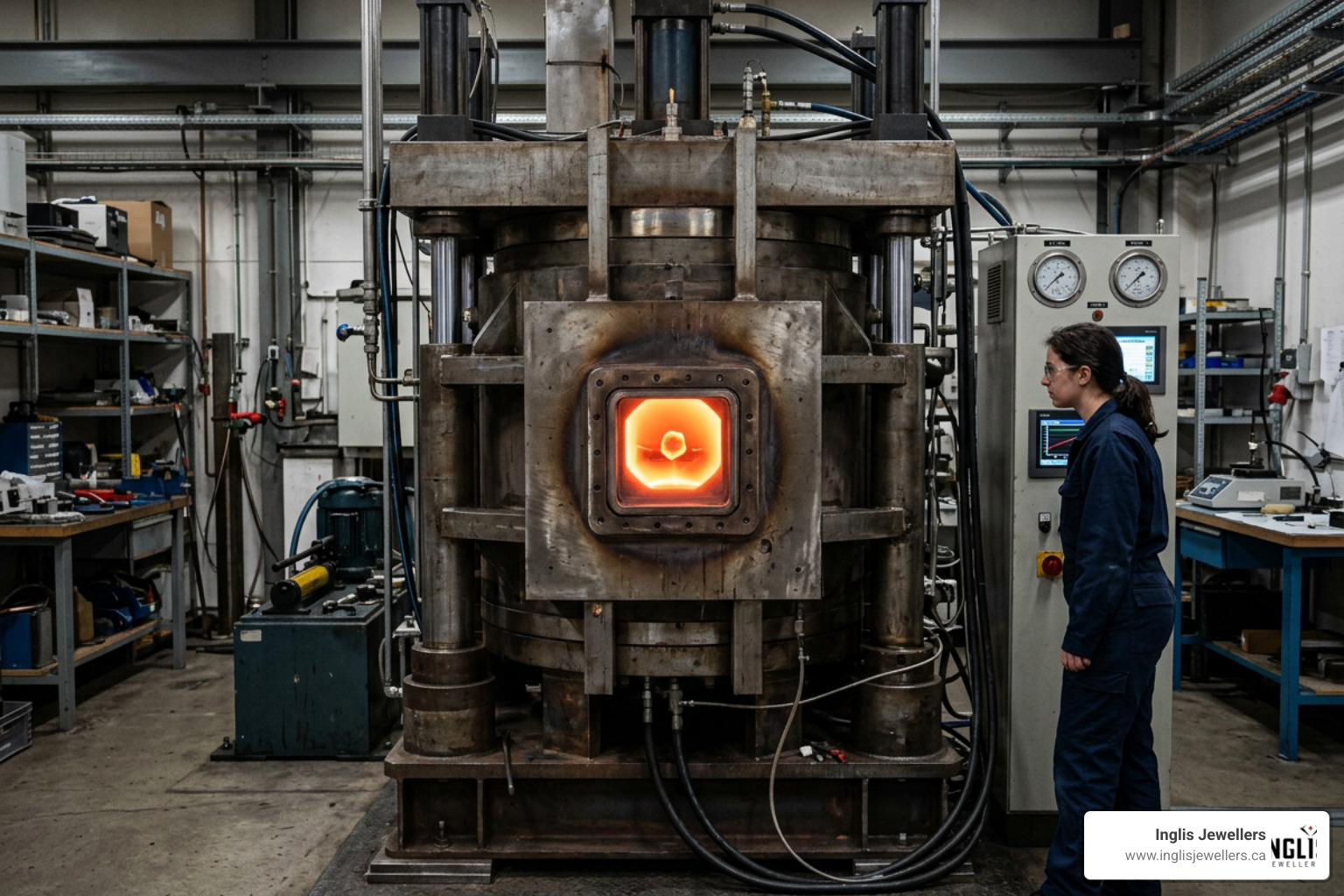
The High Pressure High Temperature (HPHT) method is the original process used to grow diamonds, first developed in the 1950s for industrial applications. This method directly mimics the intense geological forces of nature.
Inside an HPHT press, a diamond seed is placed in a growth cell containing pure carbon source material (such as graphite) and a molten metal catalyst, which usually consists of iron, nickel, or cobalt. The chamber is then subjected to extreme pressures of over 1.5 million pounds per square inch and temperatures exceeding 1,500 degrees Celsius.
Under these conditions, the molten metal catalyst dissolves the carbon source material. The carbon atoms then migrate through the liquid metal to deposit onto the cooler diamond seed, crystallizing into a beautiful, solid diamond. Because a metal catalyst is used in this process, HPHT diamonds can sometimes contain microscopic metallic inclusions that are unique to lab-grown environments. These inclusions are generally invisible to the naked eye but serve as fascinating markers of the stone's high-tech origin.
The CVD (Chemical Vapour Deposition) Method
The Chemical Vapour Deposition (CVD) method is a newer, highly sophisticated process that has revolutionized the jewelry industry. Instead of relying on brute physical force, CVD relies on chemical reactions.
The process begins by placing a flat diamond seed plate inside a vacuum chamber. The chamber is filled with a carbon-rich hydrocarbon gas mixture, typically methane and hydrogen. We then heat the chamber to around 800 to 1,000 degrees Celsius and ignite it into a high-energy plasma state using microwaves or lasers.
This plasma state breaks the chemical bonds of the gas, releasing pure carbon atoms. These freed carbon atoms rain down onto the diamond seed plate, bonding atom-by-atom to build a highly pure crystal structure. Because CVD diamonds grow in a gas-rich environment without metal catalysts, they do not have metallic inclusions. Instead, any microscopic imperfections that form are typically tiny graphite inclusions.
The precision of CVD technology allows for incredible control over the diamond's growth, resulting in exceptionally clear, beautiful crystals.
Real Diamonds vs. Simulants: Understanding the Differences
One of the most common points of confusion for Canadian jewelry shoppers is the difference between a real, man-made diamond and a diamond simulant. It is vital to understand that "man-made" does not mean "fake."
To help clarify these distinctions, let's look at how these materials perform across several key gemological benchmarks:
| Gemstone Type | Chemical Composition | Mohs Hardness | Refractive Index | Thermal Conductivity |
|---|---|---|---|---|
| Natural Diamond | Pure Carbon (C) | 10 | 2.42 | Extremely High |
| Lab-Grown Diamond | Pure Carbon (C) | 10 | 2.42 | Extremely High |
| Moissanite | Silicon Carbide (SiC) | 9.25 | 2.65 - 2.69 | High |
| Cubic Zirconia (CZ) | Zirconium Dioxide ($ZrO_2$) | 8.0 - 8.5 | 2.15 | Very Low |
The Federal Trade Commission (FTC) guidelines explicitly state that lab-grown diamonds are real diamonds. They are not imitations; they are the physical, chemical, and optical equivalent of mined diamonds, adhering to strict naming conventions and transparency standards in Canada.
Lab-Grown vs. Natural Diamonds
When comparing a lab-grown diamond to a natural diamond, you are comparing two objects made of the exact same physical substance: pure carbon arranged in a cubic crystal structure. Because of this, they share identical physical properties, including a rating of 10 on the Mohs hardness scale (making them the hardest known material on Earth) and the same optical brilliance and fire.
To the naked eye, even an experienced gemologist cannot tell them apart. It requires specialized, highly advanced gemological equipment to detect the subtle differences in growth patterns and trace elements that reveal whether a diamond was formed over billions of years in the earth or over several weeks in a controlled laboratory.
Lab-Grown Diamonds vs. Moissanite and Cubic Zirconia
Diamond simulants, on the other hand, are entirely different chemical compounds that merely look like diamonds.
Cubic Zirconia (CZ) is a synthetic material made of zirconium dioxide. While it is inexpensive, it has a much lower hardness rating (8 to 8.5), meaning it scratches easily over time. It also lacks the thermal conductivity of a diamond, causing it to look dull or cloudy after a few years of daily wear.
Moissanite is a beautiful, naturally occurring mineral (silicon carbide) that is grown in labs for jewelry use. With a hardness rating of 9.25, it is incredibly durable and makes an excellent choice for daily wear. However, moissanite has a different crystal structure that causes double refraction. This means light splitting through the stone creates a "disco-ball" effect of rainbow-colored flashes, which behaves differently than the single-refractive white and colored sparkle of a diamond.
If you are considering moissanite as an alternative, check out our Ultimate 1 Carat Moissanite Ring Guide 2026 or explore the spectacular sparkle of a 2 Carat Moissanite Ring to see which gemstone matches your personal style.
Grading and Quality: The 4Cs of Man-Made Diamonds
Just like earth-mined diamonds, man-made diamonds are not all created equal. They exhibit variations in quality, clarity, and color, which is why they are graded using the exact same international standards: the 4Cs.
How the 4Cs Apply to Man Made Diamonds Canada
When shopping for man made diamonds canada, you will want to evaluate each stone based on the following criteria:
- Cut: This is the most crucial factor determining a diamond's sparkle. Because lab-grown crystals can be grown to predictable shapes, master cutters can maximize light return, resulting in a high percentage of "Ideal" or "Excellent" cuts.
- Color: Lab-grown diamonds are graded on a scale from D (completely colorless) to Z (light yellow or brown). Because of the controlled laboratory environment, it is much easier to find stunning, premium D, E, and F colorless stones.
- Clarity: This measures the presence of internal characteristics (inclusions) or surface blemishes. Ranging from Flawless (FL) to Included (I3), most high-quality lab diamonds fall into the VVS (Very, Very Slightly Included) or VS (Very Slightly Included) categories.
- Carat Weight: This measures the physical weight of the diamond. Because growing technology has advanced rapidly, larger carat weights are now highly accessible for Canadian consumers.
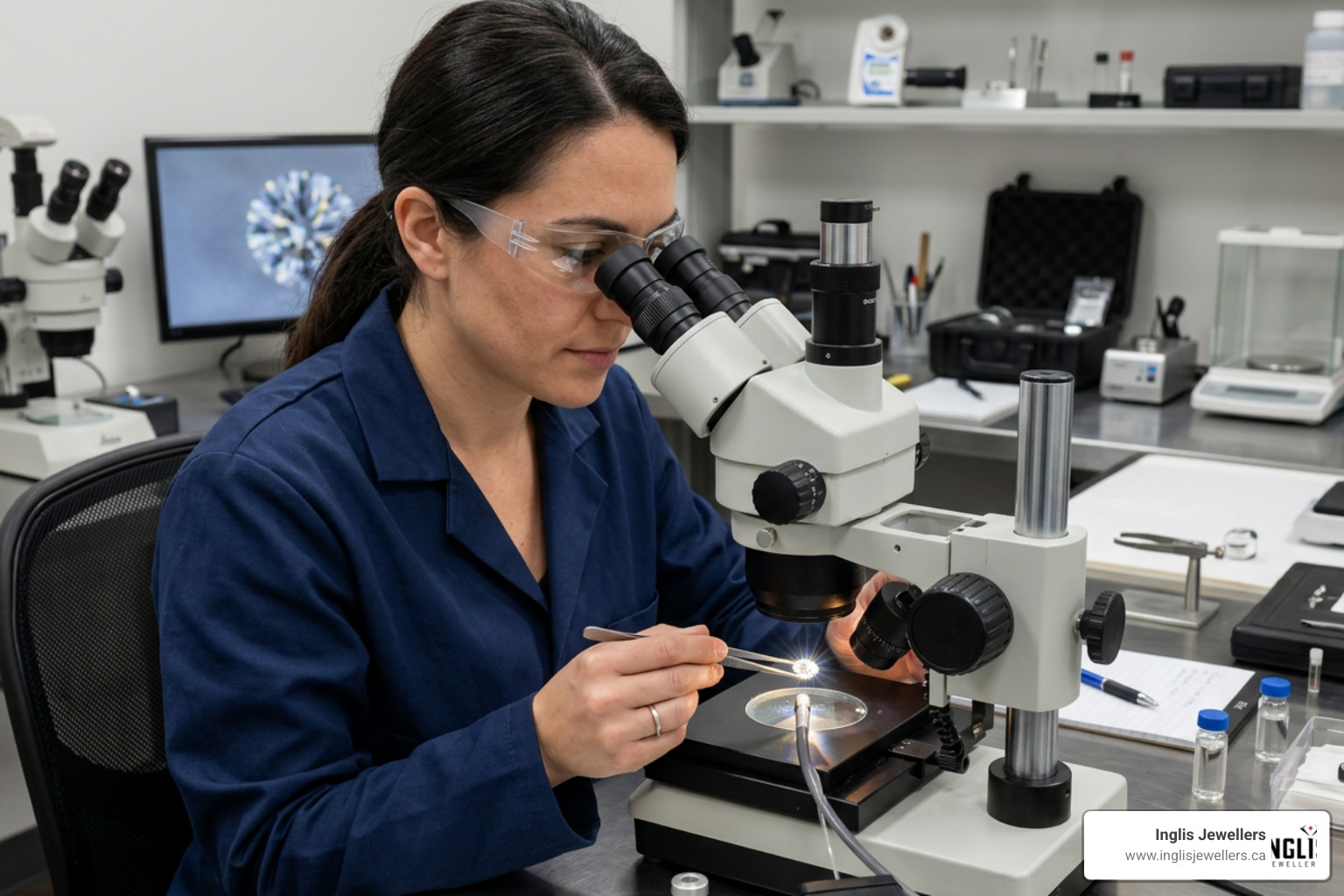
To ensure transparency, certified lab-grown diamonds feature a microscopic laser inscription on the outer edge (the girdle) containing the certificate number and the words "laboratory grown." This ensures that the stone can always be identified and never confused with a mined diamond.
Verifying Authenticity and Certification
When purchasing a diamond, you should always insist on a grading report from an independent, internationally recognized laboratory. The International Gemological Institute (IGI) and the Gemological Institute of America (GIA) are the gold standards for lab-grown diamond certification.
These reports verify the stone's exact measurements, 4Cs grading, and confirm its lab-grown origin, ensuring complete transparency and peace of mind for Canadian consumers.
The Economics of Sparkle: Pricing and Value Retention
The financial benefits are often the primary reason Canadian couples choose man-made diamonds. By removing the massive overhead costs of diamond mining, exploration, and complex international trade routes, the savings are passed directly to you.
Why Are Man Made Diamonds Canada More Affordable?
The production of lab-grown diamonds is an economy-of-scale business. As technology improves and plasma chambers become more efficient, the cost of growing a diamond decreases. Today, a lab-grown diamond can cost up to 90% less than a natural diamond of comparable quality.
This drastic price difference gives you incredible budget flexibility. Instead of compromising on size or clarity, you can easily secure a larger, higher-quality center stone for your dream ring. For example, if you are planning a budget, comparing the 2 Carat Diamond Ring Price against the 3 Carat Diamond Ring Price showcases just how much further your dollar goes when you opt for a lab-grown stone.
With these savings, many couples choose to invest in premium, custom-designed settings that perfectly showcase their brilliant new stone.
Do Lab-Grown Diamonds Hold Their Value?
It is important to have an honest discussion about value retention. Neither natural nor lab-grown diamonds should be viewed as financial investments. Like a new car, a diamond's retail value depreciates the moment you leave the store.
Because the production of lab-grown diamonds continues to scale, their wholesale market prices have declined over time. If you plan to resell your diamond in the future, a lab-grown stone will have very little resale value. However, most jewelry is bought for its sentimental value, to be worn and cherished for a lifetime. By saving thousands of dollars upfront on your purchase, you keep that hard-earned money in your bank account, which is a guaranteed return on investment!
Ethical and Sustainable Considerations for Canadian Buyers
For many Canadians, the decision to buy a man-made diamond is driven by a desire to make a conscious, ethical purchase.
Environmental Impact of Lab Growth vs. Mining
Traditional diamond mining requires shifting hundreds of tons of earth per carat of diamond recovered, which can lead to habitat disruption, soil erosion, and local water pollution. In contrast, lab-grown diamonds require zero land excavation.
While growing diamonds does require a significant amount of electricity to power the plasma chambers, many modern laboratories are shifting to 100% renewable energy sources, such as solar, wind, or hydro power. Some cutting-edge facilities even utilize carbon capture technology, pulling carbon dioxide directly out of the atmosphere to grow beautiful gems.
Choosing Ethical Settings in Canada
An ethical stone deserves an ethical home. To maximize the sustainability of your jewelry, we recommend pairing your man-made diamond with repurposed or recycled gold.
Whether you are looking for a classic 14k Gold Ring Womens or researching the premium look of a 22k Gold Ring Price, choosing recycled precious metals ensures your entire piece aligns with your conscious values. To understand the different types of gold and how to choose the perfect band for your diamond, take a look at our Ultimate Gold Ring Guide 2026.
Frequently Asked Questions about Man-Made Diamonds
To help you shop with absolute confidence, we have compiled the answers to the most common questions we hear in our Atlantic Canadian showrooms.
Do man-made diamonds get cloudy over time?
No, man-made diamonds will never get cloudy, yellow, or fade over time. Because they are 100% pure carbon with a hardness of 10 on the Mohs scale, their physical structure is completely stable.
If your ring starts to look a little less brilliant, don't worry! This is simply the result of everyday surface residue — such as hand lotions, soaps, and natural skin oils — building up on the underside of the stone. A quick clean at home using warm water, mild dish soap, and a soft-bristled toothbrush will instantly restore its original, jaw-dropping sparkle.
Can a diamond tester detect a lab-grown diamond?
Yes and no, depending on the type of tester used.
Standard thermal conductivity testers measure how heat flows through a stone. Because lab-grown diamonds have the exact same chemical structure and thermal properties as natural diamonds, they will register as a "real diamond" on these basic hand-held testers.
However, advanced multi-testers and specialized gemological equipment used by professional appraisers can measure UV light absorption and growth patterns to easily distinguish between earth-mined and lab-grown stones.
Can lab-grown diamonds be resized or repaired?
Absolutely! Because man-made diamonds share the exact same physical properties and durability as natural diamonds, they can be handled, cut, polished, resized, and repaired by any skilled goldsmith without any risk to the stone.
Whether you need to resize an engagement ring, reset a family heirloom, or repair a worn-down prong, our expert team can assist you. For a complete guide on how to keep your precious jewelry in pristine condition, refer to our Jewellery Repairs Complete Guide.
Conclusion
Choosing between a natural and a man-made diamond is a deeply personal decision. There is no right or wrong answer — only what is right for your style, your values, and your budget.
At Inglis Jewellers, we are proud to offer trusted craftsmanship and full-service support both online and in-store across Atlantic Canada. Whether you visit us in Truro NS, New Glasgow NS, Riverview NB, or Sydney NS, our team is here to help you navigate your diamond-buying journey with absolute transparency and warm, friendly service.
If you want to create a truly one-of-a-kind piece, we invite you to explore our custom design options. From classic bridal sets to a custom 14k Gold Handwriting Jewelry, a Custom Handwriting Necklace, or a bold Customised Ring for Men, our talented jewelers can bring your vision to life.
Stop by one of our local showrooms or visit Our Goldsmith Gallery: Craftsmanship, Custom and Care to see how we can craft the perfect, brilliant symbol of your love story. Ready to start comparing options? Take a look at our guide on the 2 Carat Diamond Ring Price to find the perfect balance of size, quality, and value today!