


Why Getting Your Jewelry Appraised Is More Important Than You Think
Jewelry appraisal stores give you an official, written document that describes your piece and assigns it a value — so you can insure it, sell it, settle an estate, or simply know what you own.
Here's a quick look at where and why people get jewelry appraised:
| Reason to Get an Appraisal | Where to Go |
|---|---|
| Insurance coverage | Independent appraiser or qualified jeweler |
| Estate settlement or probate | Independent appraiser |
| Divorce or asset division | Independent appraiser |
| Resale or auction | Independent appraiser or auction house |
| Charitable donation | Independent appraiser |
| General peace of mind | Local jeweler with gemological credentials |
Your jewelry tells a story. A diamond engagement ring, an inherited brooch, a custom gold necklace — these pieces carry real emotional and financial weight. But without a professional appraisal, you have no way to prove their value if they're lost, stolen, or damaged.
The problem? Not all appraisals are created equal. There are no federal laws in the U.S. requiring appraisers to hold any specific certification. That means the quality of your appraisal depends almost entirely on who you choose.
This guide walks you through everything you need to know — from finding the right appraiser to understanding what your report should include.
What is a Jewelry Appraisal and Why Do You Need One?
At its core, a jewelry appraisal is an official, legal document prepared by a qualified professional. It describes your jewelry in meticulous detail, assesses its overall quality, and provides a formal opinion of its monetary value at a specific point in time.
Why do you need one? The most common reason is to secure insurance coverage. If your favorite diamond ring slips down the drain or gets lost during a vacation, your insurance provider will require a detailed appraisal to calculate your premium and process a claim. Without this document, replacing the item with one of equal quality is incredibly difficult.
Beyond insurance, appraisals are vital for:
- Estate planning and probate: Determining the value of inherited collections so they can be distributed fairly among heirs or taxed accurately.
- Asset division: Providing an unbiased valuation during divorce proceedings or legal settlements.
- Resale and liquidation: Giving you a realistic baseline price before you list a piece on the secondary market.
It is critical to understand the difference between appraisal and gemological grading report. A grading report (like those issued by the GIA) acts as a "birth certificate" for a gemstone, detailing its scientific characteristics (such as the 4Cs) without assigning a dollar value. An appraisal, on the other hand, takes those characteristics, factors in current market conditions, and assigns a specific monetary value.
The Core Types of Jewelry Valuations
Depending on your situation, you will need a specific type of appraisal. Asking for the wrong one can result in values that are either too high (costing you extra on insurance premiums) or too low:
- Insurance Replacement Value (Retail Replacement): This is the most common type. It estimates the cost to replace the item with a brand-new equivalent of the same quality at a typical retail store. Because it reflects retail prices, it is usually the highest valuation.
- Fair Market Value (FMV): This represents the price a willing buyer and a willing seller would agree upon in a common market (like an auction or a private sale) where neither is forced to buy or sell. This value is typically lower than retail replacement because it accounts for the item's used condition.
- Immediate Liquidation Value: This is used for quick-cash situations, such as bankruptcy or rapid asset division, reflecting what a seller can get immediately under pressure.
- Estate Probate Value: Used specifically for calculating inheritance taxes. This is generally based on the fair market value of the jewelry on the exact date of the owner's passing.
How to Choose the Best Jewelry Appraisal Stores for Your Valuables
Finding trustworthy jewelry appraisal stores requires a bit of detective work. Because there are no government-mandated educational standards or licensing requirements to become a jewelry appraiser, anyone can buy a magnifying loupe and claim to be an expert.
To help you navigate your options, here is a quick comparison of the two main avenues you can take:
| Feature | Independent Appraisers | Retail Jewelry Appraisal Stores |
|---|---|---|
| Conflict of Interest | Low (They do not buy or sell jewelry) | Moderate (They may offer to buy your piece or sell you a replacement) |
| On-Site Equipment | Highly specialized gemological labs | Varies by location |
| While-You-Wait Service | Often available by appointment | Available during special appraisal events or at full-service stores |
| Best Used For | Legal disputes, complex estates, high-value collections | Insurance updates, convenient local service, custom designs |
When searching for the right professional, knowing how to find certified jewelry appraisal experts is essential. You want to look for professionals who belong to recognized national and international organizations that enforce strict ethical codes and continuing education.
Independent Appraisers vs. Retail Jewelry Appraisal Stores
An independent appraiser is someone who evaluates jewelry but does not buy, sell, or broker it. This model is highly praised because it eliminates any conflict of interest, ensuring their numbers are guided by market truth rather than retail margins. Many independent appraisers operate on this strictly unbiased model, focusing purely on providing accurate valuations.
However, established, full-service retail jewelers who employ certified on-staff gemologists also offer excellent appraisal services. The key is finding a store with a pristine local reputation. For instance, if you are looking for a trusted partner in Atlantic Canada, we provide comprehensive, certified evaluations right alongside our design and repair services. Whether you visit us in Nova Scotia (Truro, New Glasgow, Sydney) or New Brunswick (Riverview), our in-house experts ensure your appraisal is accurate, professional, and fully accepted by insurance companies. We also keep a close eye on regional trends, noting how local markets compare to other areas, such as the bustling market described in our guide on the Jewelry Store St. John's NL.
When a retail store handles your appraisal, they must calculate the retail replacement cost accurately, clearly listing any regional sales taxes separately so your insurance policy covers the exact cost of replacing the piece in your home province.
Key Credentials to Look For in an Appraiser
Never hand your jewelry over to someone without checking their credentials first. A reputable appraiser should hold several of the following designations:
- GIA Graduate Gemologist (GG): The gold standard in gemological education from the Gemological Institute of America, proving they can accurately identify and grade gemstones.
- National Association of Jewelry Appraisers (NAJA): Membership in NAJA indicates a dedication solely to the appraisal of fine gems, jewelry, and timepieces.
- American Society of Appraisers (ASA): Look for designations like Accredited Senior Appraiser (ASA) or Master Gemologist Appraiser, which require extensive peer-reviewed experience.
- USPAP Compliance: The Uniform Standards of Professional Appraisal Practice sets the ethical and performance standards for all appraisal disciplines in North America.
What to Expect During the Professional Appraisal Process

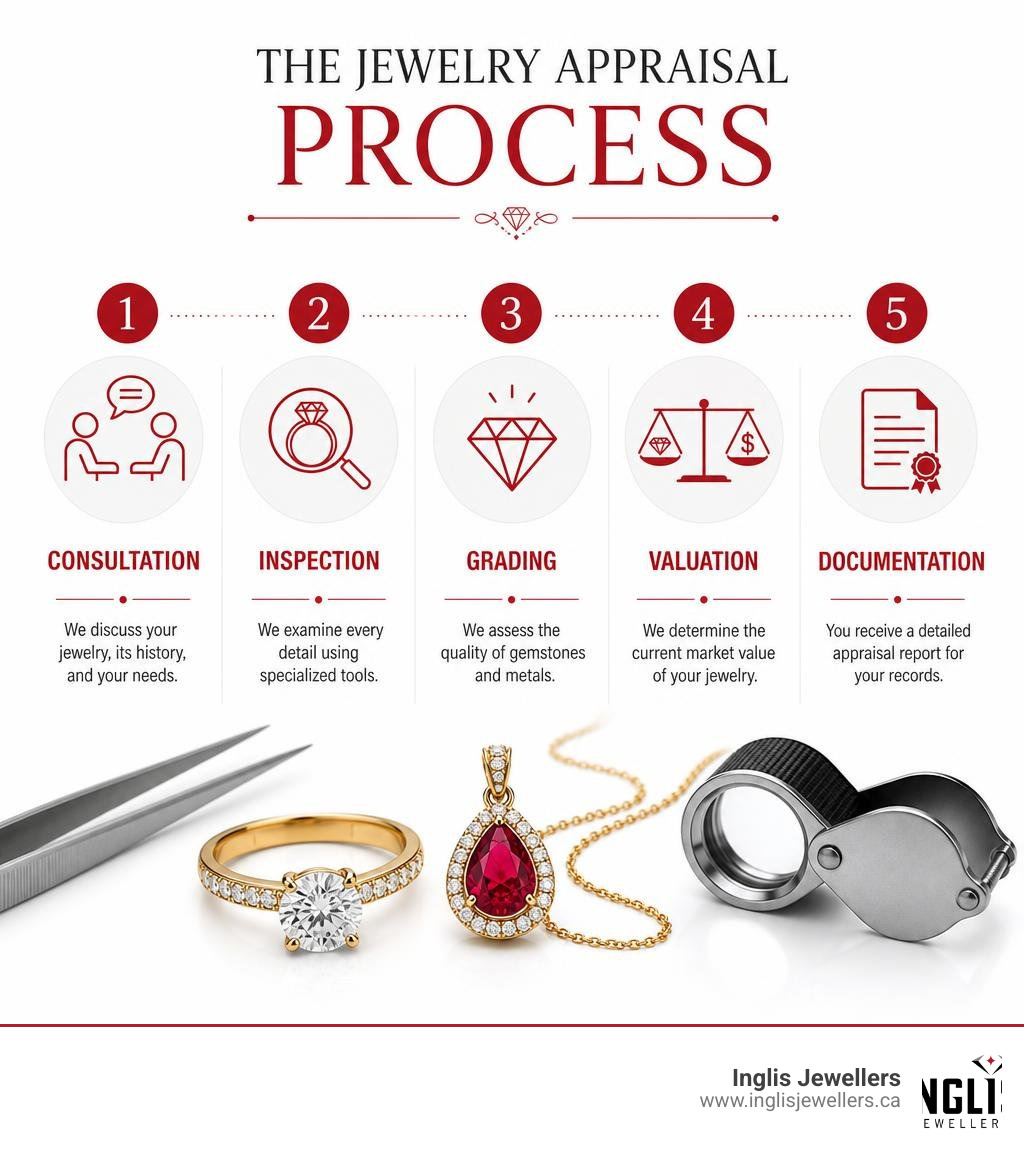
When you take your items to a professional, they don't just glance at them and guess a number. The process is scientific, highly detailed, and thoroughly documented.
First, the appraiser will clean your jewelry. Dirt and lotion buildup can mask a stone's true color and clarity, so a thorough cleaning is required for an accurate grade. Next, they will use state-of-the-art gemological equipment — including microscopes, refractometers, and electronic metal testers — to evaluate your piece.
During the physical inspection, the expert will:
- Identify and Grade Gemstones: Assess the 4Cs (Color, Clarity, Cut, and Carat Weight) of any diamonds and identify the origin and treatments of colored gemstones.
- Verify Metals: Test the purity of the metal (e.g., 14k gold, 18k gold, platinum) and inspect the construction of the piece.
- Analyze Craftsmanship: Note the manufacturing techniques, brand markings (such as Tiffany & Co. or Cartier), and historic design eras (such as Art Deco or Victorian).
What to Expect When Visiting Local Jewelry Appraisal Stores
If you prefer a hands-on, local experience, visiting a brick-and-mortar store is your best bet. Many local stores offer dedicated appraisal days or "while-you-wait" appointments where you can watch the entire process. This is incredibly comforting because your precious items never leave your sight.
If you are looking for specialized services in the Maritimes, finding a trusted regional partner is key. For those located near New Glasgow, Nova Scotia, or other parts of Atlantic Canada, you can stop by our very own Inglis Jewellers showroom in New Glasgow for personalized, friendly support. Our certified experts will handle your pieces with the utmost care and precision.
During an in-person visit, the appraiser will take high-resolution reference photos, measure your stones, and walk you through their findings before compiling everything into a final, multi-page written report.
Can You Get a Jewelry Appraisal Online or Virtually?
In our digital world, the idea of a virtual jewelry appraisal sounds incredibly convenient. However, virtual appraisals have massive physical inspection limits.
An appraiser cannot accurately test metal purity, weigh a stone, or detect modern synthetic treatments through a webcam or a smartphone photo. Without a physical inspection, it is impossible to verify if a diamond has a hidden laser inscription on its girdle or to confirm if a stone is natural or lab-grown.
In fact, many certified appraisers maintain strict policies regarding lab-grown diamonds; for example, they may refuse to appraise lab-grown diamonds that lack clear laser inscriptions or corresponding gemological laboratory documents. For these reasons, while a virtual consultation can help you estimate resale potential, a physical, in-person inspection is always required for a legally binding, insurance-compliant appraisal.
Cost, Frequency, and Document Essentials
Now that we are in June 2026, market conditions have shifted dramatically. Precious metals and diamond prices have experienced significant fluctuations over the last few years, making up-to-date documentation more critical than ever.
If you are looking for local, certified experts to evaluate your collection, our team offers reliable Professional jewellery appraisal services across Nova Scotia and New Brunswick.
When booking an appraisal, always ask how the fees are structured. Never work with an appraiser who charges a percentage of the jewelry's valued amount. This is a massive conflict of interest, as it incentivizes the appraiser to inflate the value of your jewelry to earn a higher fee. Instead, look for professionals who charge a flat fee per item or a transparent hourly rate.
Typically, a professional appraisal should be updated every 3 to 5 years. If you haven't had your collection appraised since 2021 or 2022, your current insurance policy might leave you severely underinsured due to inflation and rising gold prices.
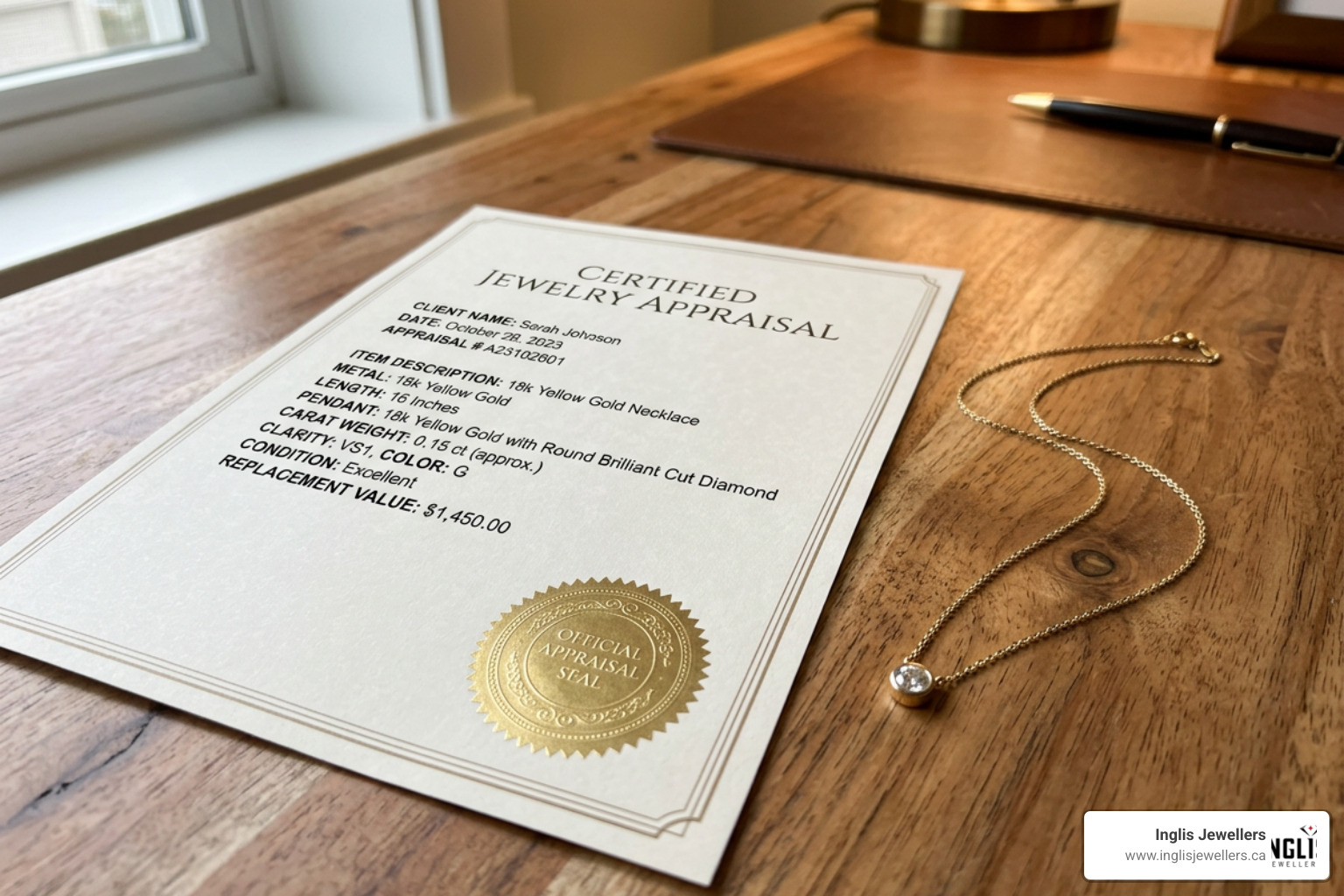
What is Included in a Professional Appraisal Report?
A complete, professional appraisal report is a multi-page document that should contain:
- A Detailed Description: The type of item, metal content, weight, settings, and overall craftsmanship.
- Gemstone Specifications: The exact measurements, weight, and quality grades of all stones.
- High-Resolution Color Photographs: Multiple angles showing the jewelry's condition and unique markings.
- The Valuation: The final estimated value, clearly stating the market market type (e.g., Retail Replacement Value).
- Appraiser's Signature and Credentials: The formal seal, signature, and professional affiliations of the gemologist who performed the work.
Frequently Asked Questions About Jewelry Appraisals
Are jewelry appraisals accepted by insurance companies and courts?
Yes, provided they are written by a qualified, credentialed appraiser and comply with USPAP standards. Insurance underwriters rely on these detailed documents to write policy riders, and courts use them as admissible evidence in probate, divorce, and estate settlements.
How much does a professional jewelry appraisal typically cost?
Fees generally range from $125 to $150 for the first item, with a discounted rate (often $50 to $75) for each additional piece appraised during the same session. Complex estate collections may be priced at an hourly rate.
How often should I have my jewelry appraisals updated?
We recommend updating your appraisals every 3 to 5 years. This ensures your coverage keeps pace with inflation and fluctuations in the precious metals market, preventing you from paying premiums on outdated values or being left short in the event of a claim.
Conclusion
Protecting your jewelry collection shouldn't feel like a chore. By choosing a qualified, credentialed expert at a trusted local store, you can secure your peace of mind while celebrating the beauty of your favorite pieces.
At Inglis Jewellers, we combine decades of trusted craftsmanship with complete, full-service support across Atlantic Canada. Whether you need a detailed valuation for a new custom piece, an update for your insurance provider, or professional repairs to restore an heirloom to its former glory, our team is here to help.
Ready to protect your valuables? Learn more about our Professional Diamond Jewellery Appraisals or visit us in Truro, New Glasgow, Sydney, or Riverview today!