


Why Jewellery Appraisals Matter More Than You Think
Jewellery appraisals are one of the most important steps you can take to protect the pieces you care about most.
Quick answer: A jewellery appraisal is a written document prepared by a qualified professional that describes a piece of jewellery in detail and states its value for a specific purpose — most commonly insurance coverage.
At a glance, here's what you need to know:
- What it is: A professional opinion of value, backed by physical inspection and gemological expertise
- Why you need one: To insure your jewellery at the right amount, settle estates, or document value for legal purposes
- How often to update it: Every 2–3 years, as gold and gemstone prices change regularly
- Who should do it: A qualified appraiser with recognized gemological credentials, such as a GIA Graduate Gemologist
- What it costs: Typically $75–$150+ per item, depending on complexity
Many people assume the receipt from their jewellery purchase is enough. It isn't. Market prices for gold, diamonds, and gemstones shift constantly — which means a piece bought years ago could be worth significantly more today. Without a current appraisal, you risk being underinsured and unable to fully replace what you've lost.
An appraisal is also a legal document. That means accuracy, credentials, and ethical standards all matter — not just the number at the bottom of the page.
What is a Jewellery Appraisal and What Are the Main Types?

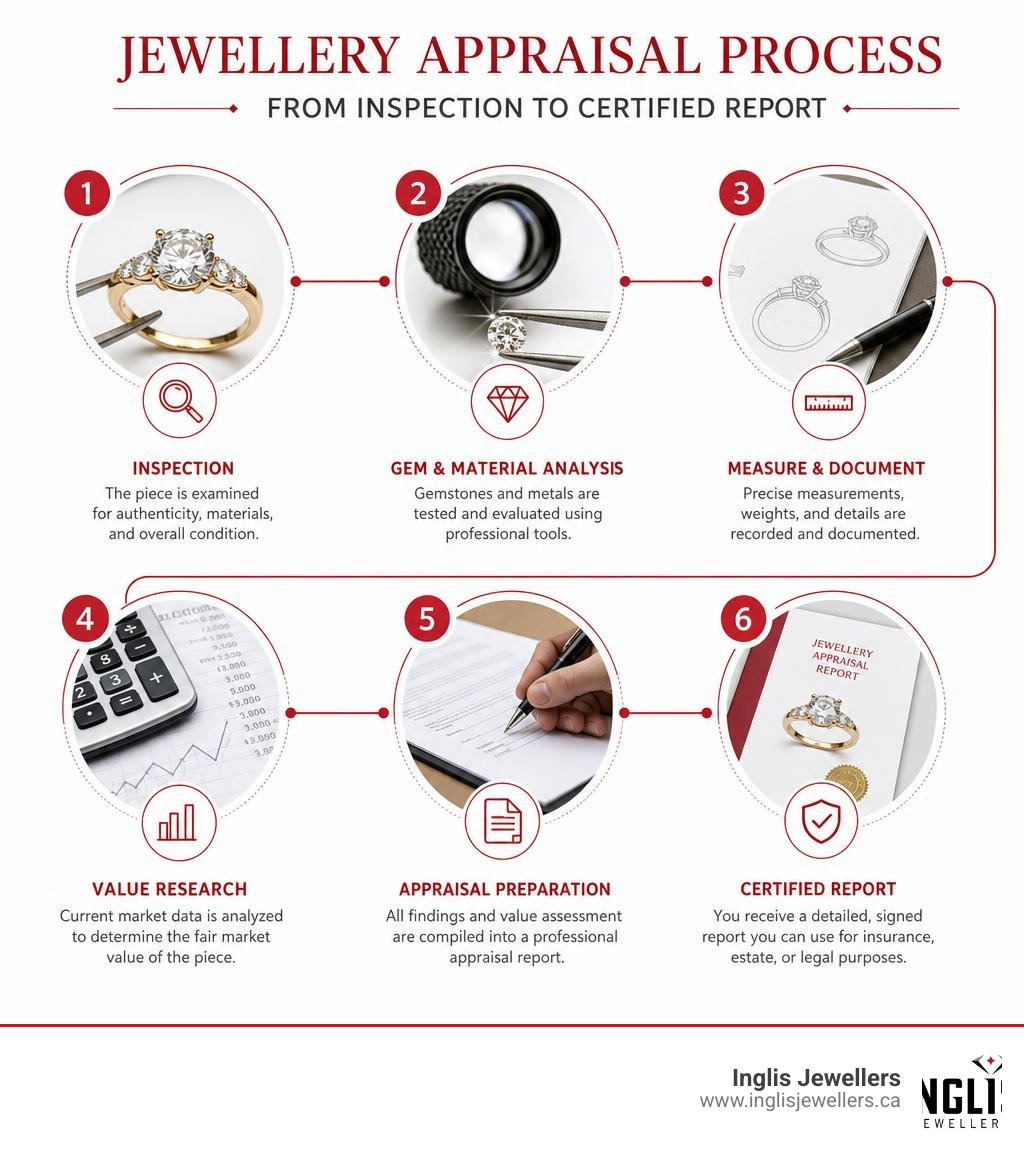
At its heart, a jewellery appraisal is a formal, legal document. It is not a casual guess or a verbal estimate scribbled on the back of a business card over a counter. It represents a professional, highly researched opinion of value based on a thorough physical inspection of your item.
When you bring an item in for valuation, a qualified gemologist uses specialized laboratory instruments—such as binocular microscopes, refractometers, polariscopes, and digital millimeter gauges—to analyze the physical, measurable, and analyzable facts of your jewellery. They will evaluate everything from the metal purity and weight to the specific optical properties of the set gemstones.
To help you understand how different scenarios require different types of valuations, we have summarized the three primary types of appraisals in the table below:
| Appraisal Type | Primary Purpose | Valuation Basis | Typical Value Range |
|---|---|---|---|
| Insurance Replacement | Obtaining insurance coverage to replace a lost or stolen item with a brand-new equivalent. | Retail Replacement Value (current retail market prices at fine jewellery stores). | Highest (reflects retail prices, including manufacturing and retail markup). |
| Fair Market Value | Estate tax settlement, equitable distribution (divorce), or charitable donation tax receipts. | What a willing buyer and seller would agree on in an open, non-forced market. | Medium (reflects used or secondary market condition). |
| Liquidation Value | Rapid cash conversion, bankruptcy, or immediate probate settlement. | Immediate cash value under forced, time-sensitive sale conditions. | Lowest (often scrap metal value plus wholesale gemstone value). |
Understanding the Purpose of Jewellery Appraisals
Why do you need to define the purpose of your appraisal before the gemologist even picks up their loupe? Because the purpose directly dictates the valuation methodology used.
If you are looking to protect your favorite heirloom against theft or loss, you need an insurance replacement appraisal. This ensures that if the worst happens, your insurance payout will cover the cost of recreating or purchasing a brand-new equivalent at current retail prices. For those looking to secure their assets, we provide detailed professional diamond jewellery appraisals designed to satisfy the strict requirements of major Canadian insurance providers.
On the other hand, if you are managing family assets, settling an estate, or planning for the future, you need a document that reflects real-world secondary market values rather than retail replacement costs.
Jewellery Appraisal vs. Gemstone Grading Report
It is incredibly common for consumers to confuse a jewellery appraisal with a gemstone grading report (often referred to as a "GIA certificate"). However, these two documents serve entirely different functions:
- Gemstone Grading Report: Issued by an independent gemological laboratory (such as the Gemological Institute of America). It is a scientific assessment of an unmounted stone’s quality. It details the "4 Cs" (Carat, Color, Cut, and Clarity) but never includes a dollar value.
- Jewellery Appraisal: Evaluates the entire, finished piece of jewellery (including the metal mounting, accent stones, craftsmanship, and design). It takes the quality data from a grading report and translates it into a current financial value based on market research.
Knowing the exact specifications of your stone is critical to determining its price. For example, if you are evaluating a larger stone, understanding how minor clarity and color differences impact the overall cost is essential—as we explain in our guide on the 3 Carat Diamond Ring Price.
Insurance Replacement, Fair Market, and Liquidation Appraisals
Let's dive a bit deeper into these three categories because choosing the wrong one can have serious financial or legal consequences.
- Insurance Replacement Value: This is the most common appraisal type. It represents the cost to replace the item with a new one of like kind and quality in the retail market. Because it covers retail markups, manufacturing labour, and local taxes, this value is almost always higher than what you could sell the item for on the street. It is the gold standard for protecting items like a newly purchased engagement ring. If you are curious about how these retail values are calculated for popular sizes, check out our breakdown of the 2 Carat Diamond Ring Price.
- Fair Market Value (FMV): The law defines FMV as the price that a willing buyer and a willing seller would agree upon, with neither being under any pressure to buy or sell, and both having reasonable knowledge of the facts. This is used for estate tax calculations and charitable donations. If you are donating a piece of jewellery valued at over $5,000, tax authorities typically require an IRS- or CRA-compliant Fair Market Value appraisal.
- Liquidation Value: This is the "I need cash by tomorrow afternoon" value. It reflects what a pawnbroker, gold buyer, or liquidator will pay for the raw materials (metal and stones) under forced-sale conditions. If you are tracking the raw material value of your heavier gold pieces, you can keep an eye on current precious metal trends and the 22k Gold Ring Price to understand how gold spot prices influence these baseline values.
What to Expect in a Professional Valuation Report
A professional appraisal is a comprehensive multi-page document. If your appraiser hands you a single slip of paper with a brief description and a dollar sign, you have not received a professional appraisal.
According to professional standards, a complete appraisal report must include:
- The date of the valuation and the date of the physical inspection.
- The name and contact information of the client.
- A clearly stated purpose of the appraisal (e.g., "For Insurance Replacement Purposes Only").
- A detailed description of the item, including metal type, weight, and fabrication method.
- Precise measurements and quality grades of all set gemstones.
- The type of equipment used during the testing process.
- The appraiser's signature, credentials, and professional affiliations.
For a deeper look into what makes an appraisal document legally and financially sound, you can refer to the official GIA Guide to Jewelry Appraisals.
Key Elements of a Certified Valuation Report
To protect you in the event of an insurance claim, the description of your jewellery must be so detailed that a skilled goldsmith could recreate the exact piece from the text alone.
Because gemstones are already set into mountings during an appraisal, the appraiser must use mathematical formulas to estimate the weight of the stones based on their external dimensions. This is a standard practice known as "weight estimation under limiting conditions," and it must be clearly disclosed in the report. Additionally, the document should feature high-resolution, clear photographs of the item from multiple angles to prove its physical condition at the time of the appraisal. Organizations like the American Gem Society Appraisal Standards emphasize that these physical details are non-negotiable for a certified report.
Legal and Ethical Standards in Jewellery Appraisals
To ensure your appraisal is accepted by insurance companies, courts, and tax authorities, the appraiser must adhere to strict ethical and professional standards:
- USPAP Compliance: The Uniform Standards of Professional Appraisal Practice (USPAP) are the widely accepted ethical and performance standards for the appraisal profession. A compliant report guarantees an unbiased, objective evaluation.
- FTC Guidelines: The Federal Trade Commission (and Canadian consumer protection laws) strictly prohibit the intentional over-valuation of consumer goods. Over-valuing an item to make a customer "feel good" is not only unethical; it is illegal.
- Avoiding Over-Valuation: Some disreputable sellers provide inflated appraisals to make a sale look like a bargain. This is a trap! If a $2,000 ring is appraised at $10,000, you will pay bloated insurance premiums for years, but your insurance company will only pay out the actual cost to replace the $2,000 ring if it is lost.
- Sales Tax Separation: A professional appraisal should clearly list the valuation of the item itself and state whether local sales taxes (such as HST in Nova Scotia and New Brunswick) are included or excluded from the final replacement estimate.
How to Choose a Trustworthy Appraiser and What It Costs

Finding the right person to appraise your jewellery is critical. In Canada and the United States, there are currently no federal laws or government regulations that mandate who can call themselves a "jewellery appraiser." Technically, anyone with a business card can claim the title.
Therefore, the responsibility falls on you to verify their credentials. You want to look for an appraiser who is independent of the transaction (meaning they aren't trying to buy the piece from you or sell it to you) and who holds recognized, verified credentials.
Credentials and Qualifications to Look For
When vetting an appraiser, treat it like a job interview. You should look for two distinct types of training:
- Gemological Credentials: This proves they can accurately identify and grade diamonds and gemstones. The gold standard is a Graduate Gemologist (G.G.) diploma from the Gemological Institute of America (GIA), or a Fellow of the Gemmological Association of Great Britain (FGA).
- Appraisal-Specific Credentials: Gemology is the science of identifying stones, but appraising is the business of valuation. An appraiser must be trained in market research, valuation theory, and legal standards. Look for memberships in respected professional organizations such as the National Association of Jewelry Appraisers (NAJA). These organizations require their members to take continuing education courses and strictly adhere to code-of-ethics standards.
Appraisal Costs and the Reality of Online Appraisals
How much should a professional appraisal cost? Typically, you can expect to pay a flat fee per item, usually ranging from $75 to $150+ depending on the complexity of the piece (a simple gold band vs. an antique tiara set with dozens of accent stones).
Crucial Tip: Never work with an appraiser who charges a fee based on a percentage of the appraised value. This is a massive conflict of interest, as it incentivizes them to inflate the value of your jewellery to increase their own payday. Always insist on a flat, per-item fee or a transparent hourly rate.
In our digital age, online appraisal services have grown in popularity, with some platforms boasting over 41,000 completed digital evaluations. While these services can be incredibly fun and useful for satisfying your curiosity, getting a quick market estimate, or deciding whether an inherited piece is worth a trip to a physical store, they have significant limitations.
A remote evaluation based on uploaded photos cannot verify metal purity, detect laser-drilled clarity enhancements, or separate natural diamonds from lab-grown synthetics. Because of these "limiting conditions," remote online appraisals are almost never accepted by major insurance companies for formal coverage. For real peace of mind, there is simply no substitute for an in-person, hands-on scientific examination.
Frequently Asked Questions about Jewellery Appraisals
How often should I update my jewellery appraisal?
We recommend updating your jewellery appraisals every 2 to 3 years.
Precious metal and gemstone markets are highly volatile. If you bought a piece five years ago, the cost of gold and diamonds may have risen significantly since then. If your appraisal is outdated, you are likely underinsured, meaning your policy won't cover the full cost of replacing your item at 2026 retail rates.
Insurance companies themselves typically ask their policyholders to submit updated valuations every 3 to 5 years to maintain active coverage. Keeping your appraisals current is especially important for classic, metal-heavy designs like Yellow Gold Eternity Bands, where the total value is heavily tied to the fluctuating spot price of gold.
Can I get an appraisal for antique or modified jewellery?
Absolutely! Appraising antique, vintage, or heirloom jewellery requires an appraiser with a deep understanding of historical manufacturing techniques, old-cut diamonds (such as Old Mine or European cuts), and historical provenance.
When appraising older items, the appraiser will also assess the wear and tear on the piece. If an heirloom is structurally compromised, they may recommend specific Antique Jewellery Repair services to secure the stones before issuing the final valuation. This ensures your treasured family history remains safe and wearable for generations to come.
Do I need an appraisal for custom or personalized jewellery?
Yes, custom-designed and personalized pieces absolutely require professional appraisals. Because these items are unique, there is no "standard retail price tag" for an insurance company to reference.
Whether you own a highly unique, modern custom piece or a sentimental, personalized item like a Custom Handwriting Necklace options or custom 14k Gold Handwriting Jewelry, a certified appraisal is the only way to document the exact weight of the gold, the quality of the engraving, and the custom craftsmanship required to recreate your personalized treasure from scratch if it is ever lost.
Conclusion
Getting your jewellery appraised is about more than just finding out "what it's worth." It is about protecting your hard-earned investments, preserving your family's history, and ensuring that your most cherished possessions are fully secured against the unexpected.
At Inglis Jewellers, we bring trusted Canadian craftsmanship and full-service support directly to you. With convenient showroom locations across Nova Scotia and New Brunswick—including Truro, New Glasgow, Riverview, and Sydney—our team of experts is here to help you navigate the appraisal process with total transparency, honesty, and professional care.
Don't wait until it is too late to find out if your coverage is up to date. Protect your treasures and Schedule your professional jewellery appraisal today with our friendly team.