


What Is a Mother-of-Pearl Dial — and Why Does It Matter?
A mother of pearl dial is one of the most distinctive and naturally beautiful materials used in watchmaking today. Cut from the iridescent inner lining of mollusk shells, it transforms an ordinary watch face into something that genuinely shifts and shimmers as light moves across it.
Quick answer: Here's what you need to know at a glance:
| Question | Answer |
|---|---|
| What is it made from? | The inner nacre layer of oyster or abalone shells |
| What makes it special? | Natural iridescence that shifts color with light and angle |
| Is every dial the same? | No — each dial is completely unique |
| Which brands use it? | Rolex, Longines, Baume & Mercier, and many others |
| Is it durable? | Yes, when protected under sapphire crystal |
| Who is it for? | Originally women's watches, now widely unisex |
No two mother-of-pearl dials are ever identical. The natural patterns, color intensity, and shimmer vary from shell to shell — and even from one part of the same shell to another. That means the watch on your wrist is, in a very real sense, one of a kind.
This guide covers everything: how these dials are made, why luxury brands prize them, how to care for them, and what to look for when buying. Whether you're considering your first mother-of-pearl timepiece or simply want to understand what makes them special, you're in the right place.
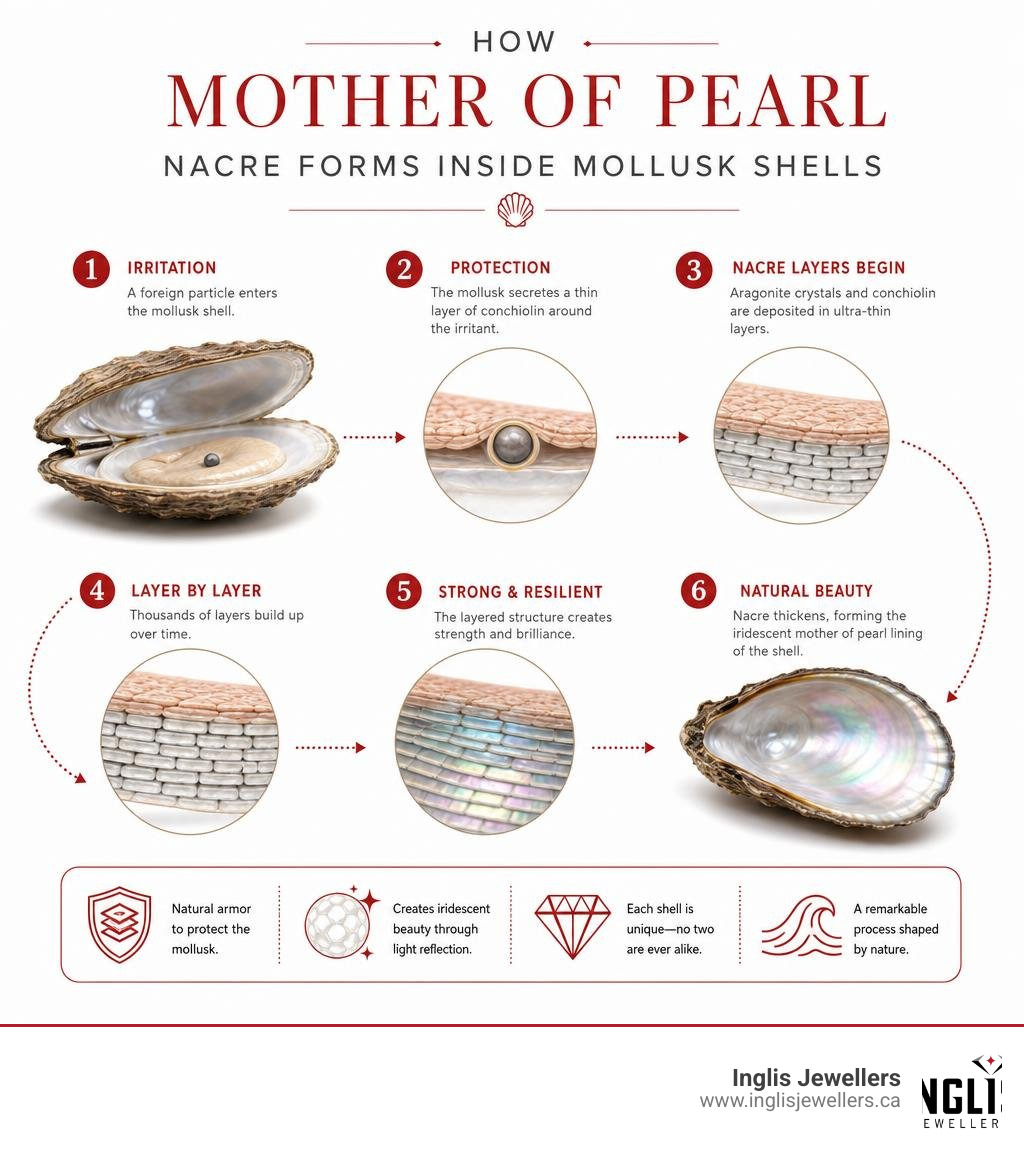
The Art and Science Behind the mother of pearl dial
To truly appreciate a mother of pearl dial, it helps to understand the incredible journey it takes from the ocean floor to the display case of your local jeweler. It is a meticulous blend of marine biology and high-precision micro-engineering.

At its core, mother-of-pearl is not a stone or a metal; it is an organic-inorganic composite material created by biology. To understand the technical details of how watchmakers manipulate this organic material, you can explore Horopedia's guide to mother-of-pearl dials.
The Natural Origin of Nacre
Often referred to by its scientific name, nacre, mother-of-pearl is the iridescent inner lining found inside the shells of certain mollusks, primarily oysters, abalone, and pearl mussels.
When a foreign irritant enters a mollusk's shell, the animal protects itself by depositing microscopic layers of calcium carbonate (specifically aragonite, a mineral) bound together by an organic matrix of proteins and chitin. This is the exact same substance that forms pearls. Over several years, these microscopic, brick-like layers build up, creating a smooth, lustrous surface designed to protect the mollusk's soft tissue.
Because it is grown organically rather than mined like traditional gemstones, nacre serves as a spectacular, sustainable gemstone alternative in the luxury world. It offers a level of depth, warmth, and luster that synthetic plastics or printed metals simply cannot replicate.
Precision Cutting and Crafting a mother of pearl dial
Working with raw nacre is an exercise in extreme patience. The material is notoriously brittle, fragile, and prone to cracking under the slightest pressure.
To create a dial, specialized artisans must carefully slice the shell's inner layer. In high-end watchmaking, mother-of-pearl dials are typically cut to a razor-thin thickness between 0.20 mm and 0.40 mm. This delicate slice is then bonded to a sturdy metal base plate, usually made of brass or gold, bringing the total dial thickness to about 0.80 mm.
Alternative manufacturing techniques involve crushing the high-quality shell into a fine paste and shaping it into ultra-thin discs as thin as 0.20 mm before polishing. However, the most coveted luxury dials are cut directly from a single, solid piece of shell using CNC machining or ultra-precise lasers.
Once cut, the dial undergoes a series of finishing steps:
- Polishing: The surface is buffed using progressively finer compounds to reveal its natural luster.
- Color Enhancement: While many watchmakers prefer the raw, natural look, mother-of-pearl can be painted or varnished on the reverse side to alter or enhance its natural color, allowing shades of deep blue, green, or red to shine through the translucent nacre.
- Engraving: The material is strong enough to handle delicate hand engraving or mechanical guilloché work, adding geometric textures to the organic shimmer.
For a deeper dive into how this material behaves under the watchmaker's tools, check out Barrington Watch Winders' analysis of mother-of-pearl.
Custom customizers and modding enthusiasts also highly value this material. For instance, builders often seek out specialty components like the Mother of Pearl Swarovski Dial — Natural (Day-Date) | Seiko Mod | Lucius Atelier or the Mother of Pearl Diver's Dial (No Date) | Lucius Atelier to create bespoke, high-character timepieces.
Why Luxury Watchmakers Value Mother-of-Pearl
For centuries, luxury watchmakers have turned to mother-of-pearl to elevate their designs. It is a material that bridges the gap between high-precision timekeeping and fine jewelry.

The Unique Iridescence and Color Spectrum
The defining characteristic of a mother of pearl dial is its iridescence—the way it appears to change color when viewed from different angles. This visual phenomenon is caused by light waves reflecting off the microscopic, overlapping layers of aragonite. As light hits these structures, it scatters and diffracts, splitting into a rainbow spectrum of pinks, soft greens, pale blues, and warm yellows.
Depending on the species of mollusk and where the shell was harvested, mother-of-pearl naturally occurs in several distinct base hues:
- White Mother-of-Pearl: The most classic and common variety, prized for its clean, cloud-like white base and soft pink-and-green shimmer.
- Tahitian Black Mother-of-Pearl: Sourced from the black-lip oyster, this variety offers a dark, dramatic base with intense, oil-slick reflections of deep green, purple, and blue.
- Pink and Yellow Mother-of-Pearl: Rarer variations that offer warm, romantic, or golden tones.
Luxury brands like Rolex are famous for their strict quality standards, ensuring their dials are never artificially colored, preserving the original, natural hues of the shell. A prime example of this natural elegance can be seen in the Rolex Lady-Datejust, which showcases how natural white mother-of-pearl pairs beautifully with diamonds and precious metals.
The History of the mother of pearl dial in Horology
The tradition of decorating timepieces with shell-based materials is deeply rooted in history. Mother-of-pearl has been used in watchmaking since at least the early 19th century, with some of the earliest documented examples dating back to around 1812.
Historically, it was primarily used to decorate the cases and dials of luxury pocket watches owned by European royalty and high society. As wristwatches gained popularity in the early 20th century, mother-of-pearl became a staple of women's cocktail watches because of its delicate, jewelry-like shimmer.
However, as we look at the horological landscape in June 2026, those traditional gender boundaries have completely dissolved. Modern collectors appreciate the material for its organic complexity, leading to a massive surge in unisex and men's watches featuring mother-of-pearl dials. From high-end sports chronographs to rugged dive watches, the material is celebrated as wearable art for everyone.
To learn more about how this material transitioned from historical pocket watches to modern wrists, read Aquacy Watch's history of mother-of-pearl. You can also see how classic feminine design elements are still celebrated today in models like the Seagull Mother-of-Pearl Dial Elegant Watch or the Heartfelt Shimmering Mother-of-Pearl Dial Watch 34.5mm | Seagull Watch Official.
Durability, Care, and Comparison of Shell-Based Dials
Because mother-of-pearl is an organic material, buyers often worry about its long-term durability.
While raw nacre is indeed fragile and highly sensitive to impact and chemicals, once it is safely installed inside a watch case, it is incredibly well-protected. In a modern luxury watch, the dial is shielded by a scratch-resistant sapphire crystal and housed in a robust case, usually made of 316L stainless steel, titanium, or solid gold. This environment protects the delicate shell from physical shocks, dust, moisture, and everyday wear.
To help you decide if a shell-based dial is right for you, here is how mother-of-pearl compares to other popular exotic dial materials:
| Dial Material | Source | Visual Appearance | Rarity & Price | Care Considerations |
|---|---|---|---|---|
| Mother-of-Pearl | Organic mollusk shell | Soft, shifting iridescence; cloud-like textures | Moderate to High | Keep away from extreme heat and direct chemical exposure during servicing |
| Enamel | Fused silica glass powder | Deep, glassy, perfectly uniform color | High (requires intense handcraft) | Highly stable, but can crack if the watch suffers a massive, direct impact |
| Meteorite | Extraterrestrial iron-nickel | Metallic, geometric "Widmanstätten" patterns | Very High | Must be coated to prevent oxidation/rusting over time |
To keep your mother-of-pearl watch looking pristine, avoid leaving it exposed to intense, direct sunlight (UV rays) for weeks at a time, as extreme heat can theoretically dry out the organic proteins in the nacre. Additionally, if you ever need to have your watch serviced or polished, always trust a professional watchmaker who knows how to handle delicate materials without compromising the case seals.
Frequently Asked Questions About Mother-of-Pearl Watches
Are mother-of-pearl dials only for women's watches?
Absolutely not! While mother-of-pearl was historically marketed toward women, modern watch design has embraced its unisex appeal. Today, you will find stunning black and dark grey mother-of-pearl dials in rugged men's dive watches, chronographs, and luxury sports models. The organic, metallic-like sheen of dark nacre adds an incredible layer of depth to masculine designs without looking overly feminine.
How can you tell if a mother-of-pearl dial is real?
The easiest way to spot a genuine mother of pearl dial is to look at it under different lighting angles. Real mother-of-pearl has a three-dimensional depth; the colors should seem to float and shift within the material, not just on the surface. Fake dials (usually made of printed plastic or lacquer) look flat, have repeating patterns, and lack the organic, cloud-like imperfections that make real shell so captivating.
Do mother-of-pearl dials fade over time?
No. Because the iridescence of nacre is a structural color (caused by the physical shape of the aragonite layers refracting light) rather than a chemical pigment, it will not fade or wash out over time. As long as the dial is protected from extreme heat, moisture intrusion, and harsh chemicals by a sealed watch case, it will retain its beautiful shimmer for generations.
Conclusion
A mother of pearl dial is more than just a watch face; it is a miniature canvas of natural artistry. By combining the organic mystery of the ocean with the rigid precision of traditional horology, watchmakers create timepieces that are truly alive on the wrist, changing character with every tilt of your hand.
At Inglis Jewellers, we believe that a great watch should tell a story. Whether you are looking to purchase a brand-new heirloom or want to breathe new life into a treasured family piece, our expert team across Atlantic Canada is here to help. With locations in Truro, New Glasgow, Sydney, and Riverview, we provide trusted craftsmanship and complete support.
If you have a classic timepiece that needs expert attention, explore our professional watch restoration services or visit us in-store today to find a watch that reflects your own unique style.