


What Is the 1 Gram Gold Ring Price Right Now?
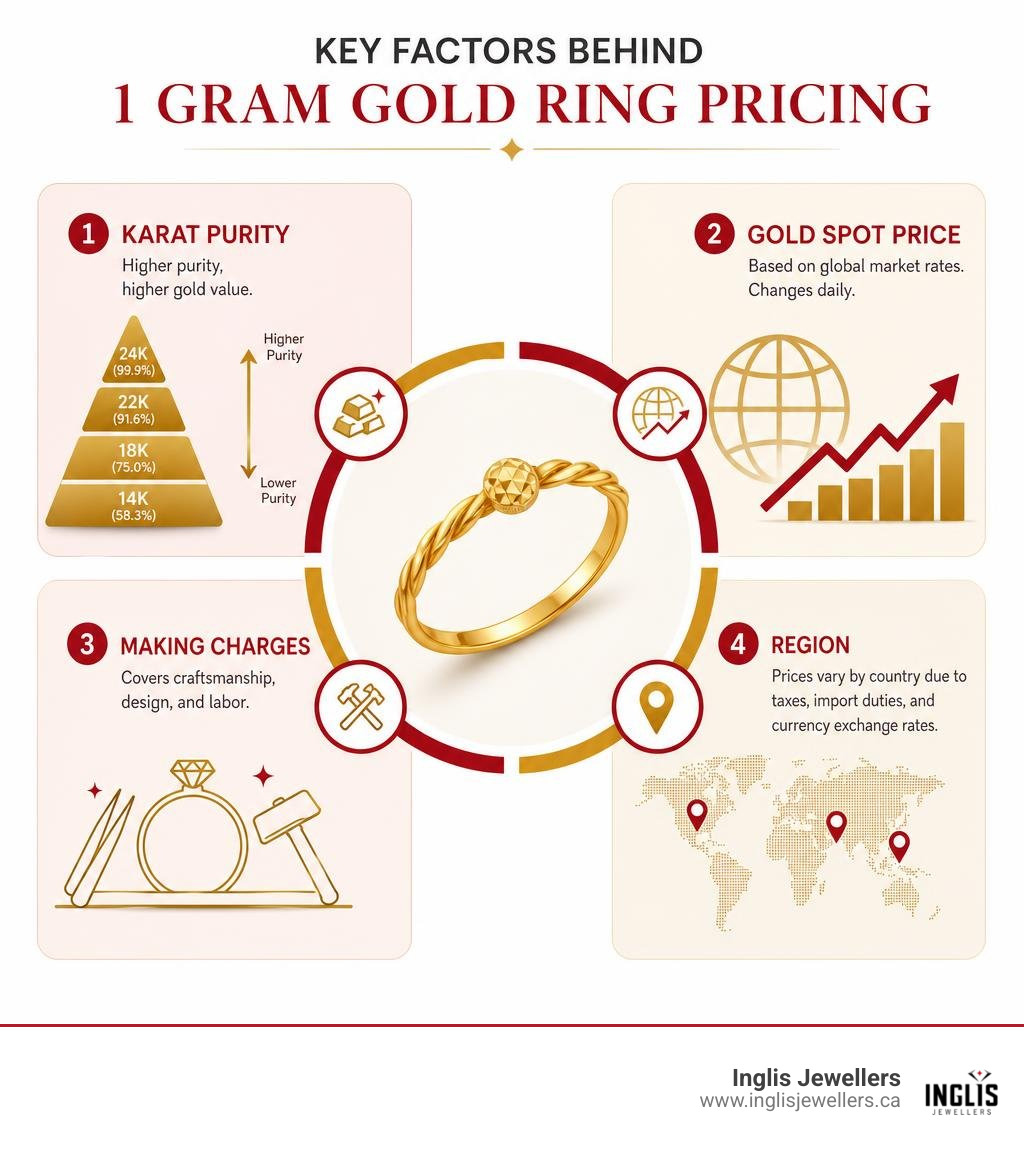
The 1 gram gold ring price depends on three things: the karat purity of the gold, where you're buying it, and the craftsmanship fees added on top of the raw metal value.
Here's a quick snapshot of what a 1 gram gold ring costs by karat, based on current market data (August 2026):
| Karat | Gold Purity | Approx. Melt Value (USD/gram) | Typical Retail Range (USD) |
|---|---|---|---|
| 24K | 99.9% | ~$130.42 | $140 – $170+ |
| 22K | 91.6% | ~$119.46 | $130 – $165+ |
| 18K | 75.0% | ~$97.91 | $110 – $145+ |
| 14K | 58.3% | ~$76.11 | $85 – $120+ |
Retail prices are always higher than melt value because they include making charges, design work, and retailer margin.
These numbers shift daily with the gold spot market. The retail price you see in a store will also vary by region — buyers in India, Pakistan, and Indonesia see very different price tags than shoppers in North America, largely due to local taxes, import duties, and currency exchange rates.
At Inglis Jewellers, we believe every buyer deserves clear, honest pricing and quality craftsmanship they can trust — and this guide walks you through everything you need to know before you buy.
What Determines the 1 Gram Gold Ring Price by Karat and Region?
Understanding how gold is priced requires looking under the hood of global financial markets and physical metallurgy. Gold prices are rooted in international spot rates, which are set on global exchanges like the London Bullion Market Association (LBMA) and COMEX in New York. These exchanges trade gold in troy ounces based on 24-karat (99.9% pure) fine gold.
To find the baseline value of a 1-gram gold piece, the international spot price per troy ounce is divided by 31.1035 (the exact number of grams in a troy ounce). However, gold rings are rarely crafted from pure 24K gold because pure gold is soft and malleable. Instead, goldsmiths blend pure gold with durable base metals like copper, silver, nickel, or zinc. This alloy creation alters both the structural resilience and the actual weight of pure gold present in the ring.
Calculating 1 Gram Gold Ring Price Across 24K, 22K, 18K, and 14K
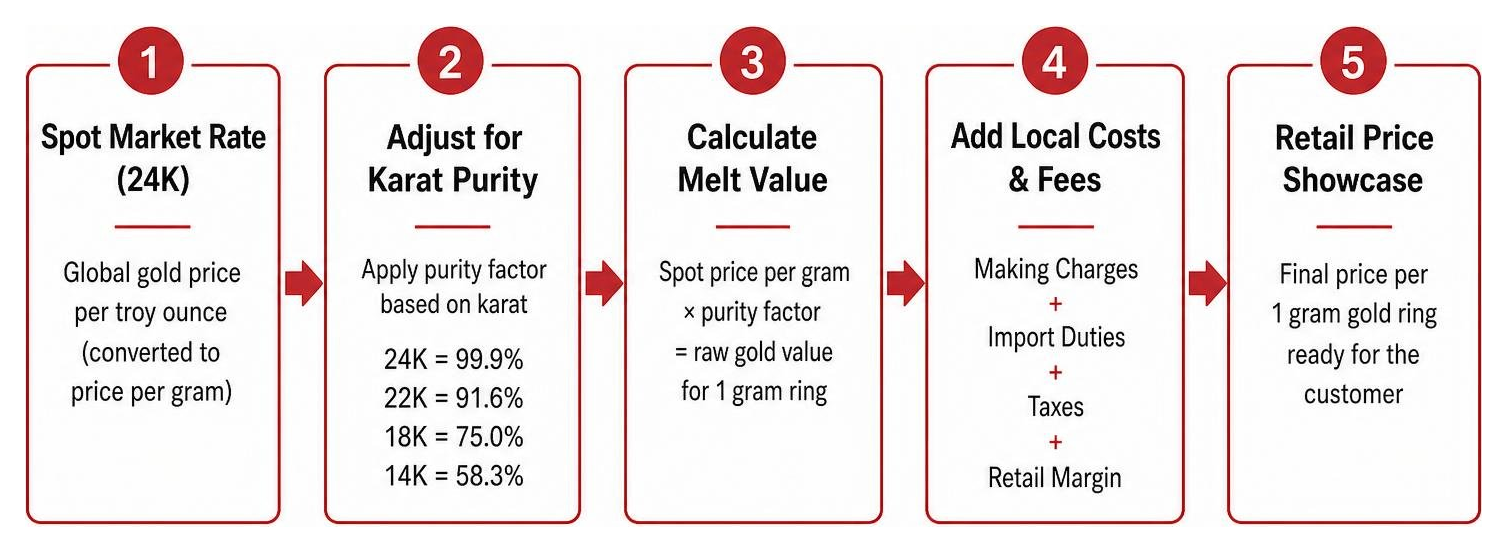
The purity of gold in any piece of jewellery is measured in karats out of a total of 24 parts. To calculate the raw gold value (often called the melt value) of a 1-gram ring, you multiply the live 24K spot price per gram by the percentage of pure gold contained in that specific karat rating.
You can check live reference benchmarks on tools like the Gold Price per Gram Today: 24K, 22K, 18K, 14K, 10K Live chart to see how spot prices fluctuate.
Here is how the numbers break down across the standard gold purities:
| Karat Rating | Hallmark Stamp | Pure Gold Percentage | Calculation Formula | Estimated Raw Gold Value (August 2026) |
|---|---|---|---|---|
| 24K | 999 | 99.9% | 1g × $130.42 × 0.999 | $130.42 USD |
| 22K | 916 | 91.6% | 1g × $130.42 × 0.916 | $119.46 USD |
| 18K | 750 | 75.0% | 1g × $130.42 × 0.750 | $97.91 USD |
| 14K | 58.3% | 58.3% | 1g × $130.42 × 0.583 | $76.11 USD |
| 10K | 417 | 41.7% | 1g × $130.42 × 0.417 | $54.44 USD |
When evaluating options in retail stores, higher karat numbers mean more gold content, but not necessarily a better ring for your daily needs. For example, checking the current 22k gold ring price shows a rich, warm tone, but a pieces styled as a 14k gold ring womens selection offers superior structural strength for everyday wear at a more accessible entry price.
Regional Market Differences: From North America to Asia
If you browse jewellery prices across international markets, you will notice significant variance in the quoted 1 gram gold ring price. This isn't because the fundamental value of gold changes from city to city, but rather due to local economic factors, trade policies, and cultural preferences.
In Asian markets such as India, Pakistan, and Indonesia, lightweight gold jewellery is bought both as personal adornment and as an accessible form of physical wealth accumulation. For instance, in Pakistan, raw 22K gold rates often hover around Rs. 33,841 per gram (as detailed in regional breakdowns like the Gold Ring Price in Pakistan: Mens & Womens Designs with Todays Rates – Gold Rates Pakistan guide). Meanwhile, Indonesian market updates from sources such as 1 Gram Gold Ring Price Today, May 18, 2026 - Pintu News show starting material prices for 1-gram rings around Rp1,800,000 to Rp2,320,056 depending on karat purity.
In North America—specifically across our local market here in Atlantic Canada—jewellery pricing incorporates different dynamics:
- Currency Exchange Rates: Spot prices are universally set in USD and must be converted into Canadian Dollars (CAD).
- Import Duties and Supply Chain Costs: Finished mountings, refined metal bullion, and settings imported into Canada incur transportation and customs clearance costs.
- Retail Standards: North American fine jewellery emphasizes 14K and 18K purities due to their balance of durability and lustre, whereas Asian markets heavily feature 22K and 24K pieces.
Key Factors Influencing the Final Retail Price of Lightweight Rings
A common point of confusion for ring buyers is the gap between the live spot market price of raw gold and the actual price tag on a finished ring inside a jewellery store display case. If 1 gram of 14K gold has a melt value of approximately $76 USD, why does a finished 1-gram 14K gold ring cost $110 USD or more?
The answer lies in the fabrication process. Transforming raw refined gold into an elegant, wear-ready ring requires specialized labor, artistic design, precision machinery, quality control, and retail operations.

Understanding Craftsmanship Fees and Making Charges
Craftsmanship fees—frequently called "making charges" in international markets—cover the skilled labor and overhead required to produce a piece of jewellery. Making charges are calculated in one of two ways:
- Percentage-Based Charges: A percentage (typically 8% to 25%) added to the raw gold value based on the intricate detail of the piece.
- Flat-Rate Charges: A fixed dollar amount applied per piece or per gram.
For ultra-lightweight items like a 1-gram gold ring, bench jewelers and manufacturers almost always use a flat-rate fee structure. Why? Because calculating a standard 10% making charge on a 1-gram band would only yield a few dollars—far below the actual labor cost required to melt, cast, file, size, polish, and hallmark a piece of fine jewellery.
As highlighted in technical updates like the Price of a 1 Gram Gold Ring Today report, crafting fees for simple 1-gram bands generally add a baseline labor markup regardless of whether the piece is plain or minimally textured.
Impact of Gemstones, Engravings, and Design Complexity
Beyond labor fees, design details directly impact final pricing:
- Gross Weight vs. Net Gold Weight: If a 1-gram ring features set gemstones, cubic zirconia, or pearls, you must determine whether the "1 gram" refers to the total weight of the ring (gross weight) or just the gold metal itself (net weight). High-end jewelers weigh and price the metal separately from the stones.
- Setting Style: Prong, bezel, or channel settings require hand-setting under microscope magnification, which adds to the finished bench fee.
- Surface Finishes and Engravings: Custom laser engravings, diamond-cut patterns, and intricate filigree work demand specialized equipment and precision craftsmanship, increasing the final retail markup over plain polished bands.
Popular Styles and Durability: 22K vs 18K vs 14K Gold
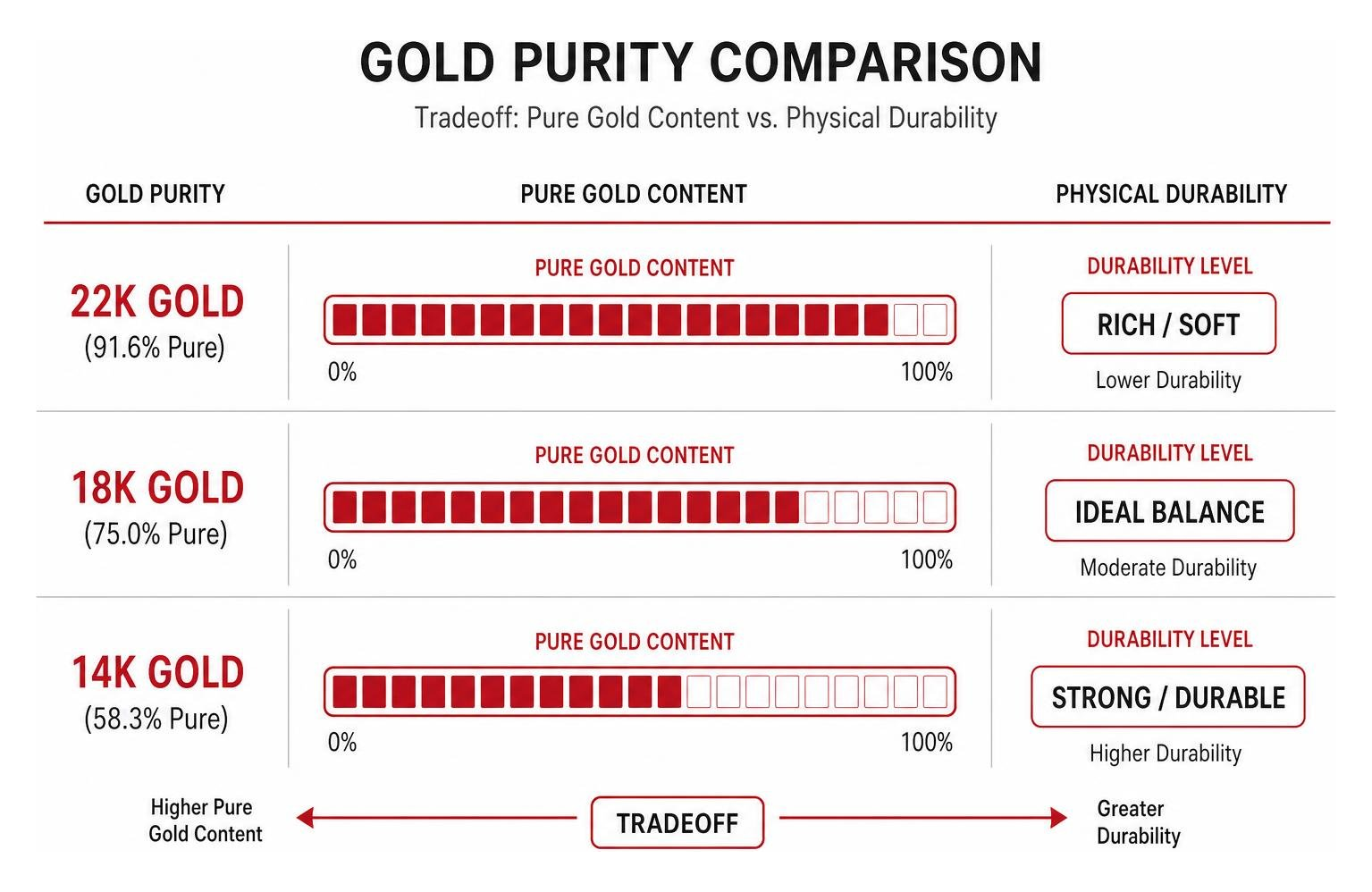
When shopping for a 1-gram gold ring, selecting the right karat purity involves balancing budget, color preference, and physical wearability. Because 1 gram is a very light weight for a finger ring, metal strength becomes a critical consideration.
Stacking Rings, Plain Bands, and Daily Wear Designs
Because a 1-gram gold ring contains a delicate volume of metal, goldsmiths design these pieces using specific structural profiles to maximize durability without adding extra weight.
Popular 1-gram gold ring design styles include:
- Ultra-Thin Stacking Bands: Delicate round or square wire bands designed to be worn in groups of two or three on a single finger.
- Beaded and Textured Wire Rings: Rings featuring diamond-cut beads or twisted rope textures that reflect light brilliantly while reinforcing structural rigidity.
- Minimalist Leaf and Nature Motifs: Petite open-ended or bypass rings with delicate leaf outlines that distribute weight efficiently across the band.
- Solitaire Accent Rings: Thin wire bands featuring a tiny bezel-set gemstone or accent stone.
- Signet and Initial Rings: Micro-signet styles with thin hollowed backs designed to present a wider top surface while keeping weight right at 1 gram.
If you are exploring gold ring options across heavier weight classes for comparison, take a look at our guide on choosing a 3 gram gold ring for gents to see how band thickness and structural reinforcement change as metal weight increases.
Durability vs Gold Content: Choosing the Right 1 Gram Gold Ring Price Point
Pure gold is naturally soft. When reduced to a slender 1-gram profile, higher karat metals behave very differently than lower karat alloys:
- 22K Gold (91.6% Pure): Has an unmistakable, deep yellow lustre and high intrinsic metal value. However, a 1-gram 22K ring is soft. Under everyday pressure—such as gripping a steering wheel, carrying heavy grocery bags, or lifting gym weights—a thin 22K band can bend out of round easily.
- 18K Gold (75.0% Pure): Contains 25% alloy metals (typically copper, silver, or palladium). This provides a rich golden hue while dramatically improving rigidity. It is a preferred choice for fine designer stackers that need to hold their shape better than 22K pieces, as discussed in analyses like How Much 18k Gold Ring Worth Our Detail Summary.
- 14K Gold (58.3% Pure): Blended with 41.7% alloy metals, 14K gold offers excellent tensile strength and scratch resistance. For a 1-gram everyday ring, 14K gold provides optimal structural integrity, ensuring the ring maintains its circular shape over years of continuous wear.
How to Calculate Melt Value and Avoid Common Buying Mistakes
Whether you are shopping online or visiting a retail showroom, knowing how to calculate metal values empowers you to shop smart, ask the right questions, and avoid overpaying.
Converting Troy Ounces to Grams and Spot Rate Formulas
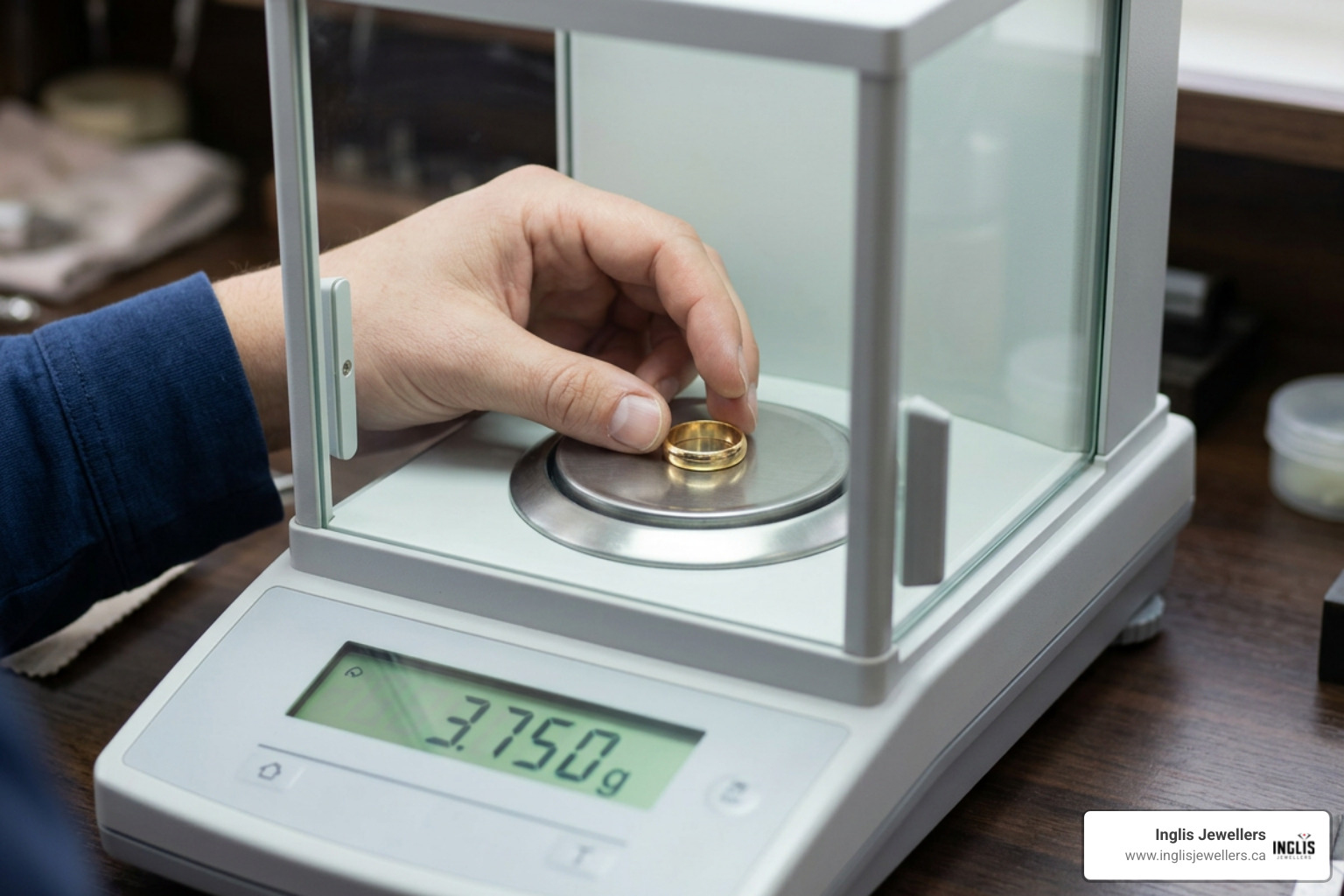
To calculate the raw metal value of any gold item, follow this step-by-step mathematical conversion:
- Find the Live Spot Price: Locate the current 24K spot price per troy ounce in your local currency (e.g., $4,056.50 USD or ~$5,480 CAD).
- Convert to Price Per Gram: Divide the troy ounce spot price by 31.1035. $$\text{Price per Gram (24K)} = \frac{\text{Spot Price per Troy Ounce}}{31.1035}$$ Example: $\$4,056.50 \div 31.1035 = \$130.42\text{ USD per gram}$
- Multiply by Karat Purity Percentage: Multiply the 24K price per gram by the gold decimal purity (0.750 for 18K, 0.583 for 14K). Example (14K): $\$130.42 \times 0.583 = \$76.11\text{ USD per gram}$
- Multiply by Net Gold Weight: Multiply by the net weight of gold in grams (in this case, 1 gram).
Reference tools such as How Much is 1 Gram of Gold Worth? provide real-time valuation updates. If you are interested in exploring lightweight physical gold in other forms, review our breakdown of the 1 gram gold coin price to compare bullion pricing against finished jewellery markups.
Pitfalls to Avoid: Weight vs Purity and Unmarked Metals
When evaluating lightweight gold items, watch out for these common buyer pitfalls:
-
Confusing Gold Filled or Plated with Solid Gold: Terms like "1 Gram 18K Gold Plated" or "1 Gram Gold Polish" mean the ring is made of brass, copper, or silver with a microscopically thin flash layer of gold on top. Solid gold rings are solid precious metal throughout. Always look for official hallmark stamps inside the band:
- 999 or 24K
- 916 or 22K
- 750 or 18K
- 585 or 14K
- 417 or 10K
- Ignoring Net vs. Gross Weight: Ensure the jeweller deducts stone weights when calculating gold values. You should never pay fine gold per-gram prices for non-precious accent stones or empty hollow spaces.
- Unclear Making Charges: Request an itemized invoice detailing the exact net gold weight, the applied per-gram gold market rate, and the making fee.
- Skipping Professional Verification: Reputable jewellers use X-ray Fluorescence (XRF) testing or precision scale verification to verify purity without damaging the piece. For detailed advice on navigating trade-ins and evaluations, explore our comprehensive guide on gold buying.
Frequently Asked Questions About Lightweight Gold Rings
Can a 1 gram gold ring be worn daily without bending?
Yes, provided you choose the right karat purity and band profile. A 1-gram ring in 14K gold with a rounded wire profile or comfort-fit shape holds up well to daily wear. However, 22K or 24K 1-gram rings are significantly softer and can warp if worn during heavy physical tasks, heavy lifting, or manual work.
Why is retail price significantly higher than live melt value?
The live spot price reflects raw, unrefined gold bullion traded in large quantities on commercial markets. Transforming raw metal into a finished ring involves refining, alloy blending, precision casting, stone setting, polishing, hallmarking, shop maintenance, and jeweler expertise. The retail price reflects the full value of a finished piece of wearable art, not just scrap metal.
Is a 1 gram gold ring a good financial investment?
If your primary goal is financial investment or capital preservation, buying 1-gram physical bullion bars or coins is generally more efficient because they carry lower markup premiums than finished jewellery. A 1-gram gold ring should be bought primarily for its aesthetic beauty, personal enjoyment, and gift value, with its scrap gold metal content acting as a stable baseline store of underlying value.
Conclusion
Finding the right 1 gram gold ring price comes down to understanding how gold karat, weight, making charges, and retail craftsmanship work together. Whether you're selecting a subtle 14K daily stacking band or admiring a rich 22K piece, knowing the math behind raw melt values and bench fees ensures you buy with complete confidence.
At Inglis Jewellers, we take pride in offering transparent pricing, expertly crafted fine jewellery, and custom goldsmithing services tailored to your style and budget. Visit our showrooms in Truro, New Glasgow, Sydney, or Riverview, or explore our online collection today.
Want to learn more about selecting the perfect ring? Read our full ultimate gold ring guide 2026 for expert advice on sizing, karat selection, and long-term care!