


Why the 1 Gram Gold Coin Price Matters for Smart Buyers
The 1 gram gold coin price is one of the most searched terms by new gold buyers — and for good reason. A single gram is the most accessible way to own physical gold.
Here's a quick answer if that's all you need:
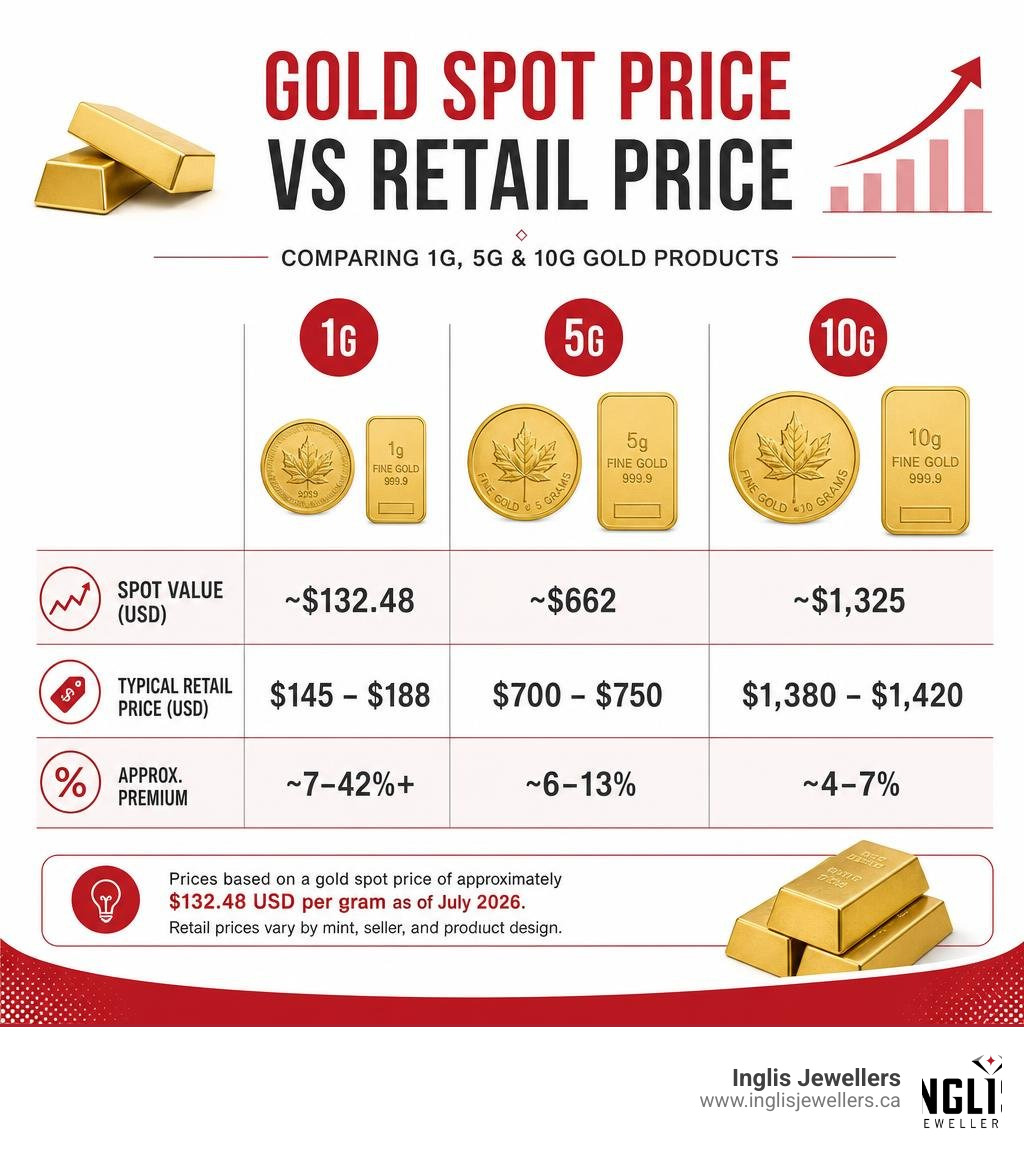
| Weight | Spot Value (USD) | Typical Retail Price (USD) | Approx. Premium |
|---|---|---|---|
| 1 gram | ~$132.48 | $145 – $188 | ~7–42%+ |
| 5 gram | ~$662 | $700 – $750 | ~6–13% |
| 10 gram | ~$1,325 | $1,380 – $1,420 | ~4–7% |
Prices based on a gold spot price of approximately $132.48 USD per gram as of July 2026. Retail prices vary by mint, seller, and product design.
So why do so many buyers start here? Because a 1 gram gold bar or coin costs roughly $145 to $188 USD at retail — an amount almost anyone can afford. Compare that to a full troy ounce at over $4,100 USD, and the appeal is obvious.
But there's a catch. Smaller gold products carry higher premiums over spot price. A 1 gram bar can carry a premium of 7% or more, while a 0.5 gram bar can run over 50% above spot. The smaller the piece, the more you pay per gram relative to gold's actual market value.
This guide breaks down exactly how those prices are set, which products offer the best value, and how 1 gram gold compares to 5 gram and 10 gram options — so you can make a confident, informed purchase.
Understanding the 1 Gram Gold Coin Price and Market Premiums
To understand why the 1 gram gold coin price behaves the way it does, we first have to separate the "spot price" of gold from its "retail price."
The spot price is the current market price at which one troy ounce of raw, unrefined gold trades on global commodities exchanges like the COMEX or through London Bullion Market Association (LBMA) electronic auctions. It fluctuates constantly from Sunday night to Friday afternoon, reacting to global economic factors, inflation, central bank moves, and geopolitical events.
To track these movements in real-time, investors look at resources like the Gold Price Per Gram | Current Gold Gram Price | BullionVault or monitor the Live Gold Price Per Gram | FindBullionPrices.com .
As of July 2026, the spot price of gold sits at an impressive $132.48 USD per gram (which translates to roughly $4,120.67 USD per troy ounce). This is part of a massive long-term upward trend. In fact, gold hit a spectacular record high of $5,602.22 USD per troy ounce on January 28, 2026! Over the long haul, gold has delivered an average annual rate of return of around 7.78% to 8% since 1971, proving its worth as a reliable store of value.
However, you cannot walk into a shop in Truro, New Glasgow, Sydney, or Riverview and buy a physical 1 gram gold coin for exactly $132.48 USD. Physical gold carries a retail premium—an additional charge added to the spot price to cover the real-world expenses of turning raw metal into a beautifully minted, securely packaged product.
How is the 1 gram gold coin price calculated?
Because gold is globally traded in troy ounces, finding the baseline value of a single gram requires a tiny bit of math.
A standard troy ounce is exactly 31.1035 grams (slightly heavier than a standard "grocery store" ounce, which is 28.35 grams). To find the melt value of a single gram of gold, we use this simple formula:
$$\text{Price per Gram} = \frac{\text{Gold Spot Price per Troy Ounce}}{31.1035}$$
You can check this conversion instantly using tools like the Gold Price per Gram - 1g Gold Price Charts or see current retail estimates on How Much is 1 Gram of Gold Worth? .
For Canadian investors visiting our showrooms in Nova Scotia or New Brunswick, there is an extra step: currency conversion. Since global gold spot prices are established in US Dollars (USD), local dealers must convert that price into Canadian Dollars (CAD) using the current exchange rate. Keeping track of the daily USD to CAD exchange rate is incredibly useful for regional buyers looking to calculate the exact local value of their gold.
Once you have the baseline Canadian spot value, you add the retail premium to arrive at the final purchase price.
Why does the 1 gram gold coin price carry a higher premium?
It might seem unfair that a 1 gram gold bar or coin has a higher markup percentage than a 100 gram bar, but it comes down to basic manufacturing and distribution economics.
Think of it like buying laundry detergent. A giant wholesale bucket of detergent is much cheaper per wash than a tiny, travel-sized bottle.
The physical cost to refine, mint, stamp, inspect, package, and ship a 1 gram gold coin is virtually identical to the cost of producing a 10 gram or even a 100 gram bar. The mint still has to pay for the artistic design, the heavy machinery, the assay card packaging, and secure, insured transport.
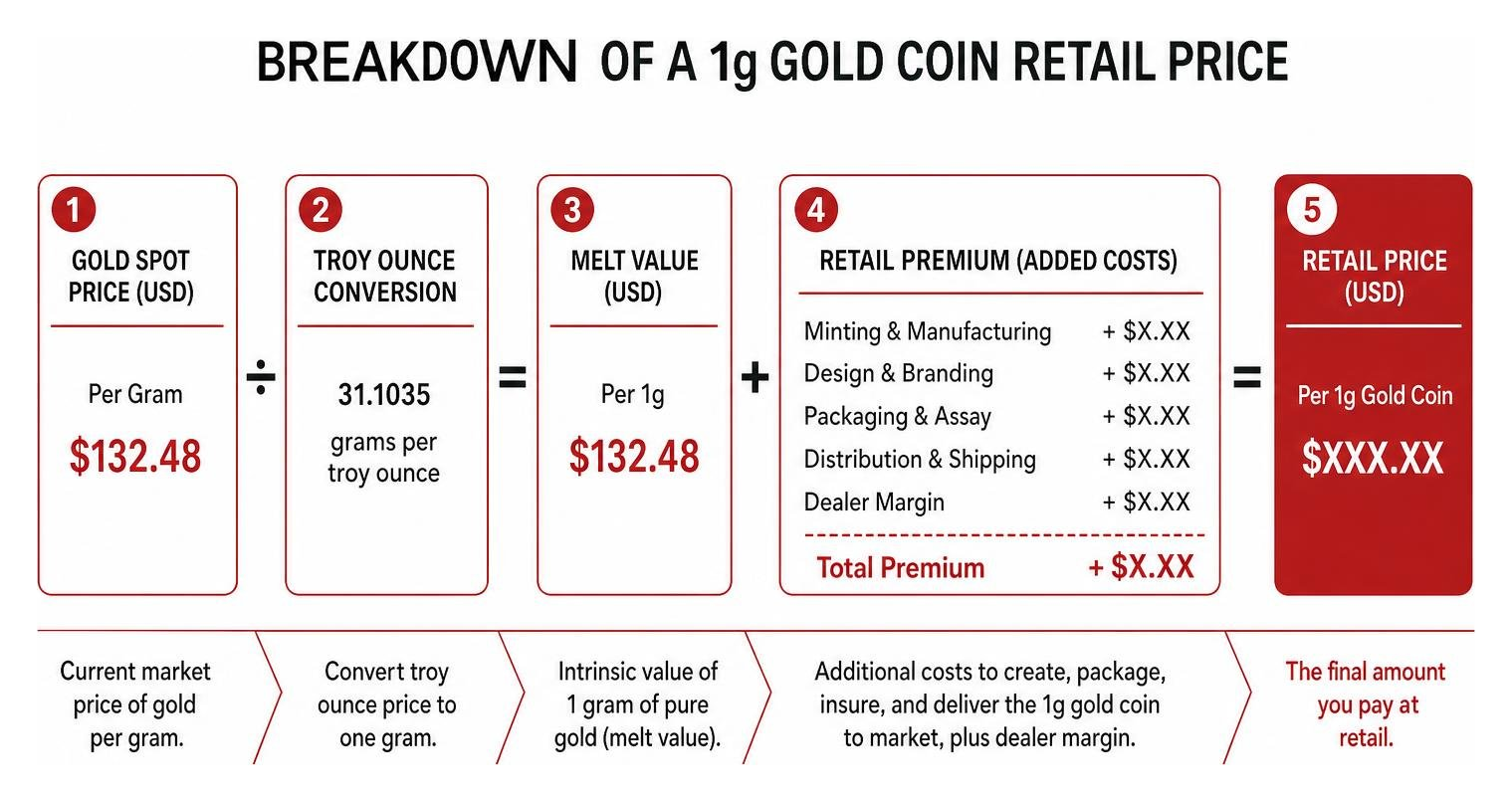
When those fixed manufacturing and handling costs are applied to a tiny 1 gram piece, they make up a much larger percentage of the total price. Retail prices for 1 gram gold bars typically start with a baseline premium of at least 7.67% over the spot price, but specialty designs, collectible coins, or low-mintage runs can push those premiums much higher—sometimes past 40%.
Comparing Small Gold Weights: 1g vs. 5g vs. 10g
If you are trying to get the most physical gold for your hard-earned money, comparing different small weights is essential. While 1 gram gold products are highly accessible, stepping up to a 5 gram or 10 gram bar can significantly lower the premium you pay per gram.
| Weight | Purity | Average Retail Price (USD) | Price Per Gram (Approx.) | Best For |
|---|---|---|---|---|
| 1 Gram | .999+ | $145.48 – $188.47 | $145.48 – $188.47 | Beginners, gifts, ultimate emergency divisibility |
| 5 Gram | .999+ | $700.00 – $750.00 | $140.00 – $150.00 | Balanced budget, moderate premiums |
| 10 Gram | .999+ | $1,380.00 – $1,420.00 | $138.00 – $142.00 | Serious investors, lower premiums, high liquidity |
As you can see, the price per gram drops noticeably as the size of the bar increases.
However, 1 gram gold has a massive advantage: divisibility and liquidity. If you need to liquidate a small portion of your wealth to cover an unexpected expense, it is much easier to sell a single 1 gram gold bar than it is to slice a corner off a 100 gram bar!
For the ultimate in flexibility, some investors choose "CombiBars" from manufacturers like Valcambi. These clever products are minted as a single 50 gram sheet but are designed with pre-scored lines, allowing you to easily snap them apart into fifty individual 1 gram bars. This gives you the lower premium benefits of a larger purchase alongside the liquid convenience of fractional gold.
Popular 1 Gram Gold Coins and Bars
When shopping for 1 gram gold, you will encounter two main formats: sovereign coins (minted by government mints with a legal tender face value) and private bars (produced by private refineries).
- Sovereign 1 Gram Coins: These are highly prized for their beautiful artistry and government-backed purity. A prime example is the 2023 Chinese Panda 1 Gram Gold Coin BU - Provident Metals™ , which contains 1 gram of .999 pure gold and carries a nominal face value of 10 Yuan. Other popular options include the Canadian Gold Maple Leaf (boasting an incredible .9999 purity) and the South African Krugerrand.
- Private 1 Gram Bars: Private mints produce some of the most widely traded gold on earth. Brands like PAMP Suisse (famous for their gorgeous Lady Fortuna design) and Valcambi are the gold standard. A 1 gram gold bar from PAMP or Valcambi typically ranges from $173.47 to $186.47 USD, depending on the design and the seller. These bars come sealed in tamper-evident assay cards that verify their weight and purity.
For regional buyers in Nova Scotia and New Brunswick, consulting with trusted local experts can give you a solid idea of what is currently circulating in our local markets.
Purity and Karat Weight Comparisons
When you buy investment-grade bullion bars or coins, you are almost always purchasing 24-karat gold, which is at least 99.9% (or .999) pure gold.
However, gold used in fine jewellery is often alloyed with other metals like copper, silver, or zinc to make it durable enough for daily wear. Pure 24k gold is incredibly soft and can easily bend or scratch.
If you are exploring gold jewellery as an alternative way to hold wealth, it is helpful to understand how karat weights translate to actual gold content:
- 24k Gold: 99.9% pure gold. Highly valuable but too soft for active jewellery.
- 22k Gold: 91.6% pure gold. Often used in traditional bridal jewellery. You can learn more about its value and market trends in our guide on the 22k Gold Ring Price.
- 14k Gold: 58.3% pure gold. The absolute sweet spot for durability, beauty, and value in North America. To see how this looks in classic designs, check out our curated collection of 14k Gold Ring Womens.
For a complete look at how to balance jewellery fashion with gold value, take a peek at our Ultimate Gold Ring Guide 2026.
Pros and Cons of Investing in Fractional Gold
Before you start filling your safe with 1 gram gold products, it is wise to weigh the benefits against the drawbacks.
The Pros:
- Ultra-Low Barrier to Entry: You do not need thousands of dollars to start investing. For under $200 USD, you can hold real physical gold in your hand.
- Exceptional Liquidity: Selling a 1 gram gold bar is quick and easy. There is always a buyer for small, affordable gold.
- Perfect for Gifting: A 1g gold coin makes an unforgettable, heirloom-quality gift for graduations, weddings, or births.
- Easy to Store: You can store a significant amount of wealth in a tiny space—even a small safe deposit box or home lockbox.
The Cons:
- High Premiums: As we discussed, you will pay a higher percentage over the spot price compared to buying larger bars.
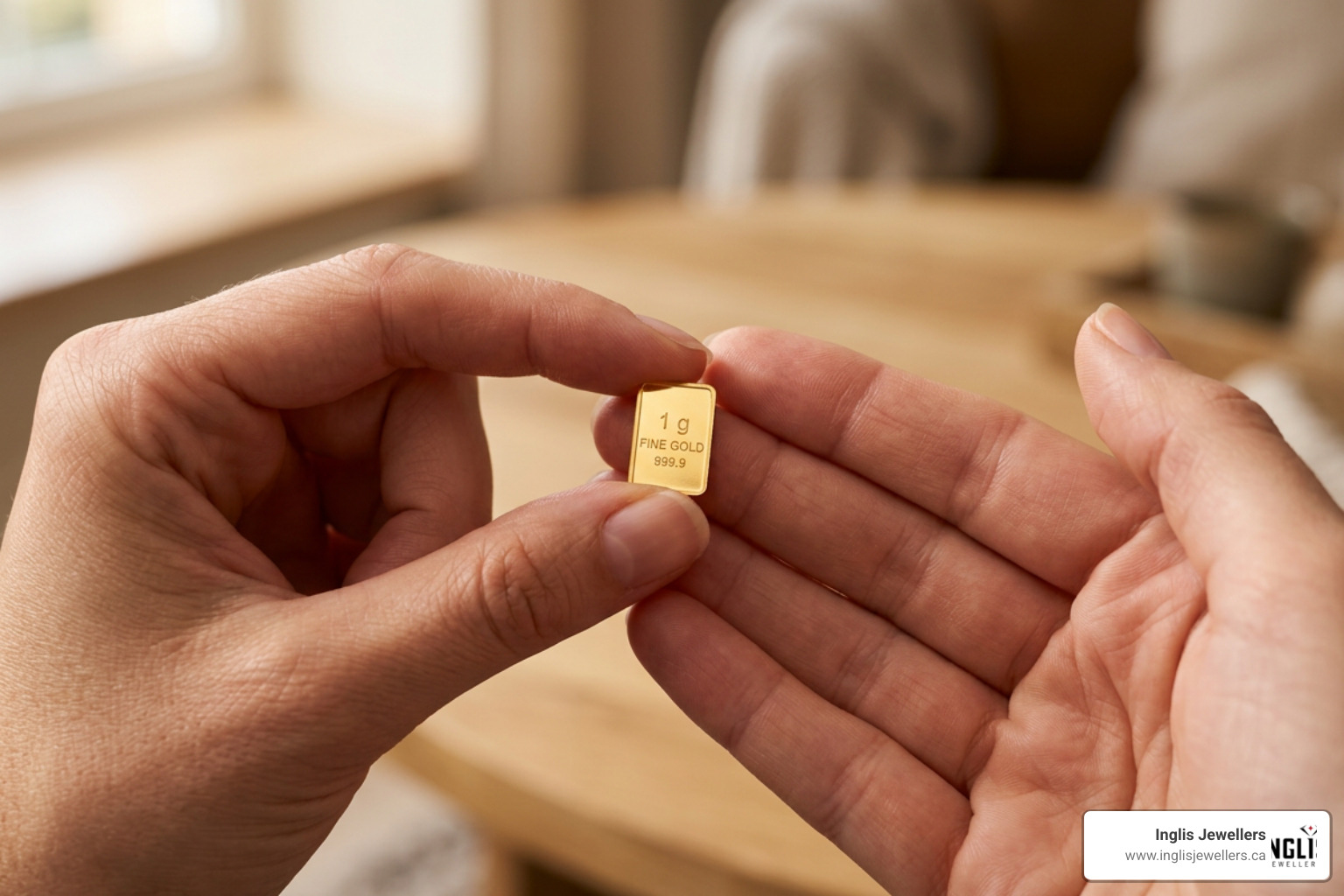
- Easily Misplaced: Because they are so small (often about the size of a fingernail), they can easily get lost if they are removed from their assay packaging.
If you want to dive deeper into how physical precious metals compare to other assets, or if you have older pieces you want to trade in to fund your new bullion goals, our comprehensive resource on Gold Buying is a fantastic place to start.
Authenticity and Secure Storage Best Practices
Because gold is so valuable, counterfeits do exist—even in small 1 gram sizes. Protecting yourself requires a mix of smart buying habits and secure storage.
- Never Remove Gold from the Assay Card: High-quality 1 gram gold bars are sealed in an "assay card." This card contains vital information, including the mint’s logo, the exact weight, the certified purity (.9999 fine gold), and a unique serial number that matches the number stamped on the bar itself. Keeping the bar sealed protects the metal from scratches and preserves its resale value.
- Verify the Security Features: Many modern mints include advanced security features. For example, PAMP Suisse uses "Veriscan" technology, which allows buyers to scan the bar with a smartphone app to verify its microscopic surface profile against the mint's database.
- Store It Safely: While 1 gram bars are small, their value adds up quickly. Keep them in a fireproof home safe that is securely bolted to the floor, or consider a safety deposit box at your local bank branch in Nova Scotia or New Brunswick.
- Buy from Trusted Local Experts: The absolute best way to guarantee authenticity is to purchase your gold from established, reputable professionals who stand behind their products.
Frequently Asked Questions About Small Gold Investments
Is 1 gram of gold a good investment for beginners?
Yes! It is an excellent, low-risk way for beginners to get comfortable with physical gold investing. It allows you to learn how the market works, experience the process of buying and storing physical metal, and build a portfolio over time without a massive upfront financial commitment.
What is the difference between a gold coin and a gold bar?
Gold coins are minted by sovereign government mints, carry a legal tender face value (even if their metal value is much higher), and usually feature intricate, culturally significant designs. Gold bars are typically produced by private refineries, focus entirely on metal weight and purity, and generally carry slightly lower retail premiums than coins of the exact same weight.
How do I verify if my 1g gold coin is real?
Check the weight using a precise digital scale (it should weigh exactly 1.00 gram, plus the weight of the packaging if sealed). Use a magnifying loupe to inspect the micro-engravings and ensure the serial number matches the assay card. For absolute peace of mind, bring your gold to any of our Inglis Jewellers locations in Truro, New Glasgow, Sydney, or Riverview, where our experienced team can verify your pieces.
Conclusion
Whether you are looking to buy your very first 1 gram gold bar, seeking a beautiful collectible coin, or exploring how to turn your older jewellery into fresh investments, understanding the 1 gram gold coin price empowers you to make smart, cost-effective decisions.
At Inglis Jewellers, we have spent decades serving families across Nova Scotia and New Brunswick with trusted craftsmanship and full-service support. From custom goldsmithing to helping you navigate your gold-buying journey, we are here to help you secure your wealth with confidence.
Ready to take the next step? Visit one of our convenient locations in Truro, New Glasgow, Sydney, or Riverview, or explore our online services.
