


When you shop for fine body jewellery online, you might notice a puzzling gap between the raw value of precious metal and the price tag on the checkout screen. A single gram of gold might seem like a modest amount of metal, but turning that tiny nugget into a polished, comfortable, and beautifully finished nose ring requires significant technical precision.
To understand the 1 gram gold nose ring price, it helps to view the final retail figure as a blend of several distinct parts:
- The Raw Melt Value: The base intrinsic value of pure or alloyed gold determined by international markets.
- The Karat Purity Level: How much pure gold is contained in the piece relative to binder metals like copper, silver, or zinc.
- Making Charges (Labor & Craftsmanship): The cost involved in melting, drawing wire, bending, soldering, and polishing tiny jewellery components.
- Taxes and Customs: Regional sales taxes, import duties, or value-added taxes (such as GST).
- Retailer Overhead and Guarantees: Quality control, packaging, insured shipping, hallmarking certification, and customer support.
Calculating Gold Melt Value for a 1 Gram Gold Nose Ring Price
The melt value serves as the absolute baseline floor for any gold jewellery item. This figure tells you what the raw gold contained inside the nose ring would be worth if it were melted back down into an unworked block.
Because live commodities markets trade gold in troy ounces rather than grams, calculating the melt value requires converting troy ounces to grams and then factoring in the karat purity. One troy ounce equals exactly 31.1035 grams. To find the current raw price per gram of 24K (99.9% pure) gold, goldsmiths divide the live troy ounce spot price by 31.1035.
When calculating the melt value of standard jewellery alloys, you multiply that 24K per-gram rate by the percentage of pure gold in your chosen karat:
- 22K Gold (91.6% Pure Gold): Spot Rate × 0.916
- 18K Gold (75.0% Pure Gold): Spot Rate × 0.750
- 14K Gold (58.3% Pure Gold): Spot Rate × 0.583
For instance, with 24K spot rates hovering around $139.65 USD per gram, the raw melt value of a 1 gram piece of 22K gold sits near $128.05 USD. An 18K piece has a melt value of approximately $104.84 USD, while a 14K piece contains roughly $81.50 USD in raw gold content. You can check dynamic spot rates directly on tools like Gold Price per Gram Today.
It is helpful to contrast lightweight body jewellery with solid investment items like a 1 Gram Gold Coin Price. Gold coins are struck in bulk with basic dies, so their retail markup over spot price is usually very small. Body jewellery, on the other hand, demands intricate hand craftsmanship, making labor a much larger proportion of the overall sticker price.
Making Charges, Taxes, and Retail Markups
If the raw metal in a 14K gold nose ring is worth around $81.50, why does the retail ring sell for $120, $150, or more? The answer lies in making charges and manufacturing overhead.
Crafting small-scale body jewellery is notoriously delicate work. Manipulating a wire that is under 1 millimetre thick requires immense precision. Goldsmiths must construct a comfortable stem, ensure smooth ends that won't scratch sensitive nasal tissue, solder tiny decorative beads or stone settings, and polish the final piece without distorting its shape.
Making charges can be calculated either as a flat fee per item or as a percentage of the metal cost. For lightweight items weighing 1 gram or less, goldsmiths usually charge a flat labor fee. Spending two hours setting a tiny accent stone or twisting delicate gold wire costs the same amount of skilled labor regardless of whether the piece weighs 0.5 grams or 2 grams. As a result, lightweight gold items always carry a higher relative labor percentage than heavy gold bangles or thick chains.
Regional taxes also influence the final cost. In India, a standard 3% Goods and Services Tax (GST) is added to gold purchases, whereas in Canada or the US, regional sales taxes apply at checkout. When you add store overhead, quality verification, and presentation packaging, the final retail cost reflects an entire network of skilled craftsmanship rather than just raw metal weight.
How Karat Purity Impacts the Price of a 1 Gram Nose Ring
Gold in its purest form—24 karat—is bright yellow, chemically inert, and extremely soft. While 24K gold is ideal for storage bars and coins, it is far too pliable for body jewellery. A 24K nose hoop would easily bend out of shape during everyday wear or deform when inserted into a piercing.
To make gold durable enough for daily use, master goldsmiths melt pure gold together with alloy metals such as copper, silver, nickel, palladium, or zinc. The ratio of pure gold to alloy metals determines both the karat rating and the physical properties of the piece.
The selection of karat dramatically shapes the final 1 gram gold nose ring price, as well as the ring's color tone, bend resistance, and suitability for sensitive skin.
| Karat Rating | Pure Gold Percentage | Alloy Percentage | Common Uses & Features | Average Retail Price Range (1 Gram Plain) |
|---|---|---|---|---|
| 24K Gold | 99.9% | 0.1% | Bullion, coins, investment bars. Too soft for nose hoops. | $145 – $170 USD (Melt value base) |
| 22K Gold (916) | 91.6% | 8.4% | Traditional Indian/South Asian bridal jewellery, rich yellow hue. | $140 – $190 USD |
| 18K Gold (750) | 75.0% | 25.0% | Premium fine jewellery, warm golden balance, excellent hypoallergenic rating. | $115 – $160 USD |
| 14K Gold (585) | 58.3% | 41.7% | North American standard, highly durable, scratch-resistant, accessible price point. | $85 – $130 USD |
| 10K Gold (417) | 41.7% | 58.3% | Maximum hardness, budget-friendly, paler tone. | $65 – $95 USD |
22K vs 18K vs 14K Gold Nose Rings
Choosing the ideal karat depends on your cultural preferences, budget, skin sensitivity, and daily routine:
22K Gold (91.6% Purity)
22K gold displays the deep, warm yellow hue celebrated in traditional South Asian body adornments. Because it contains 91.6% pure gold, it commands the highest price per gram among wearable jewellery alloys. However, because 22K is relatively soft, plain 22K hoops can warp if adjusted frequently. It is best suited for delicate nose pins, traditional studs with twist fittings, or formal occasion pieces rather than thin, flexible hoops that require constant bending.
18K Gold (75.0% Purity)
For many fine jewellery lovers, 18K gold strikes the perfect balance. Containing 75% pure gold, it retains a rich, rich yellow tone while benefiting from added structural strength provided by its 25% alloy content. It is significantly more resistant to scratching and bending than 22K gold. Moreover, because of its high gold content, 18K gold is exceptionally gentle on sensitive piercings, reducing the risk of skin irritation or redness.
14K Gold (58.3% Purity)
14K gold is the undisputed workhorse of North American body jewellery. With 58.3% pure gold, it offers exceptional scratch resistance and rigidity, making it ideal for thin hoop rings, continuous nose wire, and everyday wear. If you want a sleek, worry-free hoop that holds its shape through sleeping, exercise, and shower routines, a 14k Gold Nose Ring Hoop delivers maximum durability at a wallet-friendly price.
Popular Types and Styles Affecting Gold Nose Jewelry Pricing
Weight is only one side of the pricing equation. Two nose rings that both weigh exactly 1.0 gram can carry vastly different price tags depending on their architectural complexity, surface embellishments, and setting work.
Let's explore how popular style categories influence total retail pricing:
- Basic Unbeaded Hoops: Simple, seamless gold wire shaped into a smooth circle. Requires minimal manufacturing labor, making it the most affordable 1-gram option.
- Twisted Wire & Beaded Hoops: Gold wire featuring hand-twisted rope textures or small soldered gold beads (grains). Requires extra soldering and polishing work.
- Prong or Bezel-Set Studs: A gold post or L-shaped hook holding a cubic zirconia (CZ), natural gemstone, or diamond. Labor increases based on the stone setting technique.
- Ornate Bridal Naths: Larger traditional nose rings often featuring intricate filigree work, drop pearls, accent stones, and attachment chains.
Plain Hoops vs. Diamond and Gemstone Nose Rings
When comparing a plain gold hoop to a gemstone-studded nose pin, the cost shifts from metal weight to stone quality and setting labor.
A simple 1-gram plain gold hoop relies almost entirely on the gold spot price and basic shaping charges. However, adding accent stones changes the formula completely. For example, a basic 18K gold nose pin with tiny gold grain accents might retail around $29 to $60 USD for very lightweight wire structures (under 0.3g), whereas a full 1-gram gold piece with handset natural diamonds can easily range from $170 USD to over $400 USD.
When evaluating stone-studded nose jewellery:
- Cubic Zirconia (CZ) vs. Natural Diamonds: CZ accents provide brilliant sparkle at a fraction of the cost, making them ideal for budget-conscious shoppers. Natural diamonds add significant value, but require certified stone grading and specialized prong setting under magnification.
- Pearl and Colored Gemstone Embellishments: Adding small seed pearls or emerald accents introduces extra hand-assembly steps, pushing retail charges higher even if the total gold weight remains 1 gram.
Comparing Styles to Find a 1 Gram Gold Nose Ring Price Under $100
Many shoppers search for fine gold body jewellery under a $100 USD (or ₹10,000 INR) budget threshold. Finding a quality piece within this budget is entirely achievable, provided you understand how weight and karat interact.
Because a full 1.0-gram piece of 18K or 22K gold carries a raw metal melt value near or above $100 USD on its own, brand-new 1-gram nose rings in high karats usually retail between $120 and $200 USD once labor and taxes are included.
However, if your budget is strictly under $100 USD, consider these strategic options:
- Opt for 14K Gold: A 1-gram plain 14K gold hoop features a raw gold content worth roughly $81.50 USD, placing the retail price comfortably in the $90 to $110 USD range.
- Consider Featherweight Designs (0.25g to 0.50g): Many dainty nose pins and hoops weigh well under a full gram. For example, a 22K gold nose pin weighing 0.251 grams contains high-purity gold but retails around $50 USD because of its lightweight build.
- Choose Minimalist Unbeaded Hoops: Plain seamless rings skip stone-setting charges and complex soldering, giving you the best gold-to-price ratio.
In the Indian market, simple plain gold nose pins weighing between 0.5g and 1g often retail near ₹5,000 to ₹9,000 INR depending on market fluctuations, bringing simple designs comfortably under the ₹10,000 mark.
How to Verify Authenticity and Shop Smart Online
Buying gold jewellery online offers incredible variety, but it also requires cautious verification. Because body jewellery is small and lightweight, fraudulent sellers sometimes try to pass off gold-plated base metals or under-karated alloys as solid gold.
Hallmark Marks and Certifications
To ensure you receive genuine solid gold matching the advertised karat, always check for official hallmark stamps and independent lab certifications before completing a purchase.
-
BIS Hallmark (Bureau of Indian Standards): For South Asian 22K or 18K gold jewellery, look for the official BIS logo alongside the purity number:
- 916 = 22 Karat (91.6% pure gold)
- 750 = 18 Karat (75.0% pure gold)
- 585 = 14 Karat (58.3% pure gold)
- North American Stamps: In Canada and the US, gold items should be laser-engraved or stamped with their karat rating (e.g., "14K", "18K", "585", or "750") along with the manufacturer's trademark stamp.
- Diamond & Gemstone Certificates: If your nose ring features natural diamonds, insist on certification from recognized gemological laboratories like IGI, SGL, or GIA to confirm stone authenticity, cut, color, and carat weight.
At Inglis Jewellers, every piece of gold jewellery we craft and sell undergoes rigorous quality checks and carries official purity markings so you can buy with total confidence.
Sizing, Gauge Thickness, and Piercing Fit
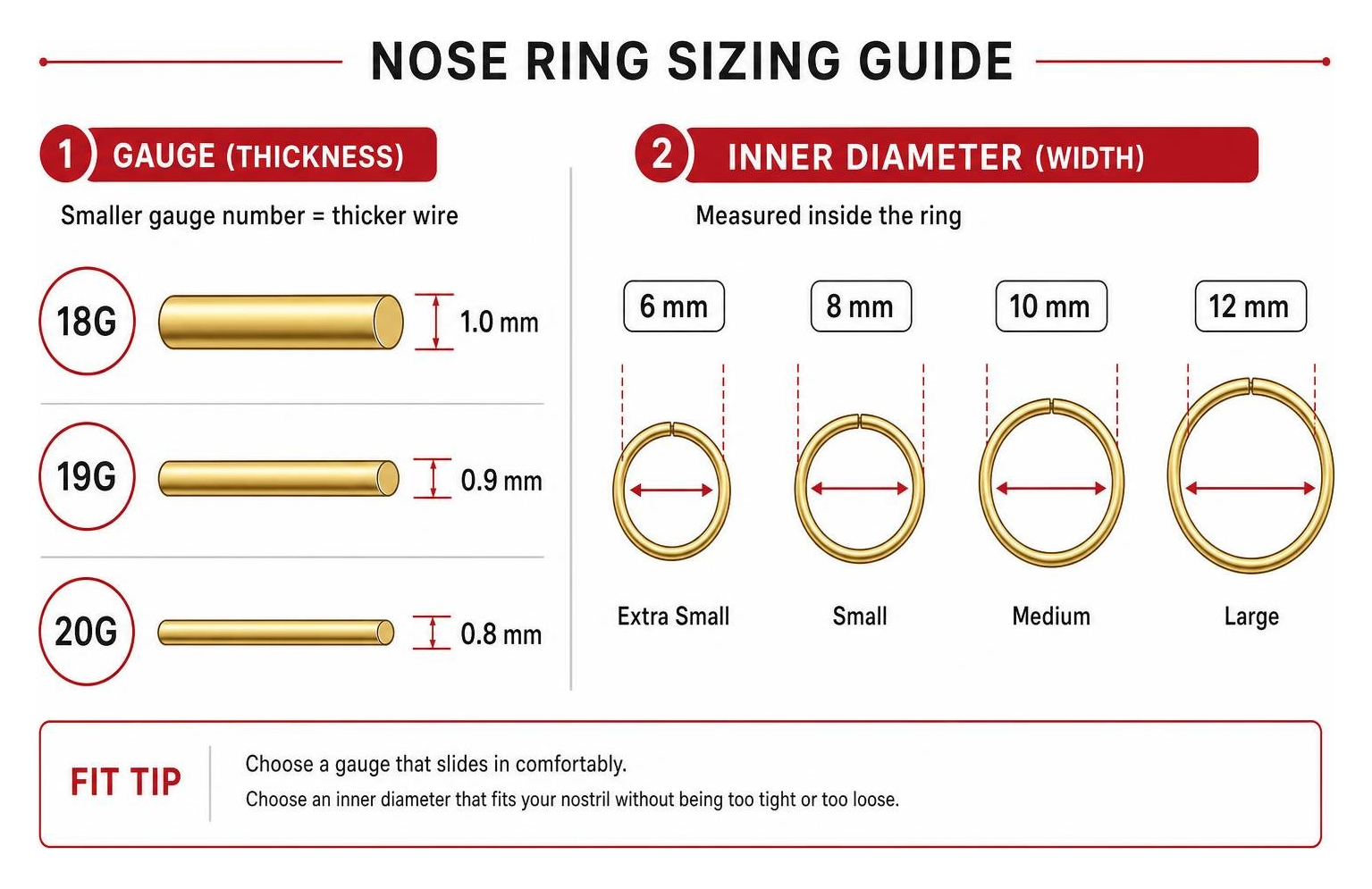
Getting a great price means very little if the nose ring doesn't fit your specific piercing comfortably. Body jewellery dimensions are measured in gauge (thickness) and inner diameter (width).
Wire Gauge Thickness
The gauge (ga) refers to the thickness of the wire post or ring stem. Counterintuitively, the smaller the gauge number, the thicker the wire:
- 18 Gauge (1.0 mm): A sturdy thickness, common for traditional Indian nose pins and initial piercing studs.
- 19 Gauge (0.9 mm): A versatile middle-ground thickness offering good structural strength.
- 20 Gauge (0.8 mm): The standard universal size for most modern fashion nostril piercings.
- 22 Gauge (0.6 mm): Very thin wire, ideal for delicate, subtle piercing looks, though more prone to bending.
Inner Diameter
For hoops, the inner diameter measures the clear space inside the ring from edge to edge. Standard inner diameters range from 6 mm (snug fit on low piercings) to 8 mm or 9 mm (roomier fit for higher nostril piercings).
If you are unsure about custom sizing or fitting choices, reviewing our comprehensive Custom Jewellery Guide 2026 can help you select the exact dimensions for your style.
Frequently Asked Questions About Gold Nose Ring Pricing
Why is a 1 gram gold nose ring more expensive than raw gold?
A 1-gram gold nose ring costs more than raw spot gold because converting bullion into fine, wearable jewellery requires specialized equipment, skilled goldsmithing labor, precise stone setting, hallmarking fees, and retail support. Lightweight items have higher labor costs relative to their metal weight because delicate handiwork takes just as long on a small piece as it does on a larger one.
How do I measure my nose piercing size before buying online?
To measure your piercing size at home:
- Measure the distance from your nose piercing hole down to the bottom edge of your nostril using a metric ruler in millimetres.
- Add 1 mm to that measurement to determine your ideal hoop inner diameter for a comfortable, non-snug fit.
- Check the thickness of your current comfortable nose stud or post to confirm whether you wear an 18 ga (1.0 mm), 20 ga (0.8 mm), or 22 ga (0.6 mm) stem.
Can I wear a 1 gram gold nose ring for everyday wear?
Yes! Solid 14K and 18K gold are among the safest, most durable metals for daily wear. Gold is naturally resistant to rust, tarnish, and corrosion. High-karat gold (14K and above) is hypoallergenic, making it gentle on nasal mucous membranes and preventing the skin irritation or dark discoloration caused by cheap plated body jewellery.
Conclusion
Finding the right 1 gram gold nose ring price comes down to balancing live gold rates with quality craftsmanship, karat durability, and personal style. Whether you are looking for a sleek, daily-wear 14K gold hoop, an elegant 18K diamond stud, or a traditional 22K piece, understanding how melt value, labor, and hallmarking shape the final price tag ensures you shop smart.
When buying gold body jewellery, prioritize authentic purity certifications, correct stem gauge thickness, and trusted goldsmithing standards over rock-bottom pricing. A well-crafted solid gold nose ring is an intimate expression of personal style that delivers comfort and shine for years to come.
Explore our fine gold jewellery collections online or visit us in person at our showrooms across Truro NS, New Glasgow NS, Riverview NB, and Sydney NS. For more expert tips on choosing timeless gold pieces, check out our Ultimate Gold Ring Guide 2026.