


What You Need to Know Before Buying a Diamond Ring
Diamond rings are one of the most meaningful purchases you'll ever make. Whether you're shopping for an engagement ring, an anniversary gift, or a personal milestone, there's a lot to get right.
Here's a quick overview of the key things to consider:
| What to Consider | Quick Answer |
|---|---|
| Best diamond shape | Round brilliant is most popular; oval and cushion are trending in 2026 |
| Most important quality factor | Cut - it determines how much a diamond sparkles |
| Natural vs. lab-grown | Both are real diamonds; lab-grown costs less, natural holds value longer |
| Metal type | Platinum is most durable; gold comes in white, yellow, and rose |
| Average price range | From a few hundred dollars to tens of thousands, depending on the 4Cs |
| Custom design timeline | Typically 3-6 weeks from consultation to finished ring |
| Certification to look for | GIA or IGI certified diamonds offer verified quality grading |
Since the late 19th century, the classic solitaire setting has helped define the diamond engagement ring as a global symbol of commitment and lasting love. That's a long time for one piece of jewellery to hold its meaning - and it shows no signs of changing.
But the market has evolved enormously. Today's buyers face choices that didn't exist a decade ago: lab-grown diamonds, dozens of cuts and settings, metal options, ethical sourcing questions, and retailers ranging from international chains to local independent jewellers.
This guide cuts through the noise. We'll walk you through everything - from understanding the 4Cs to choosing the right setting, comparing natural and lab-grown diamonds, and knowing what questions to ask before you buy.
Understanding the 4Cs of Diamond Rings
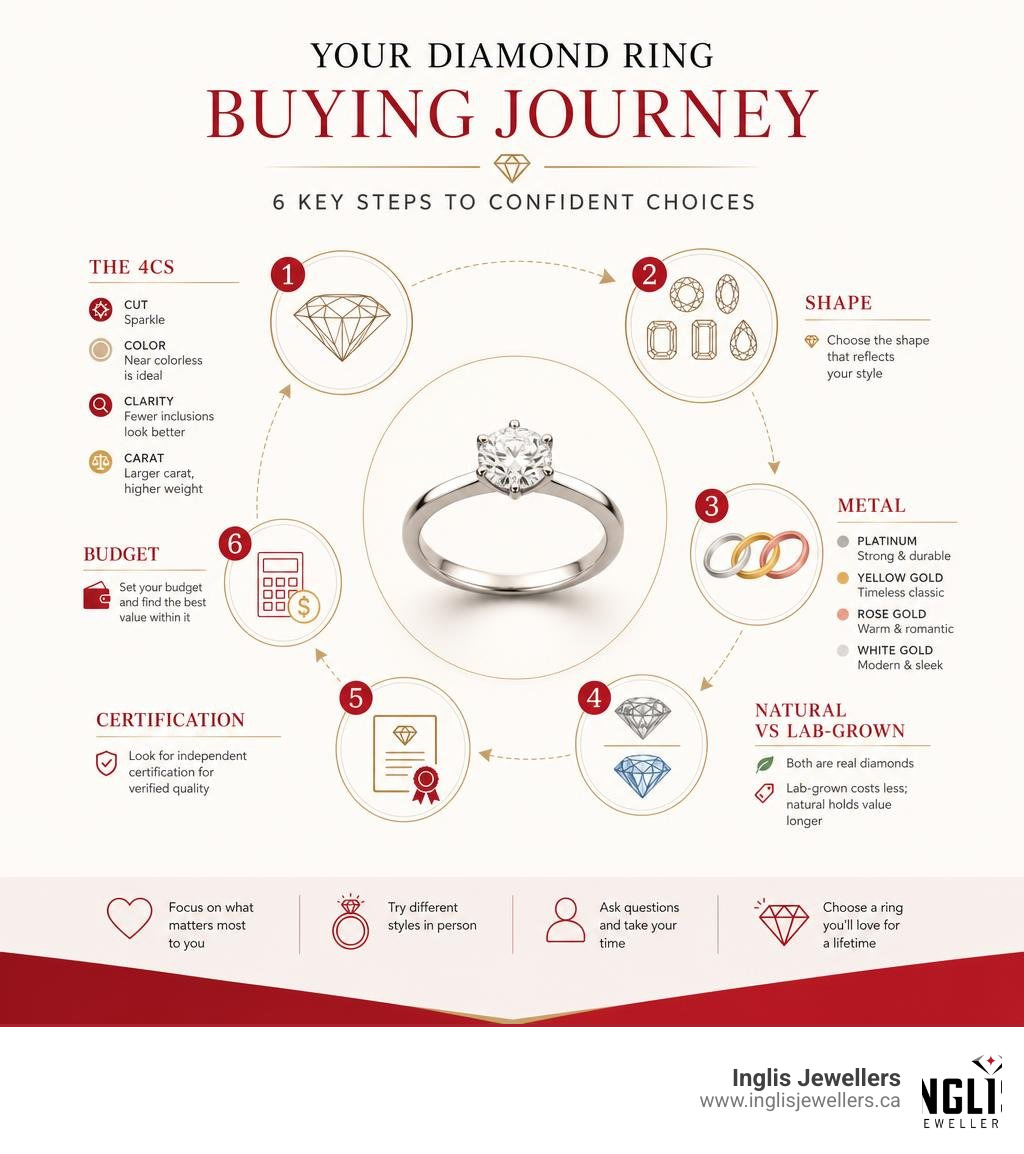
When you start exploring diamond rings, the first piece of advice you will hear from any diamond specialist is to learn "the 4Cs." Established by the Gemological Institute of America (GIA), this universal grading system evaluates a diamond's quality and value based on four distinct characteristics: Cut, Color, Clarity, and Carat Weight.
While all four are crucial, they do not impact the visual beauty and price of a diamond equally. Understanding how they interact allows you to make smart trade-offs, ensuring you get the most beautiful stone for your budget.
Cut: The Sparkle Factor
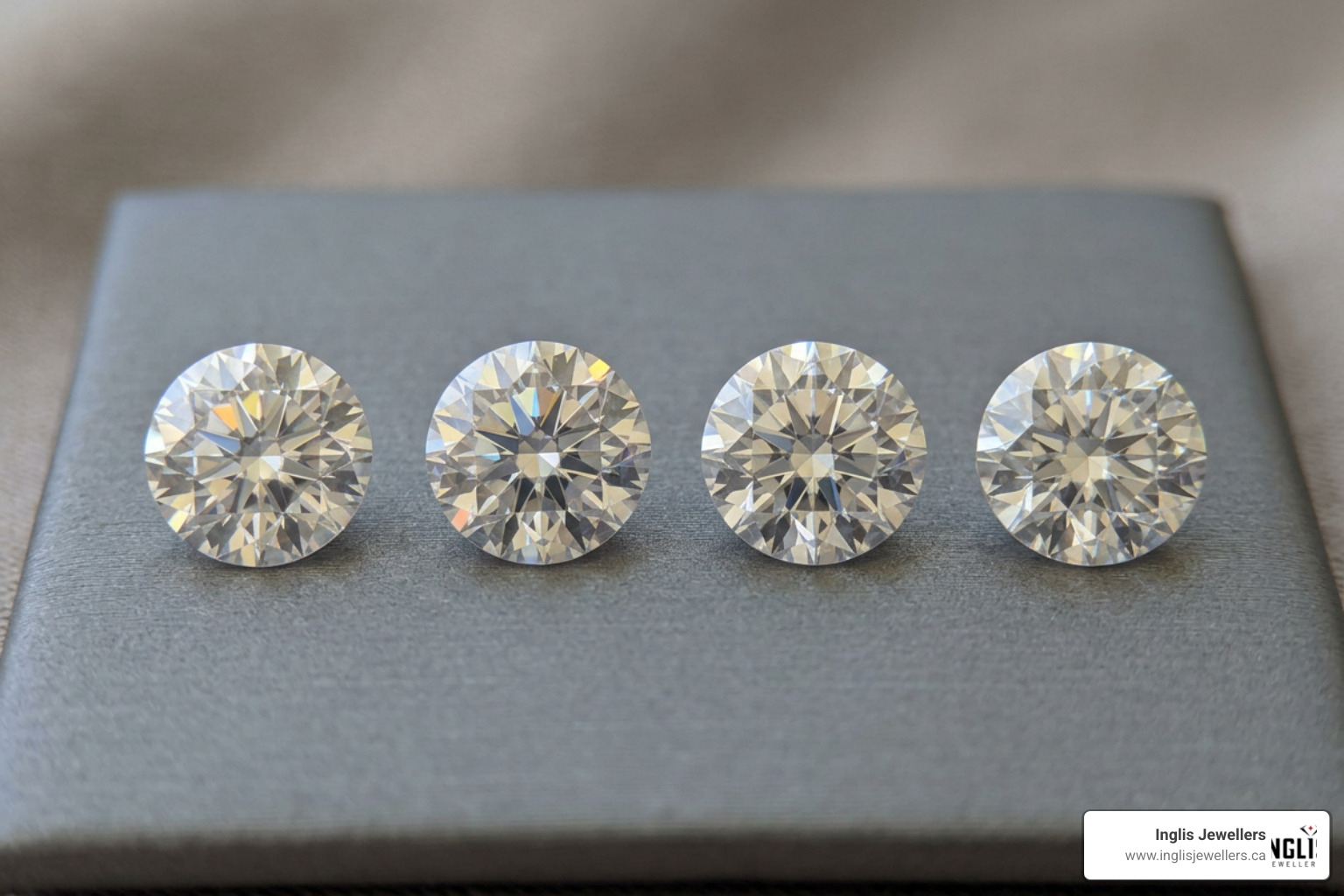
Of all the 4Cs, Cut is widely considered the most important factor for a diamond's visual beauty. The cut does not refer to the shape of the diamond (such as round or pear), but rather to how well the stone's facets interact with light.
An expertly cut diamond acts like a series of tiny mirrors, reflecting light back to the eye to produce three distinct visual effects:
- Brilliance: The total amount of white light reflected from the diamond.
- Fire: The dispersion of light into flashes of rainbow colours.
- Scintillation: The pattern of dark and light areas, or the "sparkle" when the ring moves.
If a diamond is cut too shallow or too deep, light leaks out of the bottom or sides of the stone, making it look dull and lifeless, regardless of how large or pure it is. For round brilliant diamonds, the industry gold standard is a "triple excellent cut" grade, which means the diamond has achieved excellent ratings for cut grade, symmetry, and polish. When selecting diamond rings, prioritizing an excellent or ideal cut ensures your ring will catch the light from across the room.
Color and Clarity: Rarity and Purity
Color measures the absence of colour in a white diamond. The GIA scale runs alphabetically from D (completely colourless) to Z (noticeable yellow or brown tint).
- D to F (Colourless): Extremely rare and premium-priced.
- G to J (Near-Colourless): These diamonds offer the best value. To the untrained eye under normal lighting, they appear completely white but cost significantly less than colourless stones.
- K to Z (Faint to Light Yellow): These diamonds carry a warm tone that can look beautiful when paired with yellow gold settings, though they are less traditional for engagement rings.
Clarity evaluates the purity of the diamond by looking for tiny internal characteristics called inclusions and surface flaws called blemishes. The scale ranges from Flawless (FL) to Included (I).
Most engagement-quality diamonds fall in the VS1-VS2 (Very Slightly Included) or SI1-SI2 (Slightly Included) ranges. When shopping for diamond rings, our advice is to aim for an "eye-clean" diamond. This means the inclusions are invisible to the naked eye without magnification, allowing you to save money without sacrificing the ring's overall appearance.
Carat Weight and Pricing
Carat refers to the physical weight of the diamond, not its physical size. One carat is equal to 200 milligrams.
Because larger diamonds are much rarer in nature, diamond pricing does not scale linearly. Instead, it rises exponentially. A single 2-carat diamond will cost significantly more than two 1-carat diamonds of identical quality.
Furthermore, diamonds are priced heavily around "magic numbers" like 0.50, 1.00, 1.50, 2.00, and 3.00 carats. Buying just under these thresholds (for example, a 0.95-carat diamond instead of a 1.00-carat diamond) can save you a substantial amount of money while looking virtually identical on the hand.
To understand how carat weight dramatically shifts the investment required, you can explore our detailed breakdowns of the 2 Carat Diamond Ring Price and the 3 Carat Diamond Ring Price.
Choosing Your Style: Shapes, Settings, and Metals
Finding the perfect diamond ring is about combining the raw beauty of the center stone with a setting and metal that reflect the wearer’s personal style, hand shape, and lifestyle.
| Diamond Shape | Best Setting Companion | Visual Effect on Hand | Ideal Lifestyle |
|---|---|---|---|
| Round Brilliant | Solitaire or Six-Prong | Classic, balanced, timeless | Active (highly secure in multi-prong settings) |
| Oval / Emerald | Solitaire or Slim Band | Elongates shorter fingers | Elegant, fashion-forward |
| Cushion | Halo or Vintage | Soft, romantic, antique look | Vintage lovers |
| Princess | V-Prong Solitaire | Modern, clean geometric lines | Contemporary, bold style |
Popular Diamond Shapes for Every Hand
The shape of your diamond is the first thing people notice. While the classic round brilliant remains the most popular choice due to its unmatched sparkle, fancy shapes allow for greater personalization:
- Oval and Pear: These elongated shapes create a graceful, lengthening effect on the fingers, making them highly flattering for shorter hands.
- Cushion: Featuring rounded corners and large facets, this romantic shape offers a vintage, pillow-like silhouette.
- Princess: A sharp, square cut that offers clean geometric lines and a modern aesthetic.
- Emerald: A step-cut shape with long, parallel facets that mimic a hall of mirrors, emphasizing clarity and understated elegance over raw sparkle.
Classic and Modern Ring Settings
The setting is how the diamond is mounted to the metal band. It secures the stone and defines the ring's architectural style:
- Solitaire: The ultimate classic. It features a single diamond held by prongs (usually four or six). A six-prong setting lifts the diamond higher for a crown-like symmetry, maximizing light flow, while a four-prong setting shows off more of the diamond's profile.
- Halo: A ring of smaller accent diamonds surrounds the center stone. This adds intense sparkle and can make the center diamond look up to a half-carat larger than it is.
- Three-Stone: Representing a couple's past, present, and future, this setting pairs a center stone with two matching side stones.
- Pavé: The band is encrusted with tiny, closely set diamonds held by microscopic prongs, creating a continuous line of brilliance.
- Bezel: A modern, highly secure option where a metal rim wraps entirely around the edge of the diamond, protecting it from chips and snags.
How to Choose the Right Metal for Women's Diamond Rings
The metal you choose provides the canvas for your diamond. Your decision should factor in daily durability, skin tone, and existing jewellery collections.
- Platinum: A naturally white, hypoallergenic metal that is incredibly dense and durable. It does not wear away over time and holds diamonds with maximum security.
- White Gold: Offers a similar cool, contemporary look to platinum but at a more accessible price point. It is alloyed with white metals and plated with rhodium, which requires occasional replating to maintain its bright white finish.
- Yellow Gold: A classic, warm choice that brings out the fire in a diamond. It is highly traditional and pairs beautifully with near-colourless or slightly warm diamonds.
- Rose Gold: Created by alloying gold with copper, this metal offers a soft, romantic, and vintage-inspired pink hue.
To dive deeper into precious metals and find the perfect match for your lifestyle, read our comprehensive guide on 14k Gold Ring Womens or explore the Ultimate Gold Ring Guide 2026.
Natural vs. Lab-Grown Diamonds
One of the most important decisions modern buyers face is choosing between a natural diamond and a lab-grown diamond.

Geological Origin and Rarity
The fundamental difference between these two options is their origin:
- Natural Diamonds: Formed deep within the Earth’s mantle over billions of years under conditions of extreme heat and pressure. They are delivered to the surface through ancient volcanic eruptions. They are finite, rare geological treasures.
- Lab-Grown Diamonds: Created in highly controlled laboratory environments over the course of a few weeks using advanced technology. Two main methods are used: Chemical Vapor Deposition (CVD) and High Pressure High Temperature (HPHT).
Chemically, physically, and optically, lab-grown diamonds are identical to natural diamonds. They consist of pure carbon arranged in a crystalline structure, possess the same hardness (10 on the Mohs scale), and exhibit the exact same sparkle. Even an experienced jeweller cannot tell the difference without specialized testing equipment.
Value Retention and Future Upgrades
While they look identical, their long-term economic value is very different:
- Natural Diamonds carry geological rarity, which historically helps them retain their market value over time. They are often chosen by those who view their ring as an heirloom to be passed down through generations, or those who value the romance of owning a natural miracle.
- Lab-Grown Diamonds offer an incredible cost-saving alternative. Because they can be produced on demand, they generally cost 50% to 70% less than natural diamonds of equivalent size and quality. This allows buyers to maximize their budget, opting for a much larger center stone or a more intricate setting than they could otherwise afford.
Many couples prioritize size and visual impact today, while others prioritize long-term value retention and future upgrade flexibility.
The Custom Design Process and Retailer Options
For those who want a ring that is completely unique, the custom design process offers a collaborative path to creating a one-of-a-kind piece.
Designing a Bespoke Ring
Designing a custom ring is an exciting journey that typically takes between 3 to 6 weeks. The process unfolds in a few simple steps:
- Initial Consultation: You meet with a designer to share inspiration photos, sketch ideas, choose your diamond shape, and select your metal.
- CAD Rendering: Using computer-aided design (CAD) software, the jeweller creates a precise 3D model of your ring. This allows you to view the design from every angle and make adjustments before any metal is cast.
- 3D Wax Model: Many jewellers will print a physical 3D wax model of your design so you can try it on your finger to check its proportions and fit.
- Casting and Hand-Crafting: Once approved, our master goldsmiths cast the ring in your chosen metal, hand-set the diamonds, and polish the final piece to perfection.
Custom design isn't just for women's bridal sets; it's also a fantastic way to create a tailored, meaningful piece for men. To learn more about creating a personalized piece, check out our guide on finding a Customised Ring for Men.
Chain Retailers vs. Independent Jewelers
When deciding where to buy your diamond ring, you will encounter various retail environments:
- Mass-Production Chain Retailers: These large corporations offer convenience and highly standardized inventory. However, they often feature mass-produced settings that lack structural density, and their pricing frequently includes high markups to cover corporate overhead.
- Local Independent Jewellers: Working with a local, full-service jeweller gives you direct access to on-site goldsmiths, personalized customer service, and superior quality control.
At Inglis Jewellers, we take pride in being a trusted Canadian brand that combines the extensive selection of a large retailer with the warm, personalized service of a local independent goldsmith. With convenient physical locations in Truro NS, New Glasgow NS, Riverview NB, and Sydney NS, we serve our communities across Nova Scotia and New Brunswick with unmatched care.
Frequently Asked Questions about Diamond Rings
How do I verify diamond authenticity and ethical sourcing?
To verify the authenticity and quality of a diamond, always request a grading certificate from an independent, reputable gemological laboratory, such as the GIA (Gemological Institute of America) or the IGI (International Gemological Institute). These certificates act as a "passport" for your stone, detailing its exact measurements and 4Cs grades.
For ethical sourcing, ensure your jeweller strictly adheres to the Kimberley Process Certification Scheme (KPCS). This international initiative prevents "conflict diamonds" from entering the mainstream rough diamond market. Furthermore, many modern natural diamonds can be traced directly back to their country of origin (such as Canada's Northwest Territories), ensuring they were mined under strict environmental and fair-labour regulations.
What should I look for in warranties and resizing policies?
A diamond ring is a lifetime investment, and it requires ongoing maintenance. When purchasing, ask if the retailer offers:
- A Lifetime Warranty: This should cover manufacturing defects, professional cleaning, polishing, and regular safety inspections.
- Complimentary Resizing: Fingers change size over time. Look for a policy that offers free resizing within the first 90 days or as part of a lifetime service agreement.
- Regular Prong Inspections: Prongs can snag and loosen over time. Free regular inspections ensure your diamond remains safely anchored.
- Insurance Appraisals: Your jeweller should provide a professional appraisal document detailing the replacement value of the ring, which is required by insurance companies to protect your investment against loss, theft, or damage.
Caring for Your Diamond Rings Over Time
Diamonds are incredibly tough, but they are not indestructible. Daily wear can cause dirt, oils, and lotions to build up behind the stone, blocking light and dulling its sparkle.
To clean your ring at home, soak it in warm water mixed with a few drops of mild dish soap for 20 to 30 minutes. Use a soft-bristled toothbrush to gently scrub away dirt, rinse thoroughly under warm running water, and dry with a lint-free cloth.
Avoid wearing your ring while washing dishes, gardening, lifting weights, or swimming in chlorinated pools. Most importantly, bring your ring to a professional jeweller at least once a year for a deep clean and check-up. If your ring ever needs repair, refer to our Jewellery Repairs Complete Guide to understand how to keep your precious pieces in pristine condition.
Conclusion
Choosing a diamond ring is a beautiful blend of art, science, and personal emotion. By understanding the 4Cs, exploring different shapes and metal types, and deciding between natural and lab-grown stones, you can step into the buying process with complete confidence.
At Inglis Jewellers, we are dedicated to helping you celebrate life's most precious moments. Across our locations in Truro, New Glasgow, Riverview, and Sydney, our team of passionate experts and on-site goldsmiths is here to guide you every step of the way — from selecting the perfect loose diamond to custom-designing your dream setting.
If you are still exploring your options and want to learn about beautiful diamond alternatives, check out our Ultimate 1 Carat Moissanite Ring Guide 2026 to see if this stunning, eco-friendly gemstone is the right fit for your love story!