


Lab Grown Diamond Pricing in 2026: What You Need to Know Before You Buy
The cost of lab grown diamonds has dropped dramatically over the past several years, making them one of the most talked-about shifts in the jewellery market today. If you want a quick answer before diving deeper, here it is:
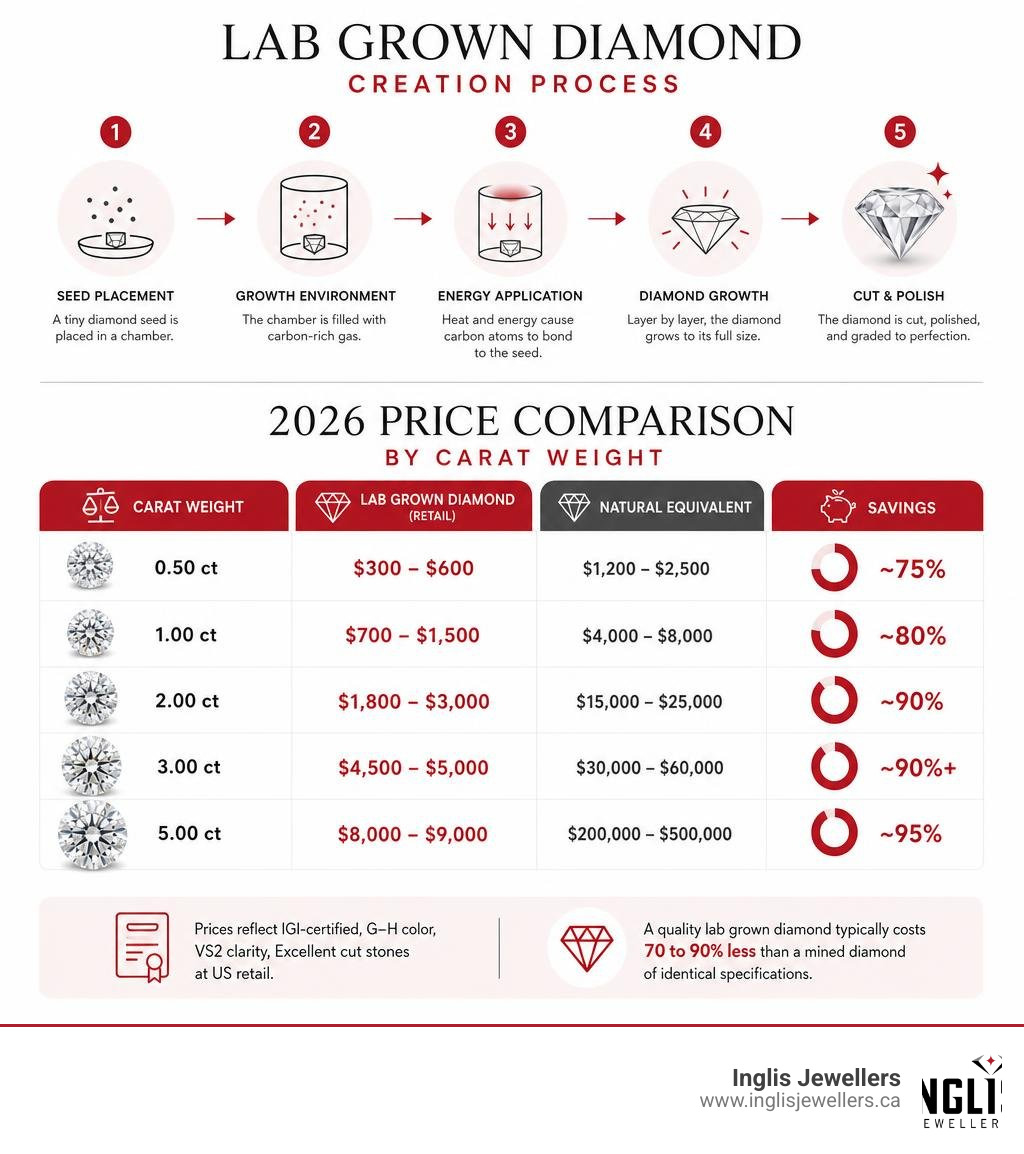
Lab Grown Diamond Price Snapshot (2026)
| Carat Weight | Lab Grown (Retail) | Natural Equivalent | Savings |
|---|---|---|---|
| 0.50 ct | $300 – $600 | $1,200 – $2,500 | ~75% |
| 1.00 ct | $700 – $1,500 | $4,000 – $8,000 | ~80% |
| 2.00 ct | $1,800 – $3,000 | $15,000 – $25,000 | ~90% |
| 3.00 ct | $4,500 – $5,000 | $30,000 – $60,000 | ~90%+ |
| 5.00 ct | $8,000 – $9,000 | $200,000 – $500,000 | ~95% |
Prices reflect IGI-certified, G–H color, VS2 clarity, Excellent cut stones at US retail.
A quality lab grown diamond typically costs 70 to 90% less than a mined diamond of identical specifications. That gap widens as the stone gets larger.
This wasn't always the case. In 2020, a 1-carat lab grown diamond wholesaled for around $3,400. By 2026, that same stone wholesales closer to $680. The reason comes down to one thing: production at scale. Lab grown diamonds are created in controlled environments using advanced technology, and manufacturing capacity has grown by more than 300% since 2020.
The result? Buyers today can get a larger, higher-quality stone for the same budget that would have bought something far more modest just a few years ago.
This guide breaks down exactly what drives those prices — by size, quality, shape, and where you buy.
Understanding the Cost of Lab Grown Diamonds in 2026
When you walk into a jewellery store today, the price tags on lab-grown diamonds can feel like a typo compared to their mined counterparts. This massive price gap—which frequently translates to a 70% to 90% savings—has completely reshaped how couples shop for engagement rings.
To understand why the cost of lab grown diamonds is so much lower, we have to look at how they are priced. Unlike natural diamonds, which rely on a complex global mining infrastructure and geological scarcity, lab-grown diamonds are priced based on the efficiency of their production.
At the wholesale level, the price of lab-grown diamonds is tied directly to the cost of running the reactors, cutting the stones, and certifying them. When Indian and Chinese diamond firms scaled up Chemical Vapor Deposition (CVD) production around 2023, the global supply skyrocketed. This created a highly competitive wholesale market, driving down the base costs.
For retail buyers, this means you are no longer paying a massive premium for "rarity." Instead, you are paying for the technology and craftsmanship required to grow and polish the stone. You can track these shifting retail dynamics using tools like Lab Grown Diamond Prices - StoneAlgo to see how retail margins have adjusted to match these lower wholesale baselines.
Lab Grown vs. Mined Diamond Price Comparison
The easiest way to understand the price difference is to look at identical specifications side-by-side. A standard 1-carat round brilliant diamond with a G color grade, VS2 clarity, and an Excellent cut is the "sweet spot" for many buyers. In a mined diamond, this stone will easily run you between $4,000 and $8,000 USD depending on the retailer. The lab-grown equivalent? It sits comfortably between $750 and $1,500 USD.
As you climb in carat weight, the price gap doesn't just grow—it explodes.
| Carat Weight | Lab-Grown Price (USD) | Mined Price (USD) | Price Gap (%) |
|---|---|---|---|
| 0.50 Carat | $300 - $600 | $1,200 - $2,500 | ~75% cheaper |
| 1.00 Carat | $700 - $1,500 | $4,000 - $8,000 | ~80% cheaper |
| 1.50 Carat | $1,200 - $2,200 | $8,000 - $12,000 | ~83% cheaper |
| 2.00 Carat | $1,800 - $3,000 | $15,000 - $25,000 | ~90% cheaper |
| 3.00 Carat | $4,500 - $5,000 | $30,000 - $60,000 | ~91% cheaper |
| 5.00 Carat | $8,000 - $9,000 | $200,000 - $500,000 | ~95% cheaper |
In the Canadian market, this means a spectacular 2-carat lab-grown diamond can be purchased direct for around $999 CAD as a loose stone, whereas a mined equivalent of the same quality would require a down payment on a house—roughly $24,000 CAD.
Historical Price Trends: 2020 to 2026
To say the market has crashed would be an understatement; it has structurally evolved. In 2020, a 1-carat F-color VS2 round lab diamond had a wholesale price of approximately $3,410. By 2026, that wholesale price plummeted to just $680—an 80% decline.
This dramatic shift was captured in investigative pieces like Expectations vs. reality: The cost of lab diamonds | Marketplace , which highlighted how rapidly scaling technology outpaced traditional retail pricing models. Between 2020 and 2023, global production capacity grew by over 300%. As reactors became more efficient—growing dozens of diamonds in days rather than weeks—the market became flooded with high-quality inventory.
However, as we move through 2026, we are seeing clear signs of price stabilization. The steep, double-digit quarterly drops of the early 2020s have flattened. Why? Because the market has hit a physical "price floor." The cost to cut, polish, and laser-inscribe a diamond remains fixed at around $100 to $150 per carat. Additionally, nearly 40% of smaller, less-efficient producers have exited the market because profit margins disappeared. If you are waiting for lab diamonds to become completely free, you will be waiting a long time; the current prices represent a mature, stable baseline.
Lab Grown Diamond Price Per Carat by Size
One of the most surprising aspects of shopping for a lab-grown diamond is how the pricing scales. If you have ever shopped for mined diamonds, you know that a 2-carat stone costs far more than double the price of a 1-carat stone. This is because larger natural diamond crystals are incredibly rare to find in the earth.
With lab-grown diamonds, we throw that old rulebook out the window.
Why the Cost of Lab Grown Diamonds Decreases Per Carat as Size Increases
In a fascinating inversion of traditional gem economics, the price per carat for lab-grown diamonds actually falls or stabilizes as the stone gets larger.
For example, a 1-carat lab diamond might cost you around $1,300 per carat. But when you step up to a 2-carat or 3-carat stone, the rate often drops to $850 or $900 per carat. According to the Lab Diamond Price Shopper's Guide 2026 | TheCaratCut , this occurs because geological scarcity is no longer a factor.
While it is true that growing a larger crystal (like a 5-carat raw stone) takes longer in the reactor—about 60 days compared to 10 to 14 days for a 1-carat stone—the process is highly scalable. The machinery and energy costs do not multiply exponentially the way nature's rarity tax does. Therefore, the larger the stone, the more disproportionate your savings become.
Pricing Breakdown: 1-Carat to 5-Carat Stones
Let's look at what you can expect to pay for loose stones across the most popular sizes in 2026:
- 1-Carat Stones: A great starting point for classic solitaires. A high-quality 1-carat loose stone costs between $700 and $1,500.
- 2-Carat Stones: This is the most popular size for modern engagement rings, offering a bold visual presence (around 8.1mm wide). A loose 2-carat stone ranges from $1,800 to $3,000. To see how this translates into a completed ring, check out our guide on the 2 Carat Diamond Ring Price.
- 3-Carat Stones: Entering the premium tier, a 3-carat lab diamond is a showstopper that measures over 9mm across. These loose stones retail for $4,500 to $5,000. Learn more about setting these large gems in our breakdown of the 3 Carat Diamond Ring Price.
- 5-Carat Stones: Once reserved exclusively for the ultra-wealthy, a massive 5-carat statement diamond now costs between $8,000 and $9,000.
Key Factors That Influence Lab Diamond Pricing
Even though lab-grown diamonds are highly affordable, not all stones are priced equally. Just like mined diamonds, they are graded by independent gemological laboratories, and their individual characteristics will dictate their final cost.

How the 4Cs Impact the Cost of Lab Grown Diamonds
The famous "4Cs"—Cut, Color, Clarity, and Carat—remain the ultimate authority on diamond pricing. However, because lab-grown diamonds are so much more affordable, you don't need to make painful compromises.
- Cut: This is the most important "C" because it directly dictates how much light the diamond reflects (its sparkle). Never compromise on cut. Always opt for an Excellent or Ideal cut.
- Color: Diamonds are graded from D (completely colorless) to Z (light yellow). The "sweet spot" for maximum value is G or H color. These stones look completely icy white to the naked eye but cost significantly less than D or E color grades.
- Clarity: This measures internal imperfections (inclusions). While flawless stones command a premium, VS2 clarity is the ultimate value sweet spot. VS2 diamonds are "eye-clean," meaning you cannot see any inclusions without a jeweler's loupe, saving you hundreds of dollars.
- Certification: Always insist on a certificate from a reputable lab like the IGI (International Gemological Institute) or the GIA (Gemological Institute of America). Uncertified lab diamonds are a major risk and should be avoided entirely.
HPHT vs. CVD Growth Methods and Quality Issues
Lab diamonds are grown using one of two technologies: HPHT (High Pressure High Temperature) or CVD (Chemical Vapor Deposition). Each method has its own quirks that can influence pricing:
- HPHT: This process mimics the intense pressure and heat of the earth. HPHT diamonds are grown in a single, continuous cycle, which often gives them exceptional transparency. However, if boron is present during growth, they can develop a subtle blue tint known as "blue nuance." Even if a stone gets a colorless grade, this blue tinge can lower its market value.
- CVD: This method uses a plasma reactor to deposit carbon atoms onto a seed plate layer by layer. Because the process is often stopped and restarted, CVD diamonds can suffer from internal striation (growth lines), strain, and a yellowish or grayish color tinge.
When shopping, it is crucial to work with a trusted jeweler who physically inspects the stones to ensure you aren't buying a cheap, hazy CVD stone or a blue-nuanced HPHT stone.
The Total Cost of a Lab Grown Diamond Engagement Ring
When planning your budget, buying a loose diamond is only half the equation. You also need to factor in the cost of the setting, the metal, and the craftsmanship required to bring the piece together.
Loose Stone vs. Finished Ring Settings
On average, the setting will make up 30% to 50% of the final ring price when buying a lab-grown ring. Because the diamond itself is so affordable, the precious metal and labor comprise a much larger share of the total cost than they would with a mined diamond.
- Solitaire Settings: A simple, elegant 14k gold solitaire setting typically costs between $300 and $800. For classic styling options, explore our collection of the 14k Gold Ring Womens.
- Accent and Halo Settings: If you want side stones or a pavé band, expect the setting to cost between $1,000 and $2,500.
- Metal Choice: 14k and 18k gold are the industry standards for durability and beauty. If you are looking for ultra-premium yellow gold, you can check out our guide on the 22k Gold Ring Price. For help choosing the right metal for your lifestyle, read our comprehensive Ultimate Gold Ring Guide 2026.
Are Lab Grown Diamonds a Good Value or Investment?
This is the golden question for many modern buyers. The answer depends entirely on how you define "value."
If you define value as getting the most beautiful, sparkling diamond possible for your hard-earned money, then lab-grown diamonds are an extraordinary value. They allow you to buy your dream ring without taking on debt.
However, if you are looking at a diamond as a financial investment to be resold later, lab-grown diamonds are not the right choice.
To keep your jewellery looking pristine over the decades, regular maintenance is key. Whether you choose lab-grown or mined, our master goldsmiths are always here to help—explore our Jewellery Repairs Complete Guide to see how we care for your treasures.
Resale Value and Long-Term Outlook
Let's be completely transparent: lab-grown diamonds do not hold significant resale value. On the secondary market, you should only expect to recover about 10% to 30% of what you originally paid. Because there is no geological scarcity, a jeweler cannot easily buy a pre-owned lab diamond and resell it for a premium when they can easily order a brand-new one from a grower.
Mined diamonds do retain a higher percentage of their retail value (usually 25% to 50%), but they are still poor financial investments because of immediate retail markups.
We recommend treating your engagement ring as an emotional investment—a symbol of your love and commitment—rather than a stock portfolio. Buy the stone that makes your heart skip a beat and fits comfortably within your budget.
Frequently Asked Questions about Lab Diamond Costs
Why are lab grown diamonds so much cheaper than natural diamonds?
The price difference comes down to supply chain efficiency and production. Natural diamonds require massive, resource-intensive mining operations to extract limited quantities from deep within the earth. Lab-grown diamonds are created in controlled laboratory settings using advanced technology, allowing for scalable, predictable production without the massive overhead of mining.
Do lab grown diamonds hold any resale value?
No, lab-grown diamonds do not hold meaningful resale value. Because they can be manufactured continuously, they lack the geological scarcity that supports the secondary market for mined diamonds. If you ever sell a lab-grown diamond, expect to recover only a small fraction (10% to 30%) of the purchase price.
Where can I find the best prices on lab grown diamonds?
The best way to find a fair price is to work with an established, trusted local jeweler who offers transparent pricing. Avoid traditional high-markup mall chains. Always compare identical certified specifications (color, clarity, and cut) and look for direct-to-consumer pricing models that pass the savings of the stabilized 2026 wholesale market directly to you.
Conclusion
The era of compromising on your dream ring is officially over. With the cost of lab grown diamonds reaching historic stability in 2026, you can proudly wear a stunning, high-quality diamond that fits your budget perfectly.
At Inglis Jewellers, we have spent decades helping families across Atlantic Canada celebrate life's most beautiful moments. With physical locations in Truro, NS; New Glasgow, NS; Sydney, NS; and Riverview, NB, our team of local experts and master goldsmiths is dedicated to providing trusted craftsmanship and full-service support. Whether you want to design a custom lab-grown diamond masterpiece or explore other brilliant alternatives, like those in our Ultimate 1 Carat Moissanite Ring Guide 2026, we are here to guide you every step of the way.
Come visit us in-store or browse our collections online today to find a piece that sparkles as brightly as your love story.