


Why Finding the Right Atlantic Canada Pearl Expert Matters for Your Jewelry
Working with a trusted Atlantic Canada pearl expert is one of the most important decisions you can make when it comes to restoring, caring for, or identifying pearls from this region.
Quick answer — what to look for in an Atlantic Canada pearl expert:
- Credentials: Look for a Graduate Gemologist (GIA) or Canadian Gemmological Association recognition
- Regional knowledge: They should know local pearl types — scallop pearls, blue mussel pearls, and quahog shell jewelry
- Restoration skills: Pearl restringing, cleaning, drilling, and custom setting experience
- Ethical sourcing awareness: Understanding of how Atlantic Canadian pearls are naturally harvested
- Proven craftsmanship: A portfolio of custom and restored pearl jewelry pieces
Atlantic Canada is home to some of the rarest naturally occurring saltwater pearls in the world. The Bay of Fundy and coastal Nova Scotia produce genuine wild pearls from Atlantic scallops and blue mussels — species that form pearls with no human intervention. Only 1 to 5% of scallops ever produce a pearl, making these gems extraordinarily uncommon.
Yet many people who own these regional treasures struggle to find someone qualified to restore, set, or properly care for them. The craftsmanship required is specialized. Not every jeweler understands the delicate nacre structure of a Bay of Fundy scallop pearl — or knows how to handle it without causing damage.
That's exactly why choosing the right expert matters so much.
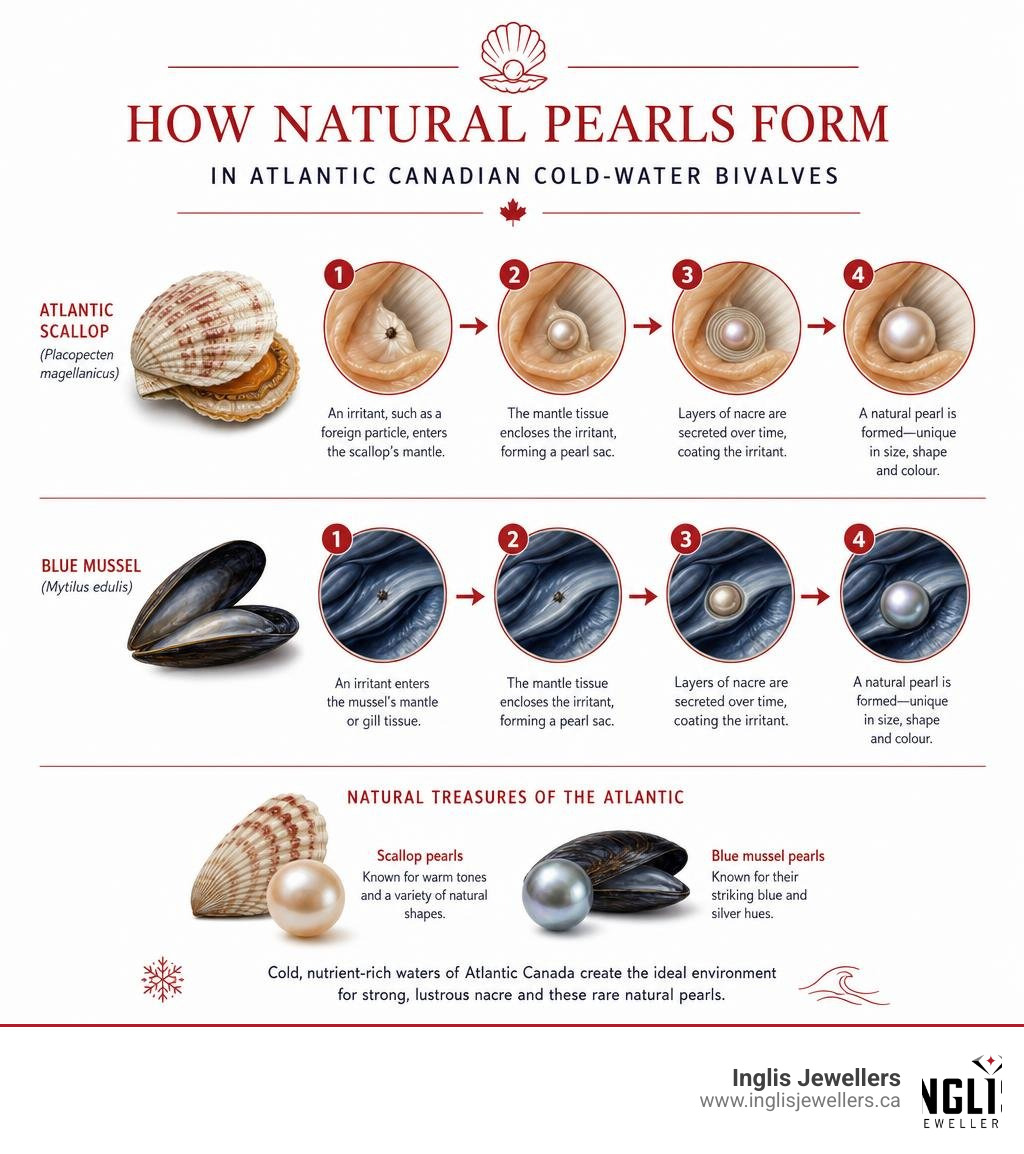
Understanding Regional Treasures: Scallop and Blue Mussel Pearls
To truly appreciate the necessity of an Atlantic Canada pearl expert, one must first understand the unique biology of our local waters. Unlike the vast majority of pearls sold globally, which are cultured (meaning humans manually insert a nucleus to jumpstart pearl formation), Atlantic Canadian pearls are entirely natural. They are wild, biological happy accidents.

Our cold, nutrient-dense waters are home to two primary pearl-producing bivalves:
- The Atlantic Deep-Sea Scallop (Placopecten magellanicus)
- The Blue Mussel (Mytilus edulis)
These creatures thrive in the dramatic, high-energy environments of the Bay of Fundy and coastal inlets like Bear River, Nova Scotia. Because these pearls are non-nucleated, they are composed entirely of concentric layers of natural nacre or calcite/aragonite platelets.
To help you understand the differences between these two regional treasures, we have compiled a quick comparison below. You can also explore detailed community discussions regarding these unique finds on Eastern North Atlantic Shellfish Pearls.
Comparing Atlantic Canadian Natural Pearls
| Feature | Atlantic Scallop Pearl (Placopecten magellanicus) | Blue Mussel Pearl (Mytilus edulis) |
|---|---|---|
| Primary Origin | Bay of Fundy, Deep Atlantic waters | Coastal bays, Bear River, tidal zones |
| Rarity | Found in only 1–5% of wild harvests | Extremely rare; mostly found by local harvesters |
| Typical Size | 2 mm to 8 mm (average around 6.5 mm) | 2 mm to 5 mm (blister pearls can reach 14–15 mm) |
| Color Range | White, cream, pink, silver, tan, bronze | Blue, mauve, metallic grey, mottled purple |
| Nacre Structure | Unique cellular, fibrous, or platelet nacre | Smooth, high-luster nacre, often iridescent |
| Visual Effect | Translucent patchwork quilt, "silvery" sheen | Deep, moody metallic shine; mirror-like luster |
The Unique Nacre of Bay of Fundy Pearls
What makes these local pearls a true marvel to gemologists is their distinct platelet nacre structure. When viewed under magnification, a scallop pearl does not look like a standard freshwater cultured pearl. Instead, it features a layered, three-dimensional platelet structure that resembles a translucent patchwork quilt.
This unique structure allows light to bounce through the layers of calcite and aragonite, creating a distinctive silvery, glittering sheen.
Blue mussel pearls, on the other hand, are celebrated for their dramatic color variations. Ranging from deep metallic blues to soft mauve hues, they capture the moody aesthetic of the East Coast shoreline. Because these pearls are formed in cold water over several years, their nacre is incredibly dense, yielding a metallic luster that is impossible to replicate in a laboratory or warm-water pearl farm.
What to Look for in an Atlantic Canada Pearl Expert
Because natural regional pearls are so structurally distinct from mass-produced cultured pearls, you cannot hand them over to just any jewelry counter. If an untrained bench jeweler attempts to clean, drill, or mount a wild scallop pearl using standard commercial practices, they risk shattering a gemstone that took years to form in the wild.
When searching for a professional to evaluate, restore, or design a custom setting for your regional pearl, look for the following hallmarks of expertise.
Credentials of a True Atlantic Canada Pearl Expert
First and foremost, ask about formal gemological education. A true expert should hold advanced credentials, such as:
- Graduate Gemologist (GG): The most prestigious professional accreditation in the gem industry, awarded by the Gemological Institute of America (GIA).
- GIA Graduate Pearls Diploma: A comprehensive, specialized credential focused entirely on pearl grading, identification, and matching.
- Canadian Gemmological Association (CGA) Fellowship: Indicates deep expertise in Canadian gemstones. This is particularly relevant because the CGA formally recognized the scallop pearl as an official Canadian gemstone in 2004.
At Inglis Jewellers, our certified appraisal and goldsmithing teams possess the precise training required to identify, grade, and handle these delicate organic gems. We understand the historical and scientific context of East Coast treasures, ensuring your jewelry is treated with the respect it deserves.
Restoration Techniques Used by an Atlantic Canada Pearl Expert
Restoring a natural Atlantic pearl is an exercise in patience and precision. A qualified expert utilizes specialized techniques designed to protect the organic integrity of the pearl:
- Gentle Cleaning: Commercial ultrasonic cleaners and harsh chemical solutions will strip the delicate nacre off a natural mussel or scallop pearl. Experts use proprietary, pH-neutral, moisture-balanced cleaning methods to lift oils without damaging the organic binders.
- Delicate Drilling: Natural pearls are non-nucleated, meaning they are solid nacre all the way through. Drilling them requires specialized, ultra-fine diamond-tipped drill bits and constant water cooling to prevent heat buildup, which can crack the pearl.
- Precision Restringing: Pearl silk must be knotted individually between each pearl. This prevents the pearls from rubbing against one another and ensures that if the strand breaks, you won’t lose your precious gems.
- Custom Settings: Because natural pearls are rarely perfectly round, they cannot be forced into mass-produced commercial mounts. A skilled goldsmith must hand-forge a custom setting—often using organic, flowing designs—to safely cradle the pearl's unique contours.
The History and Artistry of East Coast Shell Carving
You cannot fully appreciate the pearl culture of Atlantic Canada without exploring the rich history of coastal shell craftsmanship. Long before modern jewelry boutiques lined our historic streets, the indigenous peoples of the Maritimes harvested the treasures of our coastal waters.
The Northern Quahog (Mercenaria mercenaria), a hard-shelled clam found abundantly along the Northumberland Strait, holds deep cultural significance. Its thick, durable shell features striking purple and white bands, colored naturally by iron and manganese deposits in the sediment.
For centuries, these shells were meticulously carved into beads to create wampum—the sacred belts and strings used by First Nations, including the Mi'kmaq, for storytelling, ceremonial treaties, and trade.
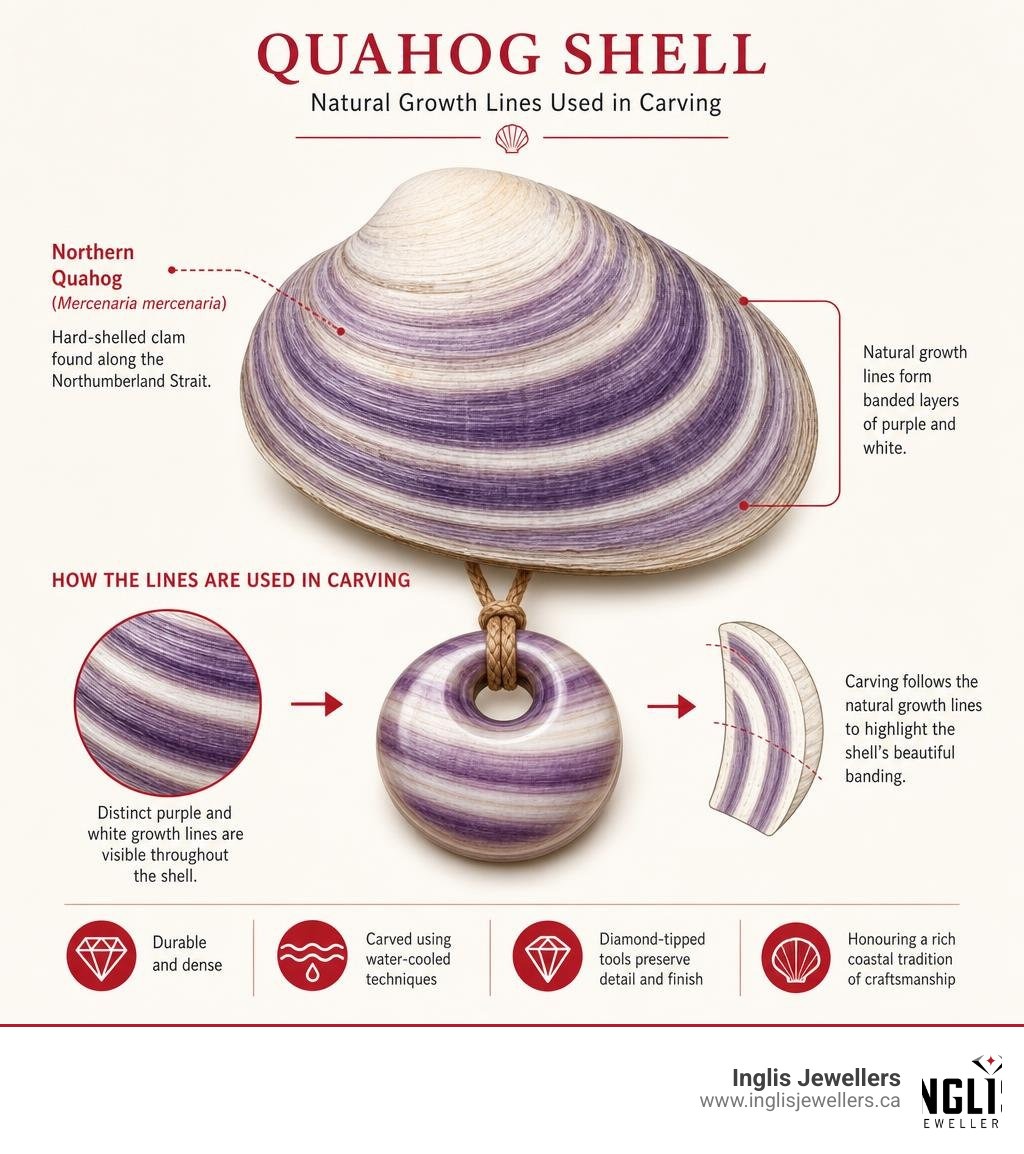
Today, this rich tradition of shell artistry continues to thrive across Nova Scotia and New Brunswick. Local artisans use highly specialized wet carving methods to transform raw quahog shells into heirloom pendants, earrings, and rings.
Because quahog shells are incredibly hard and dense, the carving process requires:
- Diamond-tipped tools: Standard steel carving tools will dull instantly against the resilient calcium carbonate of the shell.
- Constant water lubrication: Keeping the shell wet and cool during grinding prevents the material from overheating, which can cause micro-fractures or release harmful dust.
- Progressive hand-sanding: Artisans spend hours polishing the carved shell from coarse grits down to ultra-fine paper, eventually revealing a brilliant, porcelain-like luster that highlights the natural growth lines of the shell.
At Inglis Jewellers, we draw deep inspiration from this heritage. Whether you are looking to have a locally carved quahog piece polished, secured in a sterling silver bezel, or paired with a natural blue mussel pearl, our regional goldsmiths understand the physical properties of these coastal materials.
Frequently Asked Questions about Atlantic Canadian Pearls
To help you better understand and preserve your regional jewelry, we’ve answered some of the most common questions our team receives in Truro, New Glasgow, Riverview, and Sydney.
How rare are natural scallop pearls?
They are exceptionally rare. Only about 1% to 5% of wild Atlantic scallops (Placopecten magellanicus) produce a pearl. Because the vast majority of scallops harvested by the famous offshore and inshore fleets—including the world's largest fleet based in Digby, Nova Scotia—are shucked quickly at sea, finding a gem-quality scallop pearl is like finding a needle in a haystack.
Most scallop pearls are discovered by chance by local fishermen or processing plant workers. Their sheer scarcity makes them a highly prized collector's item.
Can natural blue mussel pearls be drilled and restored?
Yes, but it requires extreme caution. Because blue mussel pearls are completely natural and often form as delicate blister pearls (pearls that grow attached to the inner wall of the shell), they can have hollow cavities or incredibly thin walls.
Our goldsmiths evaluate each specimen under magnification before attempting any modification. In many cases, rather than drilling a delicate mussel pearl, we recommend creating a custom, protective claw or bezel setting to showcase the pearl securely without risking its structural integrity.
How do I care for and clean my regional pearl jewelry?
Natural pearls are organic gems that are highly sensitive to acids, chemicals, and extreme dryness. To keep your regional treasures looking radiant for decades:
- The "Last On, First Off" Rule: Always put your pearl jewelry on after applying makeup, hairspray, and perfume. Take it off first before starting your evening routine.
- Avoid Chemicals: Never use commercial jewelry cleaners, dish soaps, or ultrasonic machines.
- Wipe After Wear: Gently wipe your pearls with a soft, damp microfiber cloth after each wear to remove natural skin oils.
- Proper Storage: Store your pearls in a soft cloth pouch, separate from harder gemstones like diamonds or sapphires, which can easily scratch the delicate nacre. Avoid airtight plastic bags, as pearls need a small amount of moisture from the air to keep from drying out and cracking.
Conclusion: Trust Your Treasures to Inglis Jewellers
Natural Atlantic Canadian pearls and hand-carved coastal shells are more than just beautiful accessories—they are physical pieces of our East Coast heritage. Whether you found a shimmering wild pearl in a local Bay of Fundy scallop or inherited a treasured piece of regional shell jewelry, these items deserve the highest level of care.
At Inglis Jewellers, we combine trusted local craftsmanship with full-service support across Nova Scotia and New Brunswick. With convenient locations in Truro, New Glasgow, Riverview, and Sydney, our team of in-house goldsmiths and design experts is always nearby to help you restore, appraise, or redesign your jewelry.
If you have a local pearl that needs a custom home, or an heirloom strand that requires expert restringing, we invite you to explore our specialized services. Learn more about our dedication to preserving your jewelry by visiting our guide on custom and care, or stop by one of our showrooms today to speak with an expert in person.